

 A session of Working Group 1. Photo by Oļesja Garjutkina
From Housing to Participation. What Came Out of the EU Youth Conference
Τελευταία ενημέρωση Παρασκευή, 10/04/2026
Tens of thousands of young people across Europe had already made their voices heard—now the challenge was turning that input into policy. At this year’s EU Youth Conference, that process unfolded in real time.
More than 38,000 young people across Europe had spent months saying the same thing: the EU feels opaque and hard to reach. In March, their frustrations were meant to converge at the EU Youth Conference in Nicosia. But Nicosia, in a sense, never happened. After a drone strike on a British military base in Cyprus weeks earlier, delegates logged on instead of flying in, spending three days online in eight groups trying to turn thousands of voices into something Brussels might act on. As part of Eurodesk's Pool of Young Journalists, Oļesja Garjutkina joined one of the working groups (WG) to see how that process works in practice.
The What, The When and the How
The EU Youth Conference is part of the EU Youth Dialogue, a process through which young people’s views are gathered and turned into policy recommendations. Held in 18-month cycles under the EU Youth Strategy, the Dialogue is structured around the 11 European Youth Goals and includes national consultations followed by conferences under the rotating EU Council Presidency. The March conference under the Cypriot Presidency marked the final stage of the current cycle, focused on Youth Goal #1, “Connecting EU with Youth,” with eight working groups drafting policy proposals based on the consultation findings later intended to feed into Council texts.
Before the workshop began, WG1 – the group joined by the journalist – was presented with the numbers. Flash Eurobarometer 545, surveying young people aged 15 to 30 across the EU, showed that peace and international security ranked first among their priorities at 37%, followed by poverty and inequality, human rights and democracy, job opportunities, and climate policy. Consultation data, meanwhile, pointed most strongly to mental health and wellbeing, followed by sustainability, education, and employment. As several of these themes overlapped across the working groups, WG1 chose to focus on housing.

Flash Eurobarometer 545, dated 2024. Photo by Eurobarometer on Youth and Democracy
What does the EU already do for the housing crisis?
Although housing remains primarily a national competence, the EU has become increasingly active in shaping the conditions in which housing markets operate. On the legal side, Regulation (EU) 2024/1028, entering into force this year, targets the short-term rental sector through registration systems, platform data-sharing, and stronger transparency, helping authorities track whether homes are being diverted from long-term use. At the same time, the EU’s broader political response has expanded with the European Affordable Housing Plan, presented in late 2025, which signals a more coordinated approach, including support for investment and further action on short-term rentals and affordable housing.
Financially, however, the EU still does not have a standalone housing fund. Instead, housing support is spread across several instruments, including cohesion policy, ESF+, the Recovery and Resilience Facility, InvestEU and urban innovation funding. According to the Commission’s housing portal, this amounts to billions of euros in planned and mobilised support. That financial architecture is expected to deepen further in 2026 with the launch of the Pan-European Investment Platform for Affordable and Sustainable Housing – an online portal that lists funding options from EU programs, loans from banks and private investors, and collects “best practices, case studies, and innovative approaches across Member States”.
Overall, the tools are expanding – but their impact will depend on how effectively they are used on the ground.
Turning migration logic into housing policy
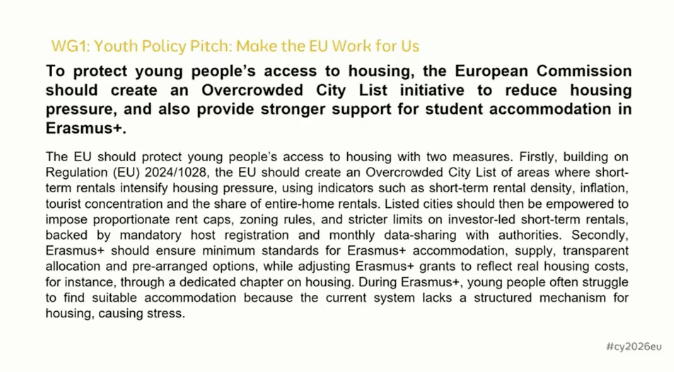
Working group 1 Youth Policy Pitch. Photo by Youth Board of Cyprus
The idea of the policy pitch was inspired by one of the EU’s more controversial tools: the “safe countries of origin” concept used in the Migration and Asylum Pact. That mechanism categorises states to work with asylum procedures – a model criticised by multiple NGOs, including Amnesty, for oversimplifying complex realities. But in the working group, the logic was turned on its head. If the EU can create lists to manage migration flows, why not apply a similar approach to housing pressure? The proposed “Overcrowded City List” borrows that structure.
In practice, the proposal would work as a trigger mechanism. The European Commission would define a common set of indicators – such as short-term rental density, rent inflation, tourist concentration and the share of entire-home rentals – and use them to identify cities or neighbourhoods where housing pressure has become structurally high. Once a city is placed on the list, member states are authorised to adopt a stronger set of local measures. The youth-policy dimension comes in through mobility access: the EU should also recognise when housing markets make that mobility unrealistic.
“I myself live in a smaller city, but the housing crisis is real there too,” said Niels Zagema, a member of Working Group 1, from the Netherlands. “I live in an anti-squatting area – I temporarily occupy empty spaces to prevent illegal squatting. That means I live with huge uncertainty, because every month I can receive a message to move out within a month.” Then he points to the Youth Progress Index, showing that in the Netherlands, young people’s satisfaction with access to affordable housing stands at just 14.94.
“I’ve read that a Dutch home now costs €470,000. That’s 10 times the annual Dutch salary – and if you are lucky to have a job”, he finalises.
What Latvia brought to the table
The Latvian Youth Delegation, representing the journalist’s home country, also took part in the conference. Viktoria Tkačenko, from Latvia’s Ministry of Education and Science youth policy unit, worked in Working Group 3, which focused on youth participation in decision-making.
“We concluded that decision-makers often do not see young people’s views as inherently valuable. Participation becomes a formal process, or there is simply not enough knowledge about how to involve young people,” Tkačenko said.
The group’s discussion led to a recommendation for a more transparent feedback mechanism linking youth input to policymaking. Participants argued that young people should be able to see how their proposals move through the system – whether they are taken up or rejected – and understand the reasoning behind those decisions. Such a mechanism, they suggested, could increase both trust and participation, while also strengthening accountability for decision-makers.
“From the presentations, I noted that at least three groups had included some form of feedback tool in their recommendations, which suggests that the process is still not very transparent,” the youth policy representative noted. “The EU Youth Dialogue is one example: some issues are discussed, then forgotten for several cycles, and later brought back again without real continuity. That is why some form of monitoring needs to exist.”
Asked about what signs at the national level might show that youth policy is working, Tkačenko said the answer often comes back to politics.
“It depends on whether the governing party sees youth as a priority,” she said. In Latvia and Denmark, there is a youth law, which provides a framework where the national youth dialogue or the role of the youth council can be written in. Greece, by contrast, does not have such a law, even though there have been efforts to make youth policy a priority.”
She added that although Latvia’s Ministry of Education and Science has a dedicated youth department, youth policy is cross-sectoral and depends on the capacity of other ministries as well. In her view, uneven knowledge and training across institutions may be part of the problem, though she cautioned that more data would be needed before identifying any single solution.
Asked whether Latvia’s existing youth infrastructure – including 30 NGOs, 194 youth centres and 33 youth councils – should already be enough, Tkačenko said this is precisely one of the issues currently being worked on.
“There are many different channels, so we are now working on creating one larger platform where most of the information young people need would be available,” she explained. “In the consultations for this cycle, we spoke to more than 600 young people, and many of them said they had no idea where to find information about opportunities. But the problem cannot be solved only by creating one good platform – we also need constant dialogue with young people in schools and universities.”
Referring to the hundreds of youth-related events that already take place across Latvia, Tkačenko said that, in her personal view, the issue is not necessarily a lack of mechanisms, but who those mechanisms reach. Existing participation structures, she suggested, often involve the same active young people.
“The real question is how to involve less represented groups, including young people in the regions or NEETs,” she said. “I do not think we need more mechanisms, but rather better communication and more in-person work. The Latvian Agency for International Programmes for Youth has travelled to schools with an outreach van so young people can approach them directly and learn about available opportunities. But that kind of in-person work cannot realistically cover every school in Latvia.”
She pointed to the newly introduced National Youth Dialogue as one possible way forward. In her view, its significance lies in the fact that it is tied to consultations, training and concrete proposals, and is more clearly anchored in Latvia’s policy framework. While she said it remains too early to judge its full impact, since this is only its first cycle, she suggested that it could prove more influential in practice.
Young Journalists in Europe - Meet the author
Oļesja Garjutkina
“My name is Oļesja, a freelance journalist from Riga, Latvia, and Deputy of Foreign Affairs for Young European Federalists (JEF) Latvia. My interests lie in EU policy, media literacy and youth participation, with a particular interest in how young people are represented on the decision‑making level both nationally and internationally. I am also interested -- currently researching for my bachelor's thesis -- in the media framing of migration in Latvia and the United Kingdom."
This article reflects the views of the authors only. The European Commission and Eurodesk cannot be held responsible for it.