

 © Youth Board of Cyprus, 2026
Trust is good, give me more of that: On the 2026 EU Youth Conference
Τελευταία ενημέρωση Πέμπτη, 30/04/2026
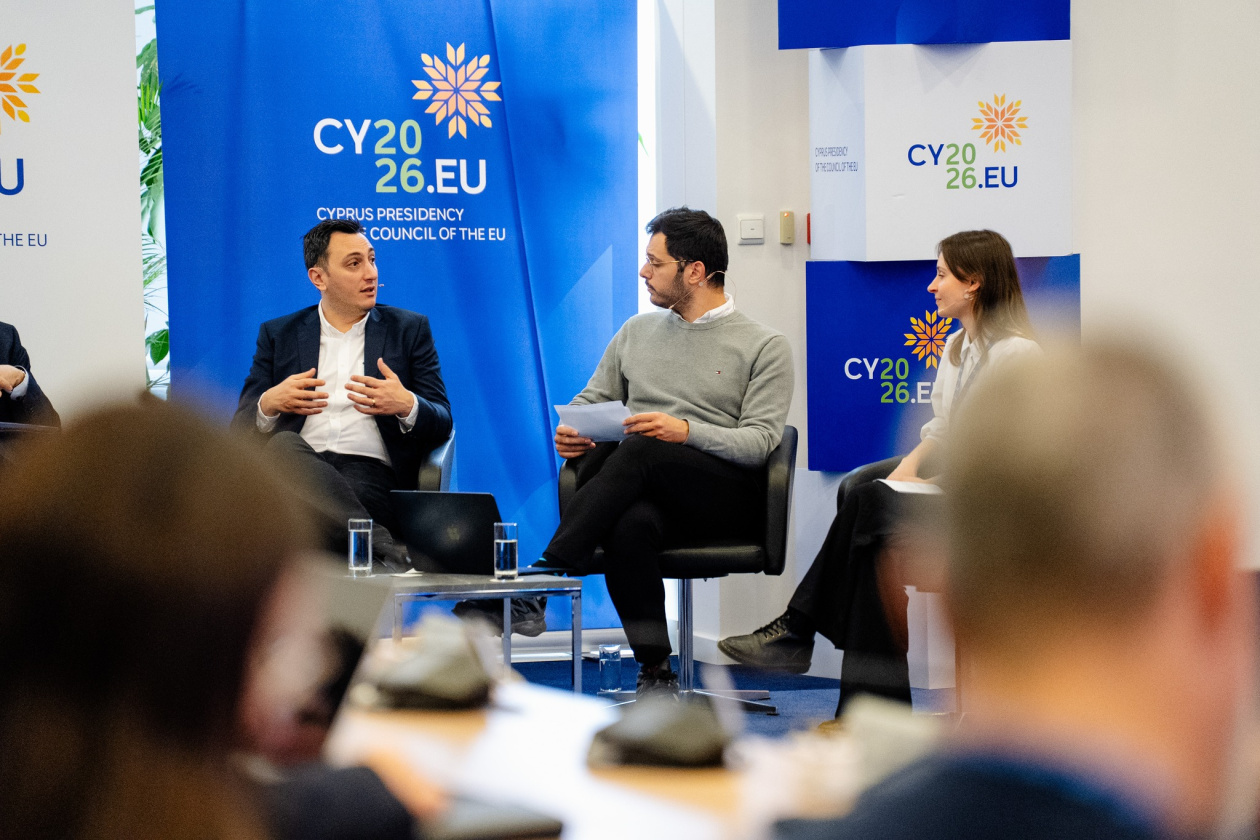
Despite having been moved to a virtual format, the 2026 EU Youth Conference brought meaningful exchanges between youth delegates, European policymakers and other participants. Reporting for us from the conference, young journalist Raul Arning takes you through the three days of the event.
Timeline:
25.02.2026: Registration for sessions at the EU Youth Conference in Cyprus opens
28.03.2026: “Operation Epic Fury” sets of a regional war in the Middle East
01.03.2026: An Iranian drone strike hits the British military base at Akrotiri, Cyprus
05.03.2026: The EUYC 2026 is fully moved to a virtual format
18.03.2026 – 20.03.2026: Days of the Conference
In the beginning, it felt like we went a couple of years back in time. Back to the pandemic. But – given the circumstances – most of us were just happy that the conference was not cancelled and that the option existed for us to still exchange opinions, raise our voices and participate in shaping EU legislation.
Now, what even is the point of an EU Youth Conference, you might ask yourself. A valid question, given that youth delegates have no legislative power themselves. While I initially thought along those lines too, an EU Youth Conference actually allows its participants to inform EU legislation. This works the following way: every six months - or once per EU Council Presidency - young people representing their National Youth Councils, international youth organisations or local youth centres gather for a week-long conference, alongside policymakers and experts. To become a youth delegate, you can with the Council of Europe.
Before its start, each delegate chooses one of eight issue areas to work on. They then work on that issue area within a working group for most of the conference. Eventually, each working group adopts one major recommendation (30 words plus explanatory text). The eight final recommendations are then presented as one joint policy paper to policy actors in EU institutions and member states.
For this conference, I had chosen Working Group 7, dedicated to “strengthening trust and transparency in EU institutions through youth involvement”. Participants were sent a background paper upfront, which identified young people’s levels, barriers and methods of increasing trust. Surprisingly, to me at least, was that more than 80% of young Europeans trust the EU institutions – to varying degrees – to make the right decisions. However, trust of young people in the EU is currently decreasing, making this a very urgent matter to work on.
Our first session discussed the background paper and made out what we considered the key barriers to trust for young people. Narrowing these down, the group identified three core issues. First, there is a lack of transparency in how the EU implements the grievances of young people. Related to this, a widespread notion among participants was that Youth proposals are often met with limited public response, reinforced by the absence of accountability mechanisms for decision-makers dealing with these. Lastly, the group regarded the present opportunities for the inclusion of young voices as insufficient, which continues to limit trust in European democratic processes.
After this initial brainstorming process, the second day of the conference was dedicated to debating solutions and establishing concrete policy recommendations. To my surprise, I was at some point introduced by the group host as an expert on the topic, which, as you might notice, is certainly a misconception. But I played my part and took on that role with a mix of pride and anxiety. This, however, resulted in me having to lead a sub-group that worked on one of two potential recommendations and its implementation strategy. In the end, our working group voted against the recommendation proposed by my group, which aimed to lower the barriers to understanding EU legislation. Probably for the best, as the recommendation that was ultimately adopted is well-formulated and poses concrete demands on the EU.
Working Group 7’s final output asks EU bodies to, following EUYC recommendations, “establish a feedback system outlining the action taken by EU institutions in response to these recommendations, ensuring accountability towards the demands of young people”. This seeks to achieve growing trust in the responsiveness of EU institutions on young people’s issues by clearly communicating how these issues are considered. It suggests regularly scheduling a meeting between the European Parliament’s Culture and Education (CULT) committee and youth delegates, where the latter can present their recommendations; a Commission report detailing implementation of these recommendations; and public communication that is not too technical and therefore accessible to everyone, particularly young people. In short, transparency plus accountability equals trust.
On the final day, each working group’s recommendation was presented to the participants and a panel consisting of European Commissioners and Cypriot ministers. Most recommendations centred on themes like participation, communications and accessibility of youth mechanisms in the EU. Or as Commissioner for Intergenerational Fairness, Youth, Culture and Sport, Glenn Micallef phrased it in his farewell speech, governing the future “means to amplify youth voices”.
In the end, exchanging with peers from all over Europe left me with the impression that we must continue to build trust in European institutions - quantitatively but mostly qualitatively. I am certain that conversations outside of “formal” meetings – in the streets, bars and cafés of Nicosia – could have amplified our voices even more, at least to each other. This view is shared by Finnish delegate Alma Jokinen, who is still pleased with the conference outcome, which “demonstrated the resilience and commitment of young people to stay engaged despite geopolitical tensions”.
There is more to be done to ensure that we, Europe’s youth, will shape our future ourselves. If you have ideas on how this should work, I suggest bringing them to the table as a delegate at the next EU Youth Conference. To take place in Dublin this year, and hopefully in person.
Young Journalists in Europe - Meet the author
Raul Arning
“I am particularly interested in the intersection of (social) media, politics and culture. A recent graduate of the MSc International Relations at the London School of Economics, I seek to write about issues that Europe’s youth face in these sectors. With film production being a hobby of mine, I want to contribute to the Pool of Journalists in various forms. Other than that, I am passionate about cooking and football club Eintracht Frankfurt.”
This article reflects the views of the authors only. The European Commission and Eurodesk cannot be held responsible for it.