

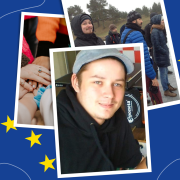
From Lapland to Lithuania as a volunteer
Aleksi Ollonen, FinlandI had suitable experience, that's why I decided to go to Lithuania. Working in a youth club supported my professional development.
Aleksi Ollonen from Lapland volunteered in Lithuania for a year. The European Solidarity Corps give young people opportunities to travel abroad and participate in volunteer work of their own choosing.
Aleksi Ollonen's working day in Kolpene, Rovaniemi is over. As he answers his phone, he has just parked the car outside his house. Ollonen launches straight into reminiscences of his experiences abroad.
Several years have already passed since he volunteered: at that time, Ollonen was 22 and had recently completed his youth instructor qualification. He had found in his mailbox an e-mail from Rovaniemi youth services, which announced the possibility of participating in an EU-funded period of voluntary work abroad. Ollonen seized the opportunity, made his way to Lithuania the following summer, and spent a year volunteering in youth activities.
Youth activities were highly suited for Ollonen because of his qualification. Ollonen had previously worked with such groups as mental health rehabilitees.
“I had suitable experience, that's why I decided to go to Lithuania. Working in a youth club supported my professional development.”
Ollonen says that the work in youth clubs in Telšiai, Lithuania, was not much different from similar work in Finland. In their free time the volunteers did all sorts of things, for example baked Finnish Christmas pastries.
“We welcomed young people to the youth club and did whatever they wanted. We also organised events”, Ollonen describes his normal working day in Lithuania.
Mutual understanding without a common language
The length of voluntary work periods can vary from two months to a year. Ollonen spent one year, plus a few days’ holiday, in Lithuania. The first six months went by in a flash. This is why Ollonen finds that a full year was more useful than the six-month period he considered first, as he had more time to integrate into the destination country.
The working language was English. Towards the end, Ollonen also learned to speak some Lithuanian. The language barrier was not a problem for Ollonen, even though everyday chores, including shopping, were a bit of a challenge at the start.
“The actual employees of the youth club were always at hand to interpret if I needed to get something specific across”, Ollonen explains.
A common language is not always needed to work together. Most of the young people only spoke Lithuanian. Ollonen and the young people often communicated by gestures, and he says that not having a common language was something fun and exciting for the Lithuanian young people.
“I remember even teaching a card game to a Lithuanian young person who didn't speak a word in English. This person then taught it to others. We did not have a single word of a common language. We just communicated by nodding or shaking our heads”, Ollonen recalls.
International experience and independence
The best thing about volunteering abroad for Ollonen was growing more independent and having new international experiences. Various projects and working together with volunteers from other countries made his work more international.
“I met volunteers from other countries, including Germany, Italy and Spain. This gave me a broader understanding of work practices elsewhere in Europe.”
His brave decision to head off to Lithuania from Lapland was a big change in young Ollonen’s life. The experience taught him a lot, including taking responsibility for himself and others.
“It was the first time I moved away from home, to a distance of 1,400 kilometres all at once. It helped me become more independent.”
Ollonen, who is today employed in Kolpene, Rovaniemi, has continued doing similar work in a day care unit for people with intellectual disabilities. Tomorrow will be another working day. Perhaps somewhere in Telšiai, Lithuania, young people are still playing the card game they learned from a volunteer from Lapland, without having a single word of a common language.
Translated from Saara Lappalainen's original text
Updated on Tuesday, 17/02/2026