

 © Júlia Rita Gyarmati
The children of the Orbán regime have grown up
Last updated on Saturday, 04/07/2026
On 12 April 2026, all eyes were on Hungary. A bubble of tension finally burst, and an era that had lasted 16 years came to an end with the victory of Péter Magyar and the Tisza Party in the parliamentary elections. But how did the generation that has grown up knowing nothing but the Orbán regime experience this historic moment? I’ll try my best to explain.
Since 2010, Hungary’s politics have followed the same recipe: uncontrolled power of Viktor Orbán and the Fidesz party. This political leadership has often been described as acting like a Trojan horse within the European Union, strengthening ties with Russia and going against EU values. Meanwhile, the political elite and those close to the centre of power have amassed immense wealth in the background, with the direct consequence that the country has become the most corrupt and poorest member state of the European Union.
What has happened to Hungarian society in the meantime? It has been torn in two. For years, the ruling party deliberately dismantled and nearly completely crippled the independent media, with the result that people getting their news from the so-called “public media” and people informing themselves from independent media lived in two different realities. Since 80% of the media was controlled by Orbán’s government, the public media, which was supposed to provide the public with reliable information, functioned more as a propaganda machine designed to keep people in the dark. The public’s state of mind has been pushed to its limits as fear, dissatisfaction, anxiety, and hope have intertwined in many people’s daily lives. In a divided society, even families are torn apart and turned against one another over political differences.
Young people had it somewhat easier in this regard, because there are hardly any supporters of the Orbán government among their circles. Why is this the case? Looking back on my 23 years, the system’s flaws are present in countless areas where the youth faced obstacles along their way growing up. In the centralised education system, local decision-making was eliminated, thereby excluding those who are most involved in the education: teachers, parents, students, and professional organisations. In universities, left to fend for themselves financially or stripped of their autonomy, which resulted in the exclusion from the Erasmus+ exchange program for most of the universities because of corruption concerns. In the housing crisis, where Hungary holds the EU’s worst record by far, housing prices in Budapest increased by +275% between 2015 and 2025. The closure of clubs in Budapest also concerned young people, as the Orbán government waged a cultural war in the name of anti-drug policy, selectively targeting creative spaces and youth culture venues. Since there’s no updated national anti-drug strategy and funding for drug prevention has also been significantly reduced in recent years, many people didn’t see the closure of venues as a healthcare policy, but as a scare tactic, a means of cracking down on subcultures, and a political overreach.
Wherever you look, you see the consequences of the past 16 years of policy decisions. Politics has failed to engage young people, so in the end, they spoke up for themselves and for their own sense of justice. While university students were trying to sustain themselves on ridiculously low scholarships and underpaid student jobs, struggling to cover unrealistically expensive rent due to the lack of sufficient dormitory places, the political elite, in contrast, lived a conspicuously luxurious lifestyle on taxpayers’ money. Starting life in these circumstances has resulted in a collective reality. It is one in which, from the very beginning of my generation’s political consciousness, our first, and till this election, our only experience with politics has been opposition to the system. It’s safe to say that by turning its back on young people, Fidesz has raised its own opposition.
As in every country that was part of the Soviet interest zone after World War II, the fall of the communist regime and the transition to democracy in the early 1990s marked a turning point in people’s lives. I only experienced the version told by my parents, but the “regime change” term has been repeated so often in recent years that the significance of the political changes then and now feels similar. It was a major turning point in my parents’ youth, just like this election for my generation. However, I must emphasise the difference: this was not a peacefully negotiated transition as it was back then, but rather the result of several years of hard work and true social cooperation.
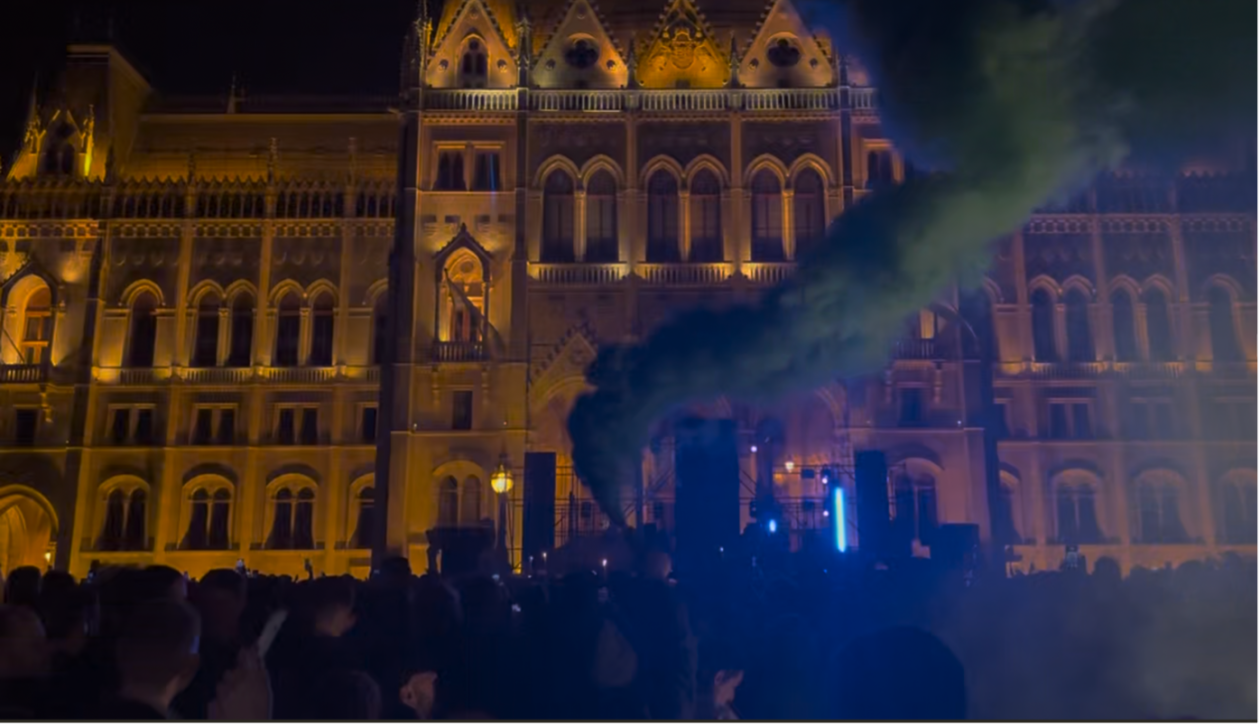
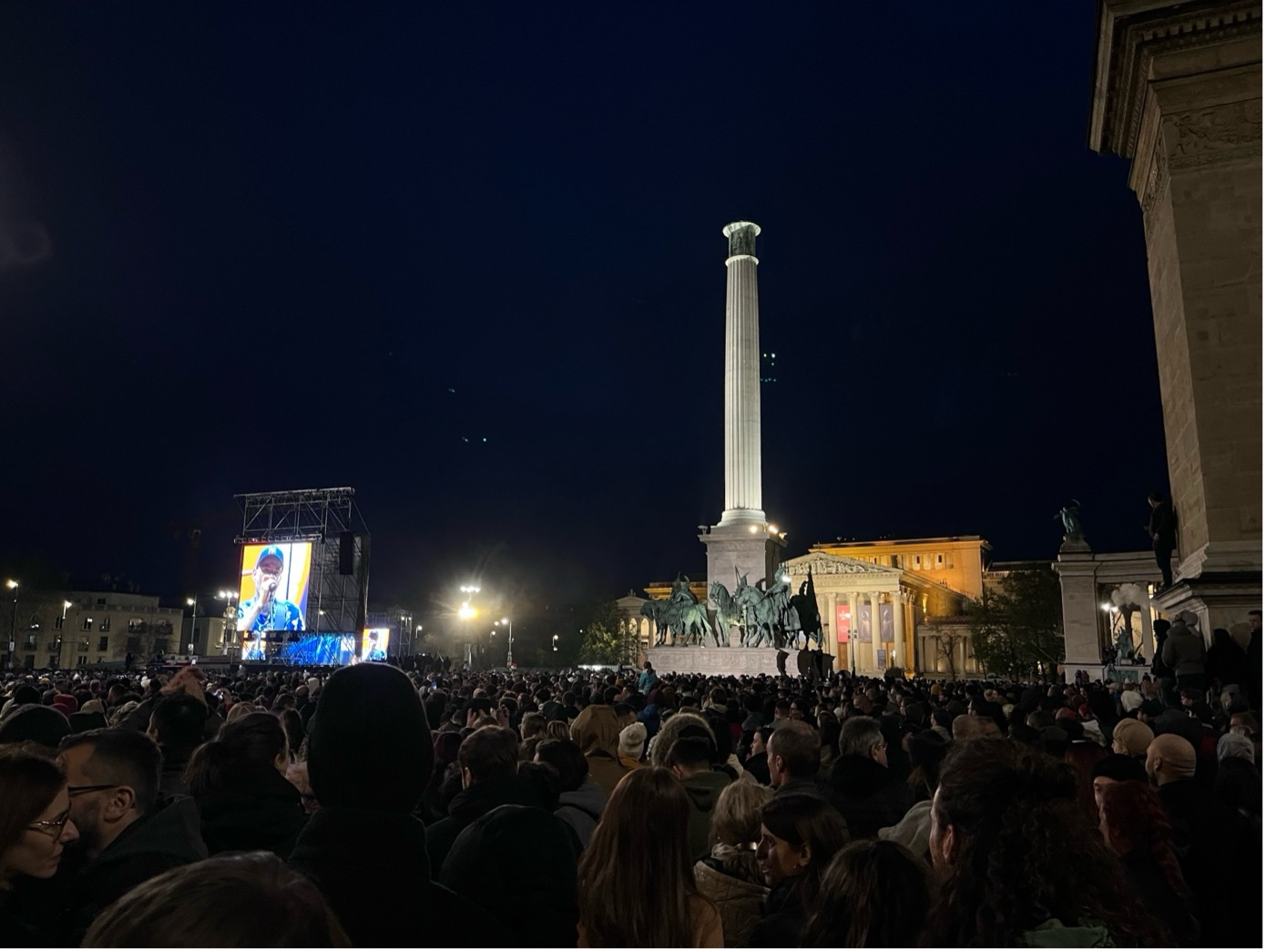
No matter whom I spoke with among my acquaintances in the days leading up to the election, everyone was preparing for one event: the system-shattering mass concert organised by the Civil Resistance Movement in Budapest on 10 April. Fifty Hungarian performers took the stage with songs addressing public issues from recent years, in front of thousands of people. From 3 p.m. until midnight, people kept arriving to express their opinion by participating.
Meanwhile, during Fidesz's critical performances, screens played back the young and charismatic Orbán’s speeches before he became prime minister, in which he called for closer ties with Europe and the withdrawal of Russian troops. Hearing these statements again felt surreal in the context of 16 years of utterly contradictory policies. The crowd repeatedly chanted “Russians go home”, a slogan well known from the 1956 Hungarian Revolution, which had regained its relevance.
István Bibó, a moral role model of Hungarian politics, once said: “Being a democrat means, above all, not being afraid: not being afraid of those with different opinions, those who speak different languages, those of different races, or revolution.” What makes this quote so ironic is that countless politicians from Fidesz began their political careers at the István Bibó College, only to mock every idea left behind by the institution’s namesake during their years in power. People at the system-shattering concert weren’t afraid, not anymore. Many of them referred to the event as Orbán's and the Fidesz party’s goodbye party.
© Júlia Rita Gyarmati
12 April 2026, a day to remember for a long time. A day that delivered a clear verdict from the Hungarian people. The vote count wasn’t even halfway through when the breaking news came: Orbán congratulated Péter Magyar on his victory. In the capital, the crowd awaiting the results breathed a collective sigh of relief; strangers hugged each other and cried with joy. Taxi drivers honked, people celebrated and sang, and the police officers just stood aside and watched the city smiling.
Fidesz looked down on young people. Its communication towards them was condescending and arrogant, but above all, they failed to take them into consideration. But without the support of the future generation, they ran out of their own future. The election results meant many things at once, but above all, they showed that no system lasts forever without the people behind it.
Young Journalists in Europe - Meet the author
Júlia Rita Gyarmati
“I am currently studying International Relations, a field that may seem broad or abstract at first, but which in fact mirrors most of my interests: politics, development, society, culture, languages, but above all, people and the stories they carry with them across borders.”
Article collaborators: Andrijana Martačić, Michael Blaško
This article reflects the views of the author only. The European Commission and Eurodesk cannot be held responsible for it.