

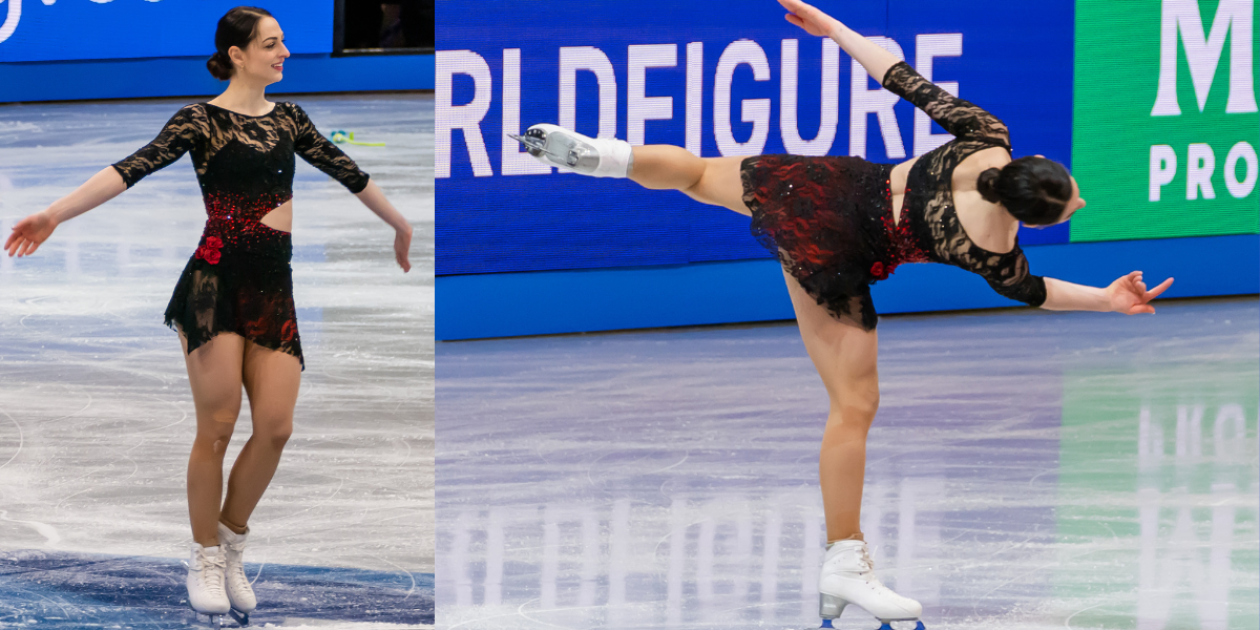
 Images by FloweringDagwood - Wikimedia Commons
The German-Romanian Self-Made Olympian: How Julia Sauter Carved Her Own Path
Last updated on Monday, 29/06/2026
“Sorry it took so long! I was dealing with a lot of stuff those past few weeks and I wanted to be mentally clear when I answered it.” - This was the message Julia Sauter sent before delving into the realities of her life as a competitive figure skater.
To step onto the Olympic ice, many athletes can rely on the backing of wealthy federations and million-dollar training camps. Julia Sauter had to rely on herself. She’s the epitome of a strong woman: an athlete who juggled three jobs: shifts as a waitress, a school aide teaching dance classes, and a local skating coach just to afford her ice time, ultimately launching a GoFundMe campaign to turn her Olympic dreams into reality.
When Sauter stepped onto the Olympic ice at Milano Cortina 2026, her goal was simple: to show the world how much she loves to skate. Instead, she left having made history. Representing Romania, she finished the competition in 17th place, the highest placement ever achieved by a Romanian female skater. She also secured a massive personal best, finishing with a total score of 190.93 points. Coming off an equally historic 7th-place finish at the 2025 European Championship in Tallinn (also a record for Romanian ice-skating), she didn't have a massive financial machine behind her, so she built it herself.
Because she was in the thick of preparing for the World Championship in Prague, a traditional sit-down was impossible. Instead, our interview unfolded over WhatsApp: I sent her questions via text, and she replied with deeply candid voice notes squeezed between her training. Derived directly from those raw recordings, here, in her own words, is the unvarnished story of how Julia Sauter navigated the struggles, funded her own passion, and became a self-taught powerhouse on the world stage.

Julia Sauter
The Sacrifice: Going "All In"
Although born and raised in Germany, Sauter has proudly represented Romania on the international stage for the past 14 years. This enduring partnership began out of necessity when the German skating federation passed her over, deeming her uncompetitive because she had not yet mastered certain mandatory jumps and figures at a young age. It was at this critical juncture that her former coach, Marius Negrea, a former Romanian Olympian who was coaching in Germany, stepped in. Recognising her raw talent and relentless work ethic, Negrea refused to let her career end prematurely and offered her a lifeline: the chance to skate for his home country. Facing a native sporting environment that lacked the patience to support her developing ambitions, she embraced Negrea's proposal and found a welcoming home under the Romanian flag. Yet, securing a country to represent was only the first hurdle. For Sauter, the journey to the elite level wasn’t a sudden realisation, but a calculated, heavy sacrifice.
"It was not really a click moment; it was more the school system in Germany; it's sometimes very hard when you want to do more in sports. So I had to make a decision, and when I was 17, I said, ‘I know what I want to do after skating and right now that's the only time I can really pursue my dream to skate more and be better at the international level, but I have to put more work in.’” she recalls.
"I knew that I had to make a sacrifice to see what opportunities I have in the sport if I put in all the work.”
The Self-Taught Olympian
Due to a complete lack of state funding from the Romanian Skating Federation (FRP), Julia’s competitive budget is a patchwork of personal funding and occasional Olympic scholarships from the COSR (Romanian Olympic and Sports Committee). This financial reality extends to her staff: without the luxury of an entire team of specialists at her disposal, her tight-knit crew consists solely of one coach, Roxana Luca Hartmann. Driven by necessity, Julia took matters into her own hands and became a true student of the sport. Unable to afford external experts, she and Roxana tackle all the choreography themselves, crafting routines that hold their own on the world stage.
“I'm trying to watch as many videos as possible to teach myself how to do certain things better,” she admits.
“Since I don't really have any financial help, I had to step up and kind of do it myself... I'm just learning from YouTube videos from different skaters. I see how other choreographers approach things.”
By 2023, after winning the National Championships six times and competing on both the European and World stages, her relentless work ethic finally caught the attention of CSM Corona Brașov. Signing with the prominent state-backed club provided a crucial lifeline, allowing her to focus on being an athlete rather than just surviving day-to-day.
"The funding is still terrible to this day, but getting hired by Corona Brașov allows me to work less. So I only coach after my practices are done. This became a lot easier because now I can work more on my physical form off the ice and also work on recovery, because the older you are, the more important it gets. And I also have more time to spend with my dog and with my family. Also, the recovery aspect literally helped me to still skate to my best abilities these days. I'm very grateful for Corona Brașov hiring me as an athlete because I don't think I would still be able to compete otherwise."
On Mentorship
Surviving the sport requires more than just physical endurance; it requires guidance. Roxana Luca Hartmann isn’t just a coach; she was a figure Sauter had admired since being a child in Ravensburg, Germany, where she used to watch Roxana train on the local ice. As the former holder of Romania's best Olympic finish with a 23rd place at the 2001-2002 Winter Olympics, Roxana taught Sauter more than just the mechanics of the sport.
"I just think that Roxana is teaching me how to be professional and how to approach certain things in life. And I think she made me grow more as an individual. I think she’s a very wise woman, and I like her perspective on a lot of things in life. And I think she continuously makes me a better skater."
When asked what advice she would give her younger self, Sauter’s answer reflects this hard-earned wisdom and fierce independence:
"It’s just about trusting yourself and not doubting yourself, and working on your self-confidence, because to me that's almost the key in the sport alongside good preparation and good training. And also I would tell her to stand up for herself more when she feels something's not right."
However, while her club contract provided a lifeline for daily survival, it couldn't cover the massive expenses of global competition. Facing the 2025 World Championships that would get her a spot at the Winter Olympics, with zero financial backing from the federation, even after three straight top-10 finishes at Europeans, Sauter was forced to turn to crowdfunding. She launched a GoFundMe with a modest goal of €7,500 to pay for her travel and preparation. In a massive show of solidarity, fans and supporters exceeded her target, raising €9,449 across more than 230 donations, ensuring she could step onto the ice without the crushing weight of financial uncertainty.
Battling the "Noise" and Self-Doubt
The mental toll of acting as the sole financier, manager, and athlete of your own career is immense. While Roxana is there to guide her on the ice, the exhausting off-ice reality of funding her own Olympic dream leaves a heavy psychological burden. Sauter is radically transparent about the fact that confidence is not a gift; you have to fight for it every single day.
"I still struggle with self-confidence many days, and I'm very hard on myself," she confesses. "In the past year, I learned to speak out more and journal. I learned that when I do that, things become smaller. I also have the right support system around me now, so I have the free space to talk about my fears, even when they sound completely crazy. I also think I'm still trying to figure out a lot of things. I just learned how to navigate things better."
When it’s finally time to compete, she uses that mental conditioning to block out the intense stress of her journey and simply exist in the moment:
"I really work on focusing on being in the present moment and turning off all the outside noise. It’s always a work in progress, but you also have to give yourself some grace. Sometimes it works out, and sometimes it does not, but it does not identify your working path; it’s just another step in learning how to deal with all the noises around you."
The Soul Behind the Skates
Despite the hardships, Sauter’s love for the art of skating and her personal authenticity remain completely intact, shaping her artistic expression.
Her artistry is driven by intuition and a desire for growth. At the start of each season, Sauter explores a wide variety of musical styles, ultimately choosing pieces that deeply resonate with her shifting moods. By intentionally experimenting with new themes, she continuously pushes her boundaries, believing that stepping out of her comfort zone is the key to becoming a truly well-rounded skater.
Over the years, her repertoire has spanned an impressive and diverse range of genres, from cinematic orchestrations and dramatic tangos like El Tango de Roxanne, to modern pop hits by Adele, soulful tracks by The Weeknd, and high-energy electro-swing beats. Most notably, she took complete creative control to choreograph her own dynamic short program to Scott Bradlee's Postmodern Jukebox cover of "Seven Nation Army," perfectly showcasing her versatility and hands-on dedication to her craft.
When looking toward the future, Sauter’s grounded realism remains front and centre. Once her competitive days are over, she plans to transition into a full-time figure skating coach and choreographer. So even though she is living in Ravensburg, Germany and representing Romania, she hopes to eventually relocate to the United States to build her coaching career, noting with a self-aware smile in a recent interview that she hopes to finally "make some money back for what I have spent my entire life."
When asked to describe herself using a travel destination, a skating element, and a food, she beautifully sums up her grounded nature:
"So lately I really have the desire to go back to Tokyo, Japan. That would be my travel destination. And then my skating element will be for sure my triple Lutz with my hands up, so it's called the Rippon Lutz. And food, I would say Sarmale with some mămăligă. I love that."
Behind the Olympic glitz, Julia Sauter proves that reaching the world stage doesn't require the help of a federation or a million-dollar machine. It simply requires the grit to build your own.
Young Journalists in Europe - Meet the author
Anda Elena Dutescu
“Computer Science student from South Romania, blending tech with the raw pulse of cinema and underground music. As AIVImedia.hub’s music lead, I turn festival energy into stories of identity. I live for the unheard voices in mosh pits and indie films, bridging European youth through authentic culture. I’m here to turn the volume up on a generation that refuses to be quiet.”
Article collaborators: Andrijana Martačić, Oļesja Garjutkina
This article reflects the views of the authors only. The European Commission and Eurodesk cannot be held responsible for it.