

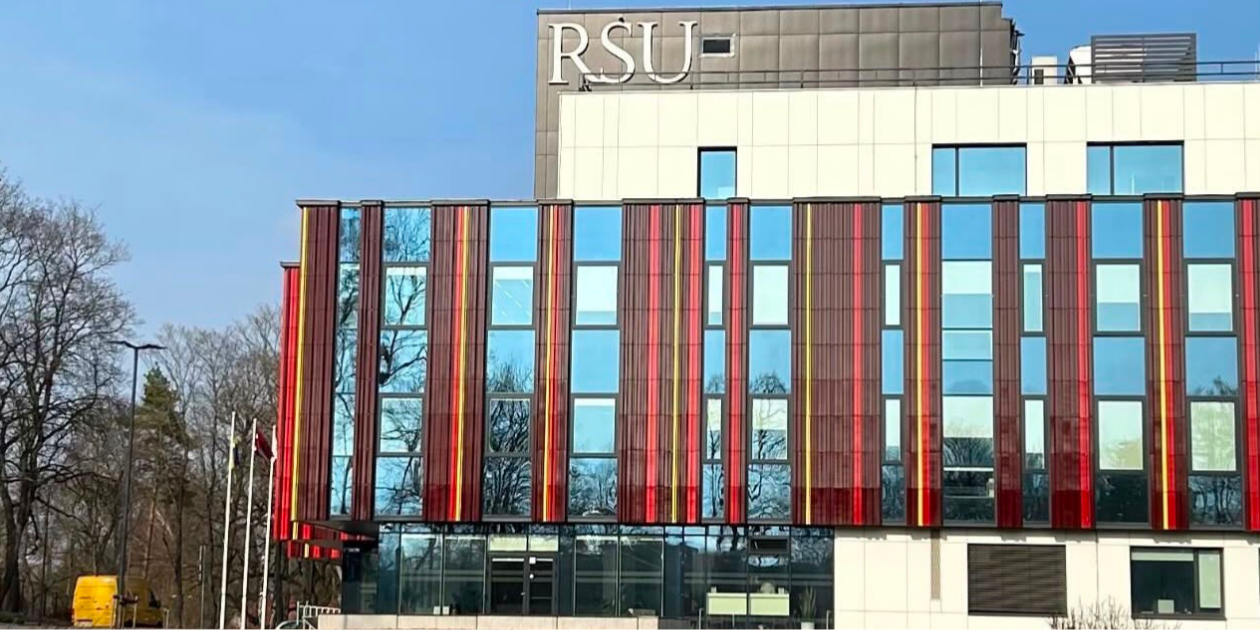
 © Oļesja Garjutkina, 2026
Third-country students built a life here. Latvia is still deciding if they belong there
Last updated on Tuesday, 16/06/2026
Latvia is one of the fastest-shrinking countries in Europe. According to the OECD, it’s also one of the fastest-growing study destinations for students from outside the EU, growing faster than France, Spain or Italy.
Over 11,000 foreign students are enrolled in Latvian universities, and the political debate about whether they belong here is getting louder. We gave the mic to some of them to reflect on what it means to build a life in a country still defining its stance on their presence.
The land that fought for freedom now debates who gets it
First, to grasp why today's debates rage over whether third-country students "belong" in Latvia, one must trace this mindset back through a century. From 1940, when the Molotov-Ribbentrop Pact delivered Latvia to Stalin, the Latvian Soviet Socialist Republic became a "lab" for russification: mass deportations ravaged families, while post-war influxes of Russian workers diluted the Latvian majority in Riga – from 60% of the city's population in 1940 to just 36% by 1989. The country that sang its way to independence in 1990 did not forget what it felt like to become a minority in its own capital.
Russia's war in Ukraine sharpened it further. Belarus's moves to push thousands of migrants across the EU frontier in 2021 gave the rhetoric new oxygen. What followed, in some quarters of Latvian politics, was a flattening: third-country arrivals – all of them, students included – collapsed into a single category – all looked with suspicion.
In 2010, fewer than 2,000 international students were enrolled in Latvian universities. By 2024, that number had crossed 10,000 – more than 7,000 of them from outside the EU. The far-right National Alliance (NA) – now a governing coalition partner – has fueled anti-migration rhetoric through figures like Jānis Dombrava, now Minister of Interior, decrying EU pacts and student influxes as cultural erosion.
Fellow Member of the Parliament Edvards Ratnieks, Riga's vice-mayor, amplified the frenzy over a Ramadan prayer event, where dozens prayed outdoors after an authorised indoor gathering overflowed, creating social media uproar and security service probes. Ratnieks' overall vowed street raids against "both legal and illegal" migrants, framing Latvia as a "place besieged," with Dombrava's parliamentary immigration commission echoing claims of a "massive invasion of other peoples and cultures." NA rhetoric brands most students "fictive" – chasing jobs, not degrees – echoed in proposals for enrollment quotas to cap non-EU shares and ban third-country students from working as food couriers – a job most migrants take on arrival.
We gave four students with different backgrounds a chance to answer back.
Arjun (name changed – ed.)
Somewhere on his phone, Arjun has the screenshots: weeks of messages to his manager at a Latvian pizza chain, asking about the work visa he had been promised. The replies came steadily: accepted, then next week will prepare documents, then tomorrow, then we will wait for a reply from the government. He made a payment toward the paperwork. His student visa was set to expire on 1 December.
With two weeks left on his legal status, the answer arrived: cancelled; upper management had reversed the decision. He asked for an explanation. There wasn't one beyond that. In fact, there were no messages after that. So, he enrolled for another master’s in a Latvian university to stay.
The reporter and the editors have seen the screenshots. What they also show, inadvertently, is that the promise from the company was unlikely to have been kept. Latvian law requires employers who want to sponsor a work visa for a third‑country national to advertise the vacancy with the State Employment Agency, show (over a statutory posting period) that no suitable local candidate applied, pay at least the sector‑average wage, and accept full legal responsibility for the employee’s stay, including housing, healthcare and, if necessary, repatriation costs. For a low‑paid position at a pizza franchise, those requirements make approval highly unlikely. Yet the manager explained nothing of that in the screenshots the journalist saw.
Unlike others in this article, Arjun asked his face not to be published and his name to be changed. The reason is the same as his situation: in Latvia, a student residence permit requires study to be the declared primary purpose of one's stay. Telling the full story carries risk.
Arjun came to Latvia in February 2023, the first person in his family to leave India for Europe. He is from Kerala, in the south, where he studied Finance before deciding that an MBA (Master of Business Administration) was the logical next step. Latvia was the practical choice – less expensive than the alternatives, an English-language program, and a straightforward application. He arrived in winter. The first week, he says, was very hard: gazes on public transport, proof of matriculation papers, settling into dorms. Apart from that, it was extremely cold.
He got a job at a pizza place to cover living costs. He pulls out his phone to show pictures – the university, the workplace, the life he has built here. He offers them without being asked, as proof, though nobody has asked for any.
Back home in Kerala, his holidays were Onam and Vishu – harvest festivals, colour, his cousin's house, cricket in the street with friends. Thrissur Pooram, the biggest festival in the state, the kind that fills a city. Here, he has celebrated Halloween, Christmas and New Year. He has played cricket with friends, which he mentions with something that sounds like surprise – that it was possible here, that people showed up. He misses his family. Everyone’s in India: his father, mother, sister, and grandmother. There’s a Kerala Community in Riga, yet it still feels different.
He tried to learn Latvian when he arrived. He didn't get far. “The main problem,” he says, “being honest, is that I am lazy. I know, I know,” he says, as I quietly laugh, “but mixing studies and work isn’t for the weakest. I am learning it, but the words just disappear with time.”
When he is not working or studying, he is at the gym. He goes consistently. His one idol, he says without irony, is Cristiano Ronaldo – he even keeps the Portuguese star as his phone wallpaper. In the idol commentary, he adds quickly, “My parents too!” But gym, cricket, watching football – sport is a huge part of his life.
Latvia is safe, he says. Mostly. The police came to the dorm once, checked his Temporary Residence Permit, but no explanation was given for why. He showed them what they needed. They left. A drunk man spat at him outside once, asked for his phone, wouldn't leave when he said no, kept at it with words he could partially understand. He didn't go to the police. “It doesn't happen often,” he says.
On the question of rating the political climate, he doesn't express outrage. “They are not completely wrong”, he says of the politicians. “Some people come just for the degree. Some focus more on work. They still attend”. He pauses. “But isn't that everywhere? Also, for EU students?”
“Yes, I think the ’illegal’ – is this how they are called? – migrants exist here. But does that mean we treat all people badly?” he asks rhetorically. “I study here, even pay taxes. I think people from other countries make trouble too, not just non-EU only.”
He doesn't follow the news closely enough to track what is being said about people like him. The courier restrictions, mentioned above, reached him through group chats, forwarded by someone who thought he should know. “Every country is reducing migrants,” he says. “You get used to it.”
He has an MBA. Finding work in Riga with it has meant knowing someone who knows someone – and the jobs at the end of that chain are dishwasher positions in food courts. “Will it help?” he asks, meaning the degree, meaning any of it, even in another country? I don't know. The language requirement [for MBA professions] is understandable, yet what do I do while I learn it? I need a job.”
His plan, if the work visa comes through, is to stay in the pizza place until it expires to save up some money and then decide – go back to India or go somewhere else. If it doesn’t come, return home. The manager who made the visa promise has since quit. Arjun is hoping the next one follows through. The process hasn't started. Yet now he is focused on finishing his studies.
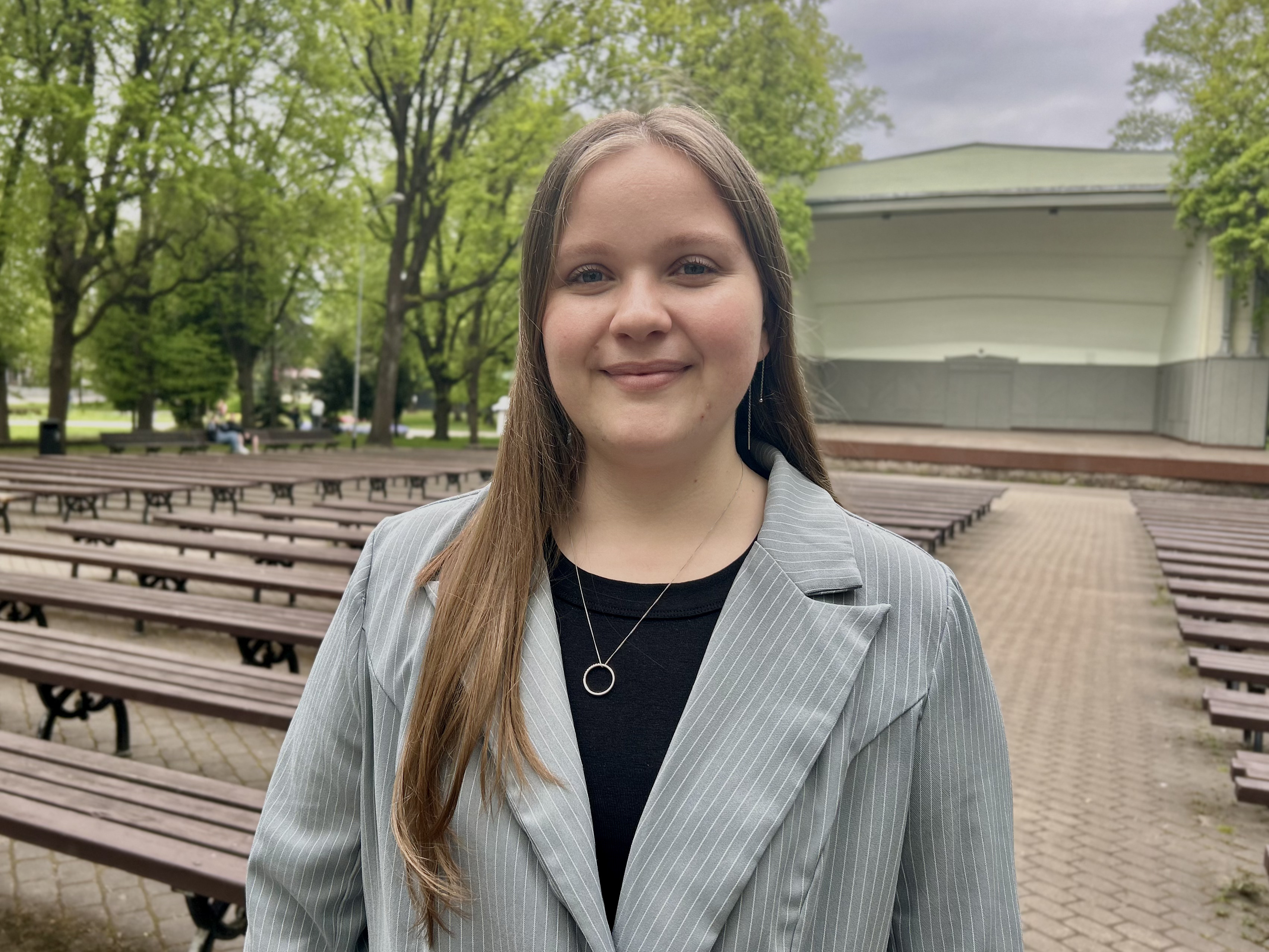
Miane in Vermanes park/photo by: Oļesja Garjutkina
Miane
She remembers looking out the window and thinking: “This is very green.” She was 17, she had no idea where Latvia was, and she'd certainly never thought about studying there when she booked the flight. She just knew she wanted a law degree, that she wanted it in English, and that her island – all 75,000 people on it – didn't have a university specialising in it. Her name is Miane Le Roux. She’s 21, originally from South Africa (prefers to add that she grew up in the Caribbean, on Dominica!), and she’s one of the 7,000 students from outside the EU currently enrolled in Latvian universities, balancing her studies with work to support herself.
“The US was out of the question – insanely expensive”, she says. The Netherlands, Germany – the fees couldn’t work. Then she found the Riga Graduate School of Law: same tuition for local and non-EU students, every question she emailed answered, and an acceptance letter that settled it. I wish it were some kind of romantic story, she says. But honestly, it was just pragmatic decision-making.
She arrived in August 2022. The full-scale invasion of Ukraine has just started. Her older sister moved to Lithuania the year before, and their parents had already lived through the anxiety of watching events unfold with a daughter in the region. By the time Miane was preparing to come, they had all been processing it for months. It never made her reconsider. Latvia, she would discover, felt safer than anywhere she had lived before, which requires some explaining.
Miane grew up in a house with gates, alarm systems on the windows, armed response services on speed dial, and a dog big enough to guard the house. You did all of that, she says, and you still never felt safe. When she was 13, her family moved to Dominica – a small island in the Caribbean where the hurricane season was not a metaphor. In 2017, a year before they relocated, the family flew out to see the island for the first time: this is your school, this will be our place. Six months later, before they had even moved, a Category 5 hurricane took most of it apart. She started her first year on the island at 13, in a UNESCO tent.
The first two weeks in Latvia were not as difficult as starting school in ruins, yet they still had some bureaucratic lingering around them. As Miane was underage, she couldn't move into the student dormitories, the accommodation she'd arranged fell through, and she couldn't qualify for a transport card. For a fortnight, she didn't take public transport at all – just waited to turn 18 so she could sort the paperwork.
Then there was the language. She had assumed, without really examining the assumption, that English would be enough while she was getting used to the country. She had completely underestimated it. Most people spoke Latvian. Her bachelor's program was mostly local students, and group projects would slip into Latvian mid-sentence, and she would have to remind people, again: the program is in English. I need to participate too. That got old quickly.
She had also packed, for a Latvian winter, skinny jeans.
The moment something shifted came that first winter. She had been invited to a negotiation training – a women's security initiative held on the coast. She booked a 5 am train – she had never taken one alone before – dead of winter, heading to a beach town by herself. She arrived ridiculously early and walked to the seaside. It was completely quiet. She sat there for about thirty minutes in total silence, alone, before sunrise, and felt completely fine. “That sounds like nothing, maybe,” she said. “But for someone who grew up the way I did – where that kind of solitude outside would have been unthinkable.”
After her bachelor's finished, she stayed for a master's degree. Passed the A2 Latvian language exam in September, sees a tutor once a week, and is aiming for C1. The Riga Graduate School of Law, she says, she simply loves. Her research paper on Russian shadow fleets, which overlaps with her day job at the Mediterranean Shipping Company, feels, as she puts it, “very alive.” After the master's, she is already thinking about a PhD – environmental law – online, because Latvian universities don't offer what she is looking for, and she is not willing to relocate.
Ask her where she's from, and she'll say South Africa. If context allows, she'll add that she grew up in the Caribbean, just to soften the expectation. Dominica doesn't work either: nobody knows where it is, and the rare times they think they do, they say Dominican Republic and ask why she doesn't speak Spanish. So, South Africa, it is, mostly because she speaks Afrikaans, and that still feels like a real part of her. Her identity, overall, she says, is still under construction. If there were none of the above options, she'd probably take it – partly just to avoid the comments. “Why are you white?” ones. The “are you friends with [Elon] Musk?” ones.
She’s careful, before saying what she thinks about Latvian immigration politics, to establish what she’s not. “I must start by acknowledging my privilege,” she says. She blends in on the streets. She has a degree that is in demand. So, when she says she does not feel unsafe about her future here, she qualifies it immediately, because the concerns around third-country nationals are not directed at one profile.
She believes, and says so without hedging, that nobody has ever been hated into assimilation. If the goal is language preservation, she says, the answer is more accessible language courses, not hostility on the news. Though she notes those courses are currently filled largely by Ukrainians and Russian-speaking residents, which, she concedes, adds its own layer of complexity.
She knows what the language barrier costs because she’s paying it. She has a private tutor. She can take an hour away from work and absorb the lost income. And even with all of that, she is at a basic level. "That says something", she says.
The road to Latvian citizenship is long, and she has already memorised it. Student years count at half rate toward residency, so she is planning to switch to a working visa in September, which means her final year counts in full. Then five years on temporary residency. Another five are permanent. Then the citizenship test. And then, if you are not European, you surrender everything else. Her South African passport. Her Dominican one. Gone.
She would do it without hesitation, she says. “Latvian government — I'm coming for you. Just give me a few more years to figure things out!”
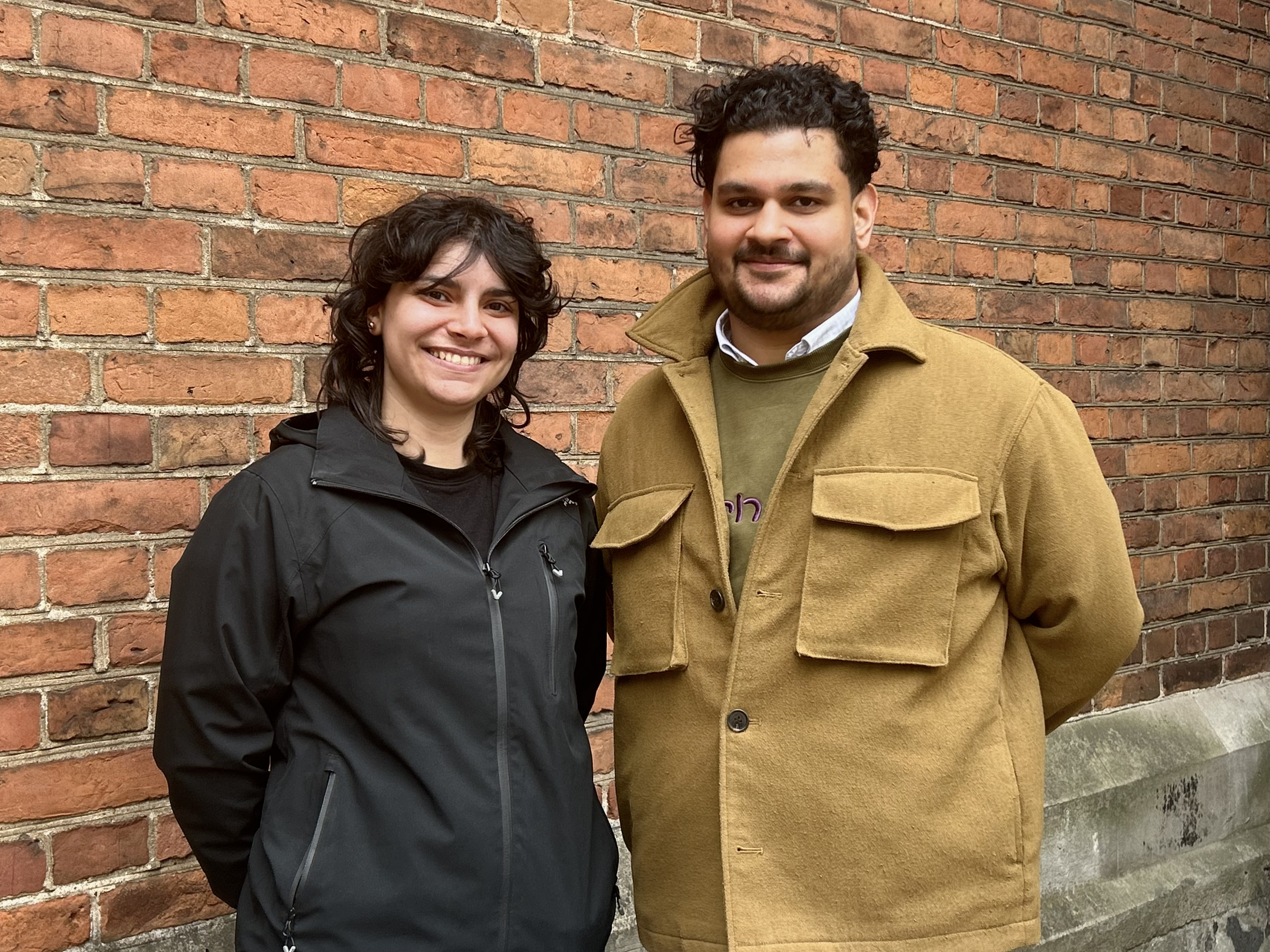
Aqeel and Alia in Old Riga / photo by: Oļesja Garjutkina
Aqeel and Alia
Aqeel is the kind of person who knows where things are happening before most locals do. The reporter met him crossing the Daugava river on foot in January, the coldest stretch Latvia had seen in years. She has been following him on social media since. His feed is a running index of Riga: pop-ups, warehouse concerts, gallery openings – events the reporter, born here, had never heard of. He has been in this city since 2018. He arrived knowing no one and has since, apparently, been everywhere.
At our meeting, he invited Alia.
Both are in their tenth semester of medicine at Riga Stradiņš University – one year left. Aqeel came from Sri Lanka, by way of Nepal, where he had started medical school and decided it wasn't working. He found Latvia through a YouTube ad. Alia came from Sweden, by way of Syria, where she spent the first thirteen years of her life before her family moved. She found Riga through a consultancy that kept putting it at the top of every list. Both of them will tell you, without much prompting, that they have no regrets.
The arrivals could not have been more different. Aqeel landed in February 2018 with snow up to his knees and walked on the frozen river the same year – he was told, after the fact, that it was illegal. The city, he says, felt intimate then. Personal. Old Town was quiet, the international student crowd was small, and the places worth knowing were still mostly known only to people who lived there. “It felt like a home initially,” he says. He understands that evolving is good, yet mentions that Riga has moved to the commercial side a lot.
Alia arrived in August 2021, during the last wave of COVID-19 restrictions. She had a week in the city before the university sent everyone home. She spent most of her first semester in Sweden, returning to Riga only for exams.
Aqeel's first week at university was, by his account, amazing. There was a Freshers Week – a proper one, in person. Later, while working with the Student Council, he helped create a program called Breaking Barriers. The idea was simple: take a group of international students and a group of Latvian students to a rented house outside the city and give them the space to get to know one another. As the student puts it, the program basically just “told people to be friends” – and somehow, it worked.
Alia missed all of it. She had a week in Riga before the university sent everyone home, spent most of her first semester in Sweden logging into anatomy lectures from her childhood bedroom, and returned only for exams. The Breaking Barriers program did not survive COVID. Thus, for Alia, who arrived after it ended, making Latvian friends has been, in her own words, “extremely difficult”. In five years, there is one Latvian girl who has had more than one interaction with her, and that happened because a girl wanted to learn Swedish.
Seven years in, Aqeel knows this city by day of the week. On Tuesdays, there is a live band at a place that used to be called Local House and is now called Möku. On Wednesdays, he goes for jazz – M Darbīca. Thursdays are for cocktail bars, because he dislikes the weekend rush. Galleries on the quieter days. Apart from Riga, he’s been all around. Cēsis, Sigulda, Valmiera, Jūrmala, Gauja, Ogre... “There's actually more”, he says. To the journalist’s question of what one can do in Ogre, a quite small town, he replies with Christmas – a snow trek through a decorated park. Alia joins his ventures pretty often.
"In Latvia, you mostly felt safe", Aqeel says of the war. He has Ukrainian classmates who told him their stories. Alia nods. She lives on Gotland when she is in Sweden, the island that Russia has long had a strategic interest in. Yet, as she says, “Your life just... goes on”.
The political question lands differently depending on who you ask. Aqeel has friends from Sri Lanka living in the UK and Australia – places with established diaspora structures and unions for third-country nationals. Latvia, on the other hand, does not. Alia mentions that across Europe, the drift has been the same: right-wing parties appearing just before elections start. Both Swedes and Latvians will come to the ballot box this year. And yes, as the student says, the results don’t look promising.
Yet, on whether they feel welcomed, Aqeel mentions finances.
“If you have it, most things are fine. If you don't, it gets complicated”, he says. Attitude, he says, always has a price – how you look, what you are wearing, how you speak. He has heard that some clubs turn away Indians outright; he has also been in situations where the answer is fifty euros, and you can come in. He is careful to note the Rock Cafe claim reached him secondhand. His own experience going out has mostly been fine – he tends to go alone and meet people on the spot. “But you know about night club culture,” he says – things happen, to everyone – “It’s not just a Latvia problem”.
The gazes are a lower-level constant. On the bus, Alia mentions, there is always an older woman just staring. Aqeel adds a note he is careful to frame carefully: there are other demographics, who can be more aggressive, coming up to ask where you are from and cycling through Asian and African countries. “Latvians, for the most part, are fine. Nice people,” he adds.
What both of them resist, unprompted, is the frame of victimhood. The conversation is full of laughter – at one point, Aqeel jokingly declares himself a victim, and we end up talking honestly about how stories like this one get written: the suffering migrant, the hostile host country, the redemption. Both would prefer it didn't. “We’re genuinely fine about this [political situation]”, Aliya says. “There are always bad times. Will worse stuff truly happen? Maybe. But now, we are fine.”
The conversation, somehow, ends up on life outside of medicine. Alia announces she is, “unfortunately”, a gamer. Aqeel laughs at the “unfortunately”. The only complication Aliya mentions is her voice, which on gaming chats sounds young enough to attract the wrong kind of attention. She has made her peace with this. “I prefer sounding like a child”, she says. “At least I feel like I'm wasting a paedophile's time – better me than an actual kid.” Aqeel, for his part, likes pretty much everything. “I don't like the fact that we only have one life,” he says. In the gaps, he reads Wikipedia. Random articles, whatever comes up.
One year left. After that, Alia goes back to Sweden for her residency in ophthalmology. Aqeel is interested in research, although he mentions that his family has a medicine business in Sri Lanka; thus, returning and helping would be the final destination.
What ties these stories together is not victimhood, heroism, or some homogenous category called “third-country nationals”. It’s ordinary life – work, study, friendships, uncertainty, ambition, nights out, family back home, trying to build a future. Latvia, meanwhile, is doing a lot of talking about them. Will it ever decide to talk to them?
Young Journalists in Europe - Meet the author
Oļesja Garjutkina
“My name is Oļesja, a freelance journalist from Riga, Latvia, and Deputy of Foreign Affairs for Young European Federalists (JEF) Latvia. My interests lie in EU policy, media literacy and youth participation, with a particular interest in how young people are represented on the decision‑making level both nationally and internationally. I am also interested -- currently researching for my bachelor's thesis -- in the media framing of migration in Latvia and the United Kingdom."
This article reflects the views of the authors only. The European Commission and Eurodesk cannot be held responsible for it.