

 @ flashvector/ from Canva
Is your screen controlling you? Breaking free from dopamine and device dependence
Last updated on Friday, 18/07/2025
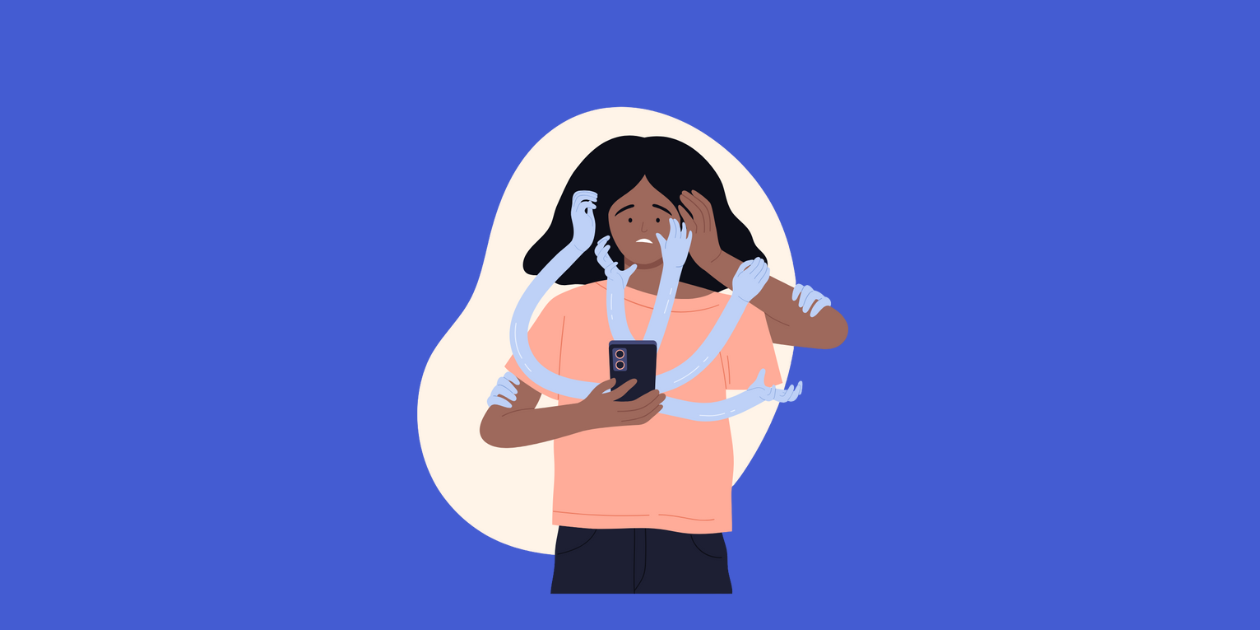
Social media connects us like never before - but it also fuels addiction and anxiety. Let's explore how too much screen time affects our brains, relationships, and well-being, and offer expert tips for reclaiming balance.
Social media has changed the habits of people and will continue to change them in the future. Nearly 25 years ago, no one would have predicted that everyone would have a 15-centimetre device in their pocket that knows the route everywhere, shows pictures, plays music and videos, and connects us to the entire world. However, it’s important to keep in mind that this is a double-edged sword and can have a serious impact on human relationships.
When ENIAC (Electronic Numerical Integrator and Computer), the first computer built for practical use, was released in 1945, the media immediately labelled it the “giant brain”. It was a true mathematical weapon of its time, capable of solving complex mathematical equations.
Scientists had achieved their first major victory in this field, but as we know, it wasn’t the last one. One victory followed another, and about half a century later, one discovery was about to change people’s lives permanently. In 1997, the website SixDegrees.com was created, which can be considered the first serious social networking site. It may even be called the father of today’s social media – members could create profiles for themselves, maintain lists of friends, and contact one another through the website’s private messaging system.
After that, the real Formula 1 began – one platform after another was created, and people's habits started to change forever. Messenger, Instagram, X, Snapchat: We can now connect with each other at lightning speed and share meaningful moments with everyone. But is everything really so rosy, or has social media also brought dangerous and problematic aspects into our lives? In this article, we are going to focus on social media addiction, the causes, awareness, possible solutions and unrealistic standards created by influencers. We’ll be doing that in collaboration with Estonian psychologist Helena Talihärm and a young European citizen called Tina.

Helena Talihärm, Estonian psychologist
Is social media a digital drug?
The term “internet addiction” was first used in 1996 and smoothly evolved into social media addiction as technology progressed. Initially, the diagnostic criteria for internet addiction were developed with similarities to alcohol addiction. A 2018 research by Burdur Mehmet Akif Ersoy University described addiction as.: “I am only good on the internet, I am not worthy when I am not on the internet, but I am an important individual on the internet, I fail when I am not on the internet, nobody likes me when I am not on the internet, the internet is my only friend, all people are treating me badly except in the internet environment.” In addition to internet use, social media began to be studied – “the results of neurological and psychiatric tests on social media users show that similar biological and psychological symptoms of alcohol, cigarette, and drug addicts are seen in active social media users.” These conclusions are still valid today.
However, Dr. Michael Rich, the director of the Digital Wellness Lab at Boston Children’s Hospital, said in an article in The New York Times that it would be better to use the term ‘Problematic Internet Media Use‘. He thinks that the usage of the word “addiction” is not the right way, because the effective use of the internet is essential to everyday life nowadays.
According to the article, published in The Guardian, specialists express concerns about labelling excessive phone use as an addiction. Some argue that medicalising this behaviour might pathologise normal habits and overlook the broader social and technological factors contributing to increased screen time. Others believe that recognising it as an addiction could lead to better support and interventions for those struggling.
Overall, it is too early to say whether social media is really addictive – positive media psychologist Sophie H. Janicke-Bowles said in the article of Psychology Today that it is a modern version of David and Goliath. In this article, we are using the word “addiction” to describe the excessive use of social media.
But what are the causes of addiction?
According to Helena Talihärm, an Estonian psychologist, to understand the problem, we need to explain human biology. “When scrolling through social media, the brain gets a quick dose of dopamine. It is an organic compound that creates a pleasant feeling. Dopamine is released when doing something enjoyable, since our body likes the pleasant feeling of it, the brain urges us to get more, which presents the risk of addictive behaviour. It is similar to alcohol or drug addiction”, Talihärm emphasises.
Tina, a young EU citizen, remembers that social media had the worst impact on her when she was just 16 years old. “I would not say that I had social media addiction, but I had a problem. An Important aspect was also my dopamine level. I couldn't watch a movie without being on the phone, also reading was kind of boring to me. That was also something I had to fix”, Helena added.
Limiting screen time
Talihärm says it’s better to address the problem early, at the first signs, rather than waiting until there’s a fire to put out. The most effective way to deal with the problem, according to her, is to set a screen time limit.
“If a young person is unable to set reasonable screen time limits for themselves, then that role must be taken on by a parent or another trusted adult”. According to Talihärm, psychiatrists and neuroscientists recommend a maximum of 2 hours of screen time per day for minors.
Tina seconds to Talihärm as she found big help from using limits. “To manage my social media usage more consciously, I’ve set a daily 30-minute limit for all social media apps using the Screen Time feature on my iPhone. The passcode needed to override the limit is known only by a friend who promised never to share it with me, helping me stay disciplined. If you’d like to try it too, you can enable Screen Time in your iPhone settings, set an app limit, and have someone you trust set and keep the passcode for you”.
Tina confirms that if a person does not have an iPhone, in-app tools can still be used. “Instagram, for example, lets you set a daily time limit in its settings, and will notify you once you’ve hit that limit”, Talihärm adds.
The foundation of social media companies
It’s clear that all the responsibility cannot be placed on the users' shoulders. Social media is designed to make people pick up their phones more often and create a desire to experience that feeling again.
Amanda Giordano, an associate professor of counselling at the University of Georgia, said in her article on Psychology Today that social media platforms are designed to be endless - they don't have stopping points like movies and books have. “There is new content every time you pull down on your screen to refresh”.
According to Giordano, social media platforms are designed to be low-effort. “Social media doesn’t take a lot of effort. Tweets span from 1 to 280 characters. TikTok videos can be a few seconds long or up to three minutes”, she adds.
Most of the time, while scrolling through social media, users are shown content they already like, making it easy for the fear of missing out (FOMO) to set in. Giordano explains that social media is highly individualised. Platforms collect data on user behaviour, and once the algorithm gathers enough information, it customises the content shown to each user based on their specific interests.
Everybody likes to win something or get rewards for achieving something. According to Giordano, social media platforms have turned that human instinct to work in their favour. When users see the notification, they get a dose of dopamine that activates a reward centre in the brain. Achieving a factor gives a person motivation to use social media more often to get more rewards.
The standards set by content creators and their impact on youth
Influencers, who produce the content that people consume, also play a major role in shaping young users' mental health. Content creators often present a flawless image of themselves on social media, aided by filters that erase every perceived imperfection from their appearance.
What is forgotten is that young people often take what they see on screen as the standard. Teenagers find it hard to ignore peer pressure. Influencer posts often have a huge number of comments and likes. Young people tend to see these numbers as benchmarks, and seeing low numbers on their own posts can severely impact their self-confidence.
According to psychologist Helena Talihärm, the behaviour of influencers and the standards they create produce anxiety and stress in young people. As Helena stated, “Standards are often unrealistic, harmful to health, and unattainable. Since a young person’s brain is highly susceptible to influence and they seek attention and belonging, their focus on these aspects is understandable. Additionally, new likes and new content on social media trigger dopamine in the brain again, making young people think more and more frequently about what is happening on social media, which in turn can lead to anxiety and emotional lows – also known as depressive states”.
Tina agrees with Talihärm and says that she has felt a similar feeling. “I was in the wrong bubble. My feed was filled with photos of fitness and ideal bodies, and I started comparing myself to that kind of content. At the time, I had a best friend who was in a similar bubble, and we had this bad habit of doom-scrolling together and discussing what we saw and thought. It was a pretty tough situation”, Tina claims.
Keyword – Awareness
Technology has developed rapidly and will continue to do so.
So, how can we use social media and devices safely and healthily? The keyword is awareness.
Talihärm defines awareness as deliberate and thoughtful action, taking into account the effects and potential consequences of a decision: “In my opinion, awareness can be increased with the help of a trusted adult. For that, a young person needs a safe, emotionally close, and authoritative relationship with them”.
“If the young person understands why it is good to limit screen time, spend time with real people in real life, engage in screen-free hobbies, be physically active, and not to believe or try to imitate everything said and shown on social media, that’s already pretty good”. Talihärm also states that it would be even better if young users analyse it all with a trustworthy adult.
Tina is certain that awareness is important. “For me, having three vision boards at home helps me. For example, I have questions on it like: Where do I want to be in 5–10 years? What is my dream job? I am aware that using social media is an obstacle on the road. Ask important people to remind you to put your phone down. Set time limits on social media. Talk to friends who have the same problem and try to find solutions. Just put your phone down and enjoy yourself — you'll enjoy things more. It doesn't matter if it's a concert, a trip, or something else, just put your phone down!”
Young Journalists in Europe - Meet the author
Egert Ninep
“I am a 19-year-old first-year journalism student Egert Ninep. I am from Estonia and currently, I study at the Baltic Film, Media and Arts School of Tallinn University. In addition to journalism, I am really into singing. Currently, we are singing with our Estonian pop-rock band Exitum.”
Article Collaborators: Friederike Kroeger, Alexandros Tsianakas, Luiza Elena Zob, Sasha Curin
This article reflects the views of the authors only. The European Commission and Eurodesk cannot be held responsible for it.