

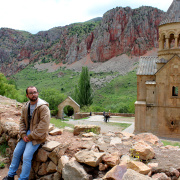
ESC in Armenia or how I felt in love with the country
Martin, FranceI feel incredibly lucky to have been able to dive into this culture so unique, at the crossroads between Europe and Asia.
A few years ago, I developed a passion for foreign languages that changed the course of my life. Before then, I had never really felt the need to leave my comfort zone or explore the world but all of a sudden, all I could think about was travelling abroad, discovering new cultures and practicing new languages. To the astonishment of my relatives, I turned my thoughts into actions and, thanks to exchange programs and internships, I left France to work and study in various countries. And I liked it. After I graduated, I started looking for new opportunities and that was when I first heard of the ESC programme from a friend. I started scrolling through the projects on the European Youth Portal. I had no specific destination in mind. I would either practice a language or learn a new one, so it didn’t really matter. The most important thing for me was to find a project that matched my personality and skills. One day, I came across a post from KASA, an organisation aiming at promoting the French language in Armenia. Curiosity instantly overwhelmed me. What could life be like in Armenia? Which alphabet do the Armenians use? What kind of landscapes can one see there? Is Armenia’s Soviet past still present? Now, I was sure. The only place I wanted to go to was Armenia. I applied without hesitation and a few weeks later, I was heading to the Caucasus region.
Once settled in Armenia, I joined KASA’s team in Yerevan. My main task was to take pictures during events. Doing so allowed me to travel through Armenia, meet various communities and understand much better Armenian society and the importance of KASA’s work. I could develop technical and artistic skills, but also work on photo editing. Simultaneously, I was teaching French to the staff through formal classes and conversation workshops. Occasionally, I was helping the team with punctual tasks: translating, proofreading, indexing, teaching English and even preparing crepes! Lastly, when I had free time at the office, I wrote a journal to talk about my experience as a volunteer, the projects in which I was involved and life in Armenia. The main purpose of this was to encourage potential new volunteers to join KASA.
Speaking of life in Armenia, there would be a lot of things I could say. First of all, I was pleasantly surprised by Yerevan’s city center, which really stands out from stereotypical Soviet cities, often depicted as bleak and ugly. On the contrary, with its numerous parks and fountains, colorful pink tuff buildings, museums and monuments, Yerevan is a very interesting, easy city to visit. Putting aside wild dogs and traffic, insecurity is quite low and the pace of life is rather slow. During my volunteering, I stayed with an Armenian family and was able to taste a wild range of traditional dishes from Armenia, but also from Georgia and Russia (how I miss my Armenian grandma’s pirojkis!). Talking with them, I discovered many aspects of Armenian culture and history (did you know that chess was a compulsory subject at school there?) and practiced Russian, still the second most important language in the country. What about Armenian people? They are very welcoming! They are very proud of their culture and they will be happy to share it with you. (Be ready to receive baskets filled with all kinds of fruits!)
And Armenian culture is extremely rich. Despite invasions and tragedies, Armenians have managed to keep alive their language, religion, traditions and identity. I feel incredibly lucky to have been able to dive into this culture so unique, at the crossroads between Europe and Asia. In only five months, I learned the basics of Armenian, tasted many Caucasian dishes, danced at an Armenian wedding, set foot in each of the 10 provinces of Armenia, met local and diaspora Armenians (but also Russians, Lebanese, Iranians, Syrians and even a French girl coming from my hometown!) and visited numerous places dear to Armenians. And interesting places in Armenia are indeed numerous! Whether you are looking for nature or culture, you will definitely get more than you bargained for! From pagan temples to monasteries so typical of the Armenian Apostolic Church, from the snowed-capped peaks of the Aragats to the green canyons in Lorri region to Lake Sevan in the East… In the end, the only thing Armenia doesn’t have is the ocean. About cultural shock, one thing that stroke me as a French person in Armenia is the local concept of time. If you plan a meeting with an Armenian, don’t be surprised if you have to wait half an hour or even a whole hour before they show up! (This is also true for professional meetings). After a while however, you get used to it.
I would say that I got used to living in Armenia pretty well. I have absolutely no regret about my decision to go there for my ESC. It was a lifetime opportunity to get to know this underrated country and its culture and I am happy I took it. I keep in touch with former colleagues, my host family and friends living in Yerevan. I keep learning Armenian and I hope that some day I will be visiting the country again!
Updated on Tuesday, 31/10/2023