

Forgotten Crises at the European Youth Week: What is the EU Doing to Help?
Última actualización Jueves, 08/10/2026
When we picture a country in the grip of a humanitarian crisis, urgently in need of the world's attention, chances are what comes to mind is one we have already seen on the news. It is probably not Malawi, Namibia, or Zambia, three of the ten most under-reported crises of 2025 according to CARE, despite being among the most severe.
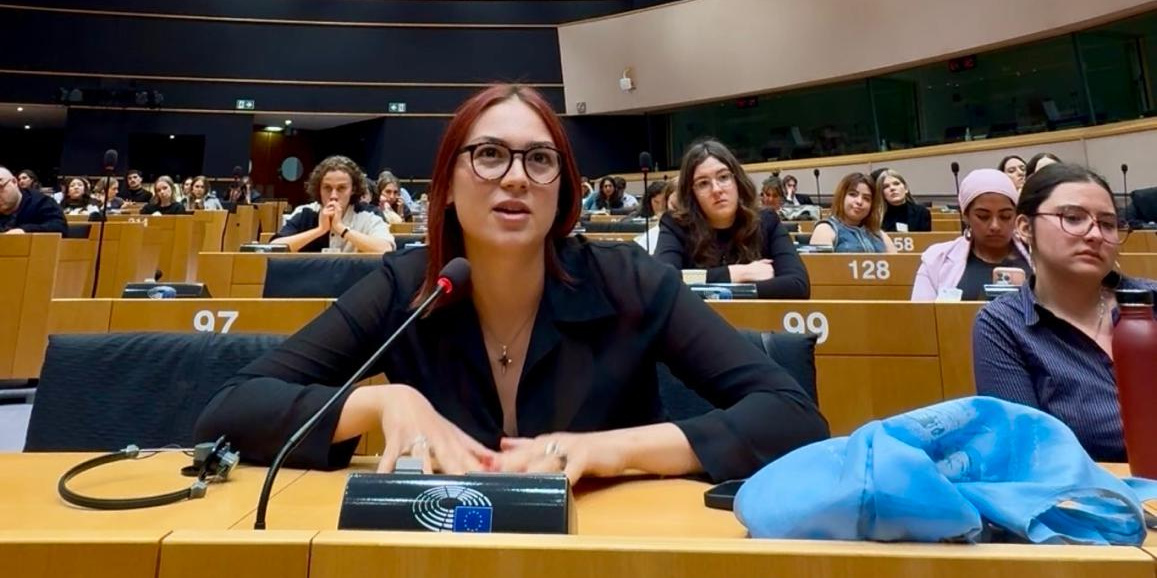
That gap between visibility and need was the subject of a session on "Forgotten Crises" we attended during the European Youth Week launch event at the European Parliament in Brussels this April. Organised by the Directorate-General for European Civil Protection and Humanitarian Aid Operations (aka DG ECHO) and delivered by Yolanda Valassopoulou, Information and Communication Officer at DG ECHO, it looked much less a presentation than an hour of sustained, occasionally pointed exchange, as a room full of young people from all over the EU and candidate countries pressed a Commission official on where, exactly, the limits of "forgotten" lie.
Earning attention, and who gives it
For Yolanda Valassopoulou, Information and Communication Officer at DG ECHO, the question of forgotten crises is less about whether coverage exists than about who produces it and how. She cited CARE International research showing that, in 2023, the Barbie film received nearly 300 times as much online coverage as the humanitarian crisis in Angola. There's also a structural imbalance within the industry: roughly 70 per cent of photography assignments and awards, she said, have been credited to white photographers from the Global North, a pattern she linked to shrinking foreign correspondent budgets. She pointed to The New Humanitarian, an outlet deliberately built around reporters from the countries it covers, as her favourite publication and a model worth following.
How the EU decides what counts as forgotten
According to official EU figures, one euro in every seven of EU humanitarian funding goes toward crises that have "escaped the media and international community's attention." But how are that figure and those countries decided?
DG ECHO's process for identifying forgotten crises is anchored in the four humanitarian principles that govern aid delivery under international law: humanity, neutrality, impartiality, and independence. Valassopoulou described an annual assessment that combines those principles with reporting from staff deployed directly in crisis zones. EU humanitarian aid itself is channelled through NGOs and civil-society organisations working directly on the ground, rather than through host governments.
Scale and severity come first. "Last year, Gaza became our biggest crisis simply because the needs were so enormous," Valassopoulou told the room, while Sudan, she noted, ranks high on both counts: the number of people affected and the severity of their situation.
Following the money
Behind those judgment calls sits a budget process the Commission does not control. "The Commission is actually last in line here," Valassopoulou said, explaining that member states and the European Parliament, jointly known as the budgetary authority, set humanitarian spending in seven-year cycles and adjust it annually. Last year's final humanitarian aid budget came to €2.4 billion. This January's initial figure was €1.9 billion, a drop Valassopoulou reframed as an opening position, later revised upward through top-ups.
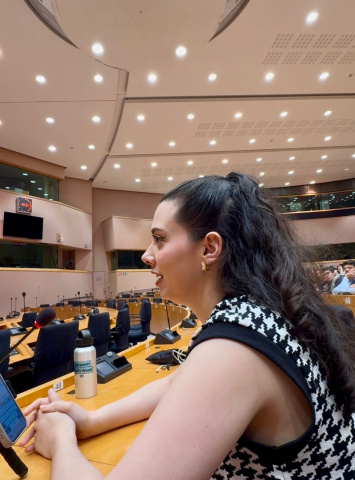
Fani Apospori from the Pool of Young Journalists in Europe.
Within that budget, 15% is earmarked for forgotten crises, though DG ECHO has exceeded that figure every year on record, reaching as high as 36% in 2022. A further 10% goes toward education in emergencies. "We're the only donor doing this at that scale," she said, noting that global humanitarian funding for education typically hovers around 1%. There is also a standing reserve for sudden-onset disasters, from earthquakes and volcanic eruptions to conflicts that break out without warning.
Outside the EU's borders, that funding translates into concrete, if narrowly scoped, projects. Since October 2023, DG ECHO has allocated more than €600 million to Gaza, funding air-bridge flights and evacuations that moved over 1,000 patients, most of them children, to EU member states, before pausing in March 2026 amid the regional war with Iran. In Southern Africa, it funds disaster preparedness for a region facing increasingly frequent extreme weather. What DG ECHO does not fund, Valassopoulou was careful to clarify, is infrastructure. "We might, for instance, fund a field hospital," she said, but permanent construction falls to other parts of the Commission entirely.
Does coverage move the funding?
If the first half of the session established how DG ECHO decides what counts as forgotten, the second turned to a more uncomfortable question: does media attention actually shape those decisions, or merely reflect them?
Referencing a panel discussion on media coverage of the war in the former Yugoslavia, Valassopoulou said the conclusion reached by academics and practitioners was that institutional funding rarely follows coverage in any straightforward way. "There's correlation, but it usually runs the other way", meaning that governments that have already decided to fund a crisis tend to use media coverage to justify that choice rather than the reverse. "Media creates an enabling environment. They don't set the agenda themselves", she mentioned.
But what about media influence? It isn't always immediate, and it isn't always institutional, Valassopoulou argued. Raising awareness might "eventually build public pressure on governments," but it rarely moves funding or policy overnight. More often, she suggested, it shapes what a generation carries into future elections.
That is not to say the media has no role in DG ECHO. The institution runs journalist field trips throughout the year, including a recent one sending four Europe-based reporters to Bangladesh to cover the Rohingya crisis, which she said had already led to coverage in multiple international publications. It also runs @EU_echo on Instagram, sharing personal stories from the communities it works with.
The power of the people
Media coverage may not move institutional budgets directly, but Valassopoulou pointed to a different kind of influence: its effect on public opinion. She cited the 1984 famine in Ethiopia, one of the best-documented crises in Africa's history, and the BBC coverage that preceded Live Aid in 1985. Individual donations rose sharply afterwards, she said, citing Oxfam figures; British government aid to Ethiopia did not.
"Did anything really change? Thirty years later, famine still exists in Africa," Valassopoulou said. "But what changed was the public attitude. It did create a huge global movement and inform a whole generation of people who'd never thought about anything beyond their own backyard. Did it change the situation on the ground long-term? Probably not. But I wouldn't dismiss that wave of public interest."
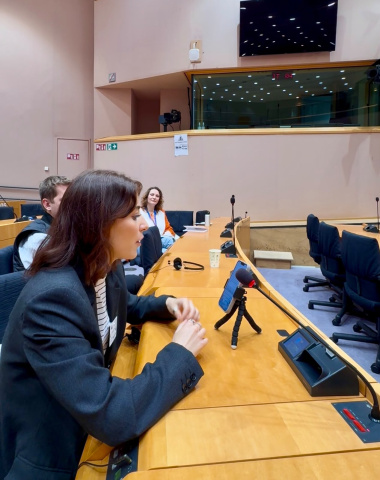
Elisabetta Semeraro from the Pool of Young Journalists in Europe.
What counts as outside
Several participants pushed back, asking why "forgotten" excludes crises inside EU borders. Valassopoulou's answer came down to the mandate: DG ECHO's aid is directed exclusively at third countries; poverty and inequality within the EU fall to other Directorates-General, among them DG REGIO and DG EAC.
Civil protection within the EU runs on a separate track, also handled by DG ECHO, but is only activated when a member state formally requests support. Candidate countries (Albania, Bosnia and Herzegovina, Georgia, Kosovo, Moldova, Montenegro, North Macedonia, Serbia, Türkiye, and Ukraine) occupy a third category: rather than humanitarian aid, they receive pre-accession assistance (IPA) through DG NEAR, aimed not at emergency relief but at aligning them with EU law ahead of membership.
For Katarina Popovic, one of the young people in the room, that structure was the session's biggest surprise. "I'd assumed most of the work went through governments, which felt risky given that some aren't very democratic," she said afterwards. "But it seems they work a lot with the UN and local partners on the ground, which matters for making sure aid actually reaches people."
What stayed with us can ultimately find an echo through one of Valassopoulou's most honest lines, delivered without much polish: "My honest view is that humanitarian funding will never be enough as long as there are conflicts and weather events. We do our best with what we have. If you can convince your governments to give more, we can do more."
Young Journalists in Europe - Meet the authors
Elisabetta Semeraro
“I’m from Italy and currently pursuing a master’s degree in International Relations at the University of Bologna. By joining the Pool of Young Journalists, I aim to cultivate my passion for journalism by combining storytelling with global politics and international affairs.”
Fani Apospori
“Hi! I'm a multimedia communicator and aspiring journalist from Greece. I'm particularly interested in foreign correspondence and blending data with human and community-centred storytelling at the crossroads of environment, health, gender and post-conflict realities. Through my journalistic work, I aim to cultivate belonging, connection and resilience by gathering people around facts and inviting them to build better futures.”
This article reflects the views of the authors only. The European Commission and Eurodesk cannot be held responsible for it.