

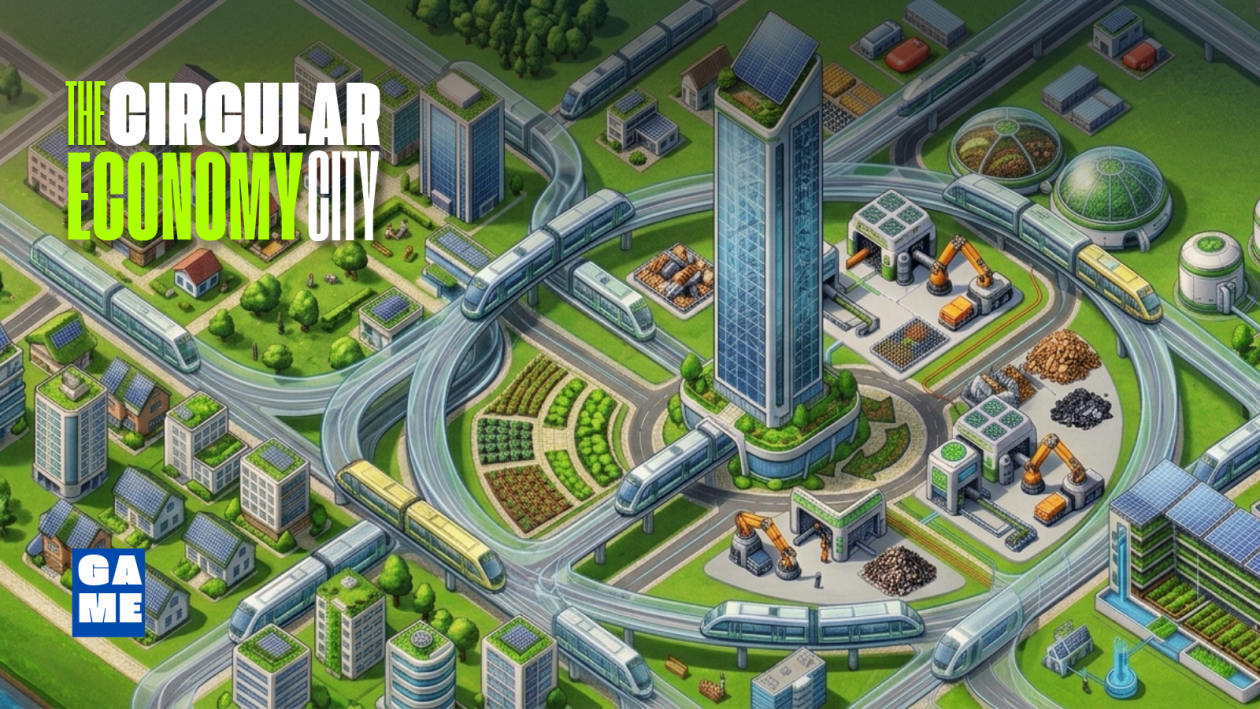
 An image created for the Circular World game by @EymenYağızBozdağ , 2026
From Gaming to Action: Designing Circular Cities at European Youth Week
Last updated on Wednesday, 26/08/2026
Get ready to create your own city! On 24 April 2026, during a breakout session of the European Youth Week Kick-off event at the European Parliament in Brussels, two members of Academics for Circular Economy (ACE) introduced a new free mobile simulation game. Selin Gökkut, a research assistant at Kadir Has University in Türkiye, and Eymen Yağız Bozdağ, a 17-year-old high school student in Türkiye, created a mobile-based simulation game called Circular World to help young people explore the principles of the circular economy.
What is the circular economy (CE)?
At the start of the session, when I thought I was only going to play a city-building game, Circular World taught me about the concept of the circular economy, which I did not know much about. The circular economy is a system that keeps the value of products, materials and resources in the economy for as long as possible and minimises waste. This means a system where products are reused, repaired, remanufactured or recycled.
This concept is something nature has been trying to teach us for years. We can see that everything that forms, grows and disappears in nature comes back to us. For example, leaves that fall in autumn become a source of food for the soil, or the seeds of the fruit we eat return to us as fruit trees again. The goal of the Circular World game is to show us this valuable cycle of nature inside a simulation of human life.
How should we play the game?
The game has many difficulty levels. Before we started building the city, the logic behind the buildings in our hands was explained to us by Eymen. Housing, farmland, factories, renewable energy systems, recycling plants, infrastructure elements and public services each served a different purpose. The first step was simple. Before you start building your city, the game offers you three scenarios: easy, medium and hard.
The easiest scenario, resource scarcity, took us to an island city with very limited natural resources. The goal here was to keep the city going without using new raw materials from outside. To do this, it was necessary to use recycled materials as efficiently as possible and to build a system that brings waste back into production.
The next scenario, waste crisis, took place in a city showing signs of bad management. Factories were polluting the environment, waste was building up quickly, and the existing system was struggling to handle this burden. The player’s job was to strengthen the recycling infrastructure, protect public health and bring back environmental balance.
The most difficult scenario was industrial transformation. This time, we were managing a city that was economically strong, but was having serious environmental problems because of heavy industry. The real challenge was to switch to clean energy and make production more sustainable without hurting economic growth.
I chose the waste crisis scenario. As you start building your city, the game comes up with new scenarios based on your choices. We discussed the results of these decisions in the session led by Selin and Eymen, and we saw that even well-intentioned decisions could lead to unexpected results. The overconsumption paradox showed that even if living standards go up, resource use can keep rising. The waste-system collapse showed that recycling alone is not enough, while the efficiency trap reminded us that technological improvements can also increase production and emissions.
Circular World game does not give us a perfect city on a plate. While making us think about these real-life scenarios, it shows us the results of this extreme system. Every well-intentioned decision and improvement we make brings a new problem with it. So, who is responsible for these problems? Society, companies, or governments?
Who is responsible for the circular economy?
These questions after the game pushed us into a debate. Everyone agreed that without structural change, personal efforts will always be limited. If recycling options are missing, if repairing things is not supported, or if companies keep pushing linear models, consumers simply do not have many choices.
Because of this, one of the suggestions for the game was to add a “policy and regulation module”. Participants thought that players should not just build buildings and facilities. If they could also make macro-level policy decisions like carbon taxes, consumption quotas, green public buying, Extended Producer Responsibility (EPR), and banning waste exports, it would make the game much more educational.
At the end of the session, I interviewed Selin and Eymen, the creators of Circular World, to learn about the starting point of their ideas and their motivation.
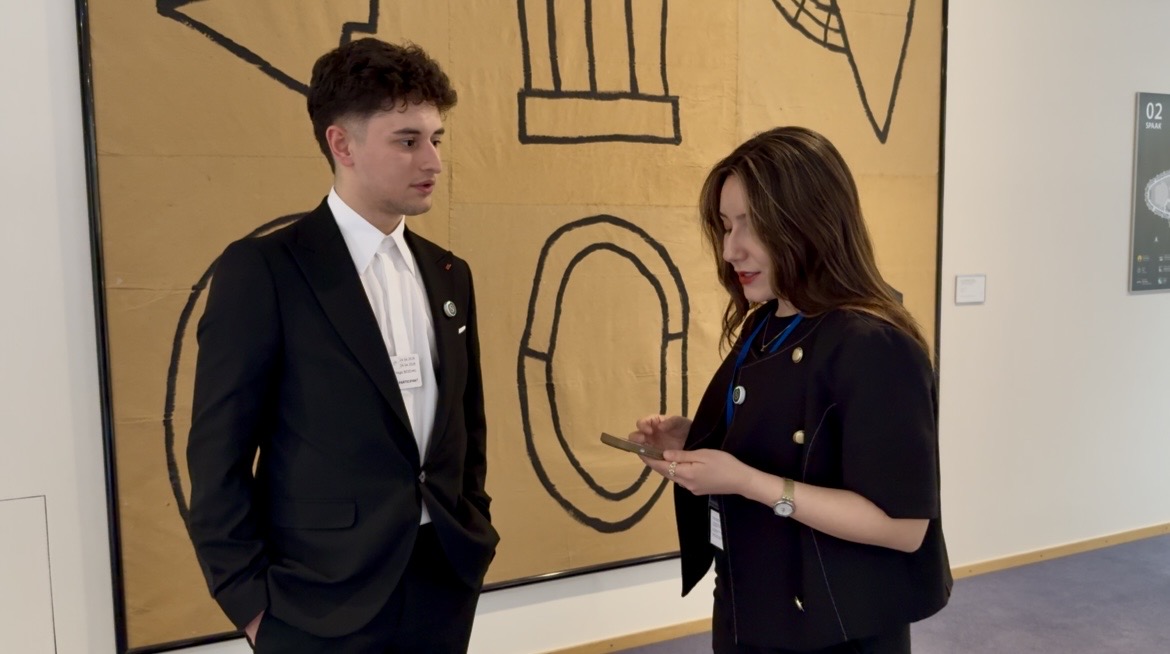
Interview with Eymen Yağız Bozdağ at the European Youth Week Kick-off event, April 24, 2026. @Zeynep Altundağ, 2026
Eymen Yağız Bozdağ: “Games are our language”
17-year-old Eymen, a student at TÜBİTAK Science High School in Türkiye, is the youngest member of ACE. He explains his motivation with these words:
"To be honest, books tell us to protect the world, but games actually let us try to do it. I wanted to turn these theories into real action."
Eymen believes that games are the most effective tool to help young people understand complex topics:
"I believe games are our language, especially for my generation. When you see your own city fail, you stop ignoring the problems and start searching for new solutions. We have fresh ideas and no fear of technology. I think we can use simulations to test the future before we build it.”
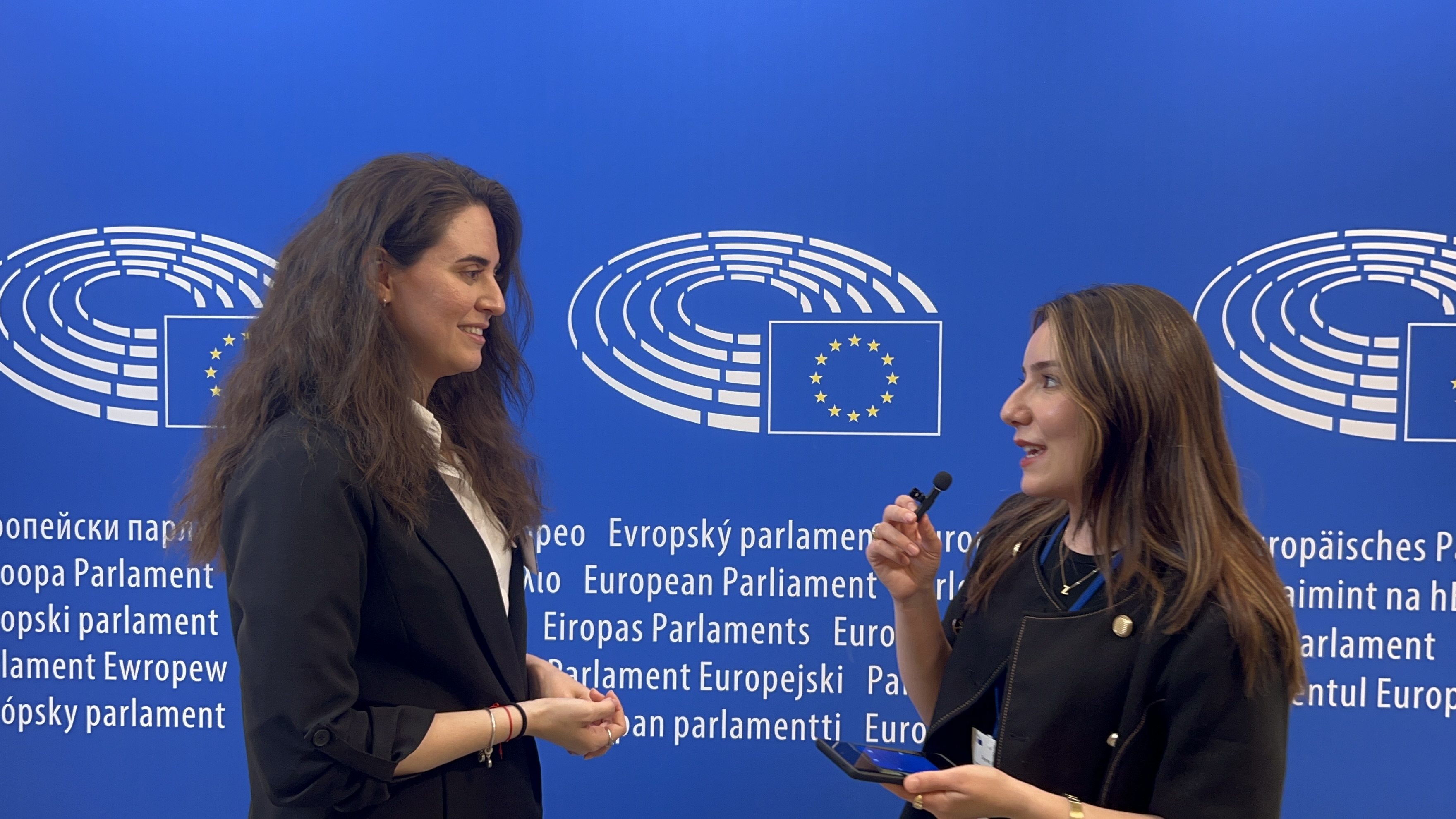
Interview with Selin Gökkut at the European Youth Week Kick-off event, April 24, 2026. @Zeynep Altundağ, 2026
Selin Gökkut: “Education Is the Most Important Thing”
Selin Gökkut, a research assistant at Kadir Has University in Türkiye, says that a sustainable city needs to give every young person the chance to learn about this field.
"A circular city is a place that offers every young person the opportunity to receive education on sustainability. For us, education is the most important thing."
Selin notes that sustainability usually stays in theory at schools and that it is hard to show students how it works in real life. That is why they use Circular World as an educational app.
Circular World gave us the chance to experience the circular economy instead of just learning about it in theory. Every choice we made showed real-world dilemmas we might face. In the end, winning or losing did not matter in the game. What we really learned was that sustainability needs shared effort. This simulation we experienced reminded us that systems survive on the responsibilities we share, not just on rules.
Young Journalists in Europe - Meet the author
Zeynep Altundağ
“I am Zeynep, a Turkish designer and aspiring journalist with a degree in Fine Arts and Design. I focus on visual storytelling that supports journalism and international dialogue. I believe powerful journalism is not only about words, but also about visual impact. I am honoured and excited to join the Pool and share diverse perspectives. In my free time, you can find me exploring European art galleries.”
This article reflects the views of the authors only. The European Commission and Eurodesk cannot be held responsible for it.