

European Heritage Training Course " Traditional lime plasters"
 @European Heritage Volunteers
16/08/2022 18:00
27/08/2022 09:00
Ora dell'Europa centrale [CET]
wifi_tethering https://www.heritagevolunteers.eu/EuropeanHeritageTrainingCourses/TrainingCourses2022/TraditionalLimePlasters?
The site
Mauerbach Charterhouse, the Carthusian Monastery of Mauerbach, was founded in 1314 by the Duke of Austria Friedrich der Schöne (Frederick the Fair) from the House of Habsburg, who was later buried at the place. The new monastery was established and consecrated in 1316 by twelve monks under Prior Gottfried, who relocated from Seiz (Žiče, located in current Slovenia). The original Gothic monastery was seriously damaged when the Turks first laid siege to Vienna and also by the Neulengbach Earthquake in 1590. The reconstruction of the monastery in the form which it essentially has today began under Abbot Berthold Fasel in 1616, and was completed under Abbot Johannes Werner between 1665 and 1670. The early Baroque interior decoration was extensively destroyed when the Turks attacked again during the second siege of Vienna in 1683, and had to be renewed in the late 17th and early 18th centuries. The impressive Baroque monastic complex is one of the most important structures of its kind in Austria today.
After the Mauerbach Charterhouse was abolished by Joseph II in 1782, the monastery was used as a poorhouse and infirmary. The buildings were subsequently adapted for their new function, accommodating up to 800 people. In 1944 / 1945 the former monastery was put to use as an emergency hospital. Between 1945 and 1961 the monastery was used to house homeless; over 100 families were sheltered there. In 1961 it was acquired by the Austrian Federal Government and remained unused for over twenty years. The monastery was left to decay until it was eventually taken over in 1979 by the Burghauptmannschaft Österreich (the Federal Buildings Authority of Austria). In 1984 a new function was conceived for the ensemble, and it was handed over to the Österreichisches Bundesdenkmalamt (the Federal Monument Authority of Austria), thus ensuring the preservation of this protected monument. In 1985 conservation and restoration works at Mauerbach Charterhouse started.
Today the site houses the Information and Training Centre for Heritage Conservation of the Federal Monuments Authority of Austria and the Department of Archaeology of the Federal Monument Authority of Austria. It is now used to hold professional training courses in historic handicraft techniques, scientific seminars and advanced training on multiple problems of conservation.
The main focus of the Information and Training Centre for Heritage Conservation is the investigation of traditional building techniques, such as lime burning in an experimental kiln, direct slaking, handmade bricks and stone varieties, and traditional materials, like natural sands, lime and hydraulic binders. Additionally, the Information and Training Centre serves also as a hub for testing innovative methods of conservation and restoration, as well as consultation point for owners of heritage sites, conservators and architects.
The dissemination of this special knowledge to craftsmen, conservators-restorers and architects takes place in context of conferences, seminars and courses, while the Mauerbach Charterhouse itself functions as the training site. The former monastery, with its various historic surfaces and architectural details, such as windows or floors, is itself undergoing a continuous conservation and restoration process that is occurring gradually, based on a slow and meticulous method that adheres to the best standards and thus setting an example of best practices for heritage conservation in the Republic of Austria. The courses for blacksmiths, engravers, stonemasons, painters, masons and carpenters held at Mauerbach Charterhouse focus on traditional crafts, while they at the same time raise awareness and promote a respectful approach to handling original structures and substances.
The conservation of architectural surfaces is one of the major topics of the Information and Training Centre for Heritage Conservation. In particular, the Centre has been able to acquire a wide range of experiences in the fields of conservation and restoration of medieval and Baroque rendered facades as well as of plasterwork and decorated renders dating to around 1900. In particular, special courses for restorers-conservators and masons are offered aiming on working with decorative plasterwork dating from 1900 onwards. These courses explore the different composition of mortars, the use of Roman cement and Portland cement for stone imitating plaster, and the application techniques to apply these materials.
The approach in heritage conservation and the educational contents of the courses and seminars at the Information and Training Centre for Heritage Conservation at Mauerbach Charterhouse is summarised in “Standards der Baudenkmalpflege” (“Standards of heritage conservation”), a publication which serves as a guideline for conservation of built heritage in Austria.
The work
The training course will focus on the conservation and restoration of historic architectural surfaces and will take place at the original Baroque facades of Mauerbach Charterhouse, in particular at the walls of the former monk cells and the portal to the monastery.
The program of the training course will start with the process of analysing the damages, salt problems, humidity problems and damages resulting from bio-deterioration. The initial survey of damages and the documentation of the current state of conservation will be followed by the development of concepts for the conservation measures and the definition of conservation and restoration goals.
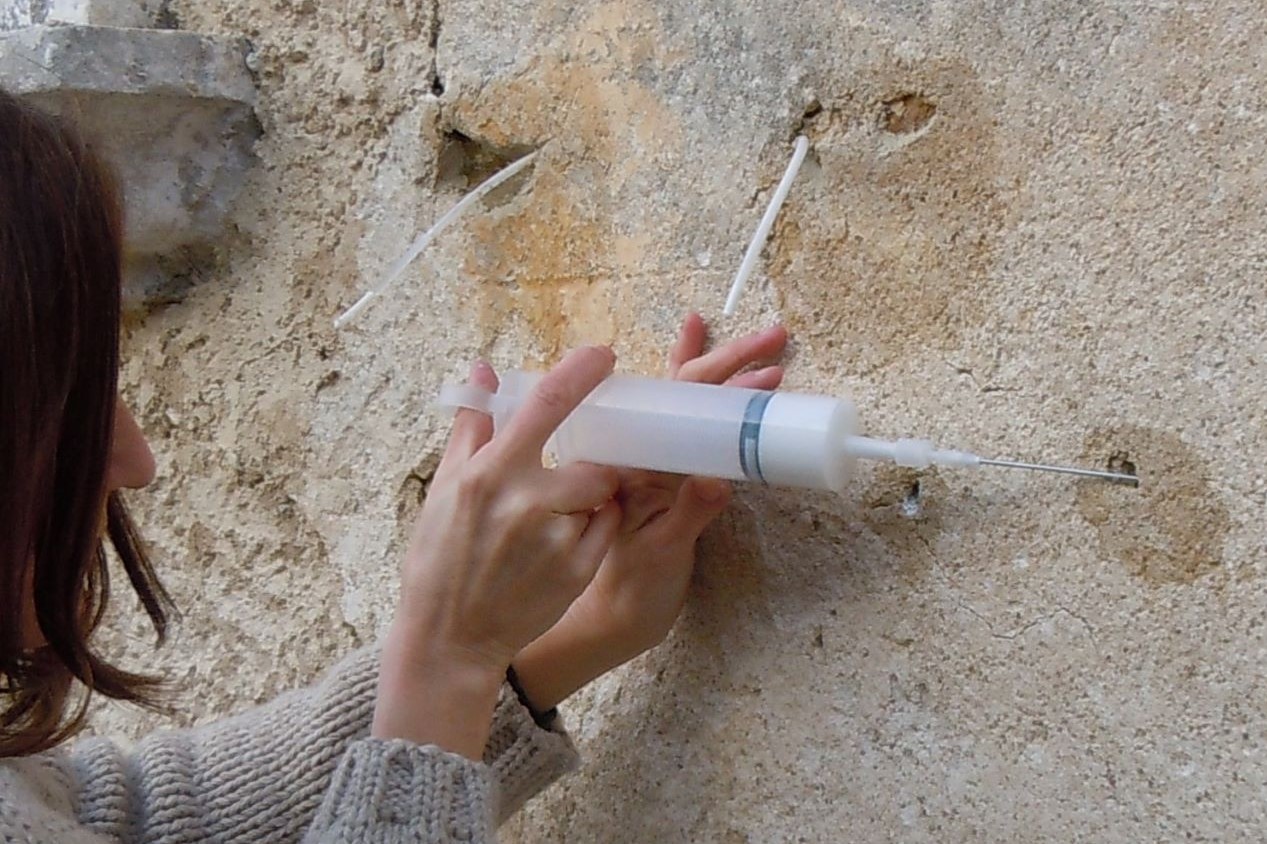
The practical work will comprise lime slaking, mixing of different mortars and plasters with different aggregates, consolidation in lime-technique, injections of lime slurry and liquid lime mortar, salt reducing methods, preparation of pigments and applying lime wash and paints.
The technical instructors are restorers for architectural surfaces, restoration scientists and masters of handicrafts who work as freelancing restorers and professional trainers for traditional crafts and conservation of build heritage since more than thirty years.
The educational programme will be complemented by guided visits and excursions to heritage sites in Vienna which had been recently restored or are currently undergoing conservation or restoration measures.
The training course will take place from August, 16th, to August, 27th, 2022, and is jointly organised by European Heritage Volunteers, the Bundesdenkmalamt Österreich (the Federal Heritage Authority of Austria) and the Burghauptmannschaft Österreich (the Federal Buildings Authority of Austria).
DETTAGLI DELL'ATTIVITÀ
| Formato dell'attività | In presenza |
| Data di inizio | 16/08/2022 18:00 |
| Termina il | 27/08/2022 09:00 |
| Fuso orario | Ora dell'Europa centrale [CET] |
| Organizzata da | European Heritage Volunteers and the Bundesdenkmalamt Österreich (the Federal Heritage Authority of Austria) and the Burghauptmannschaft Österreich (the Federal Buildings Authority of Austria). |
| Sito web dell'organizzazione | https://www.heritagevolunteers.eu |
| Indirizzo e-mail di contatto | info@heritagevolunteers.eu |
| Fascia di età | 18-24; 25-30; 31-35 |
| Lingua dell'attività | Inglese |
| Tipo di attività | Altro |
| Argomenti dell'attività | Partecipazione e impegno; Valori europei; I giovani nel mondo; Istruzione; Scambi formativi; Cultura; Ricerca e innovazione |
| Prenotazione | Prenotazione sempre necessaria – vedi i dettagli |
| Accessibilità per sedie a rotelle | Non accessibile con sedia a rotelle |
| Obiettivi per la gioventù legati all'attività | Collegare l'UE e i giovani; Apprendimento di qualità; Organizzazioni giovanili e programmi europei |
| Collegata alla Conferenza sul futuro dell'Europa | No |
| Stima del numero di partecipanti previsti | 14 |