

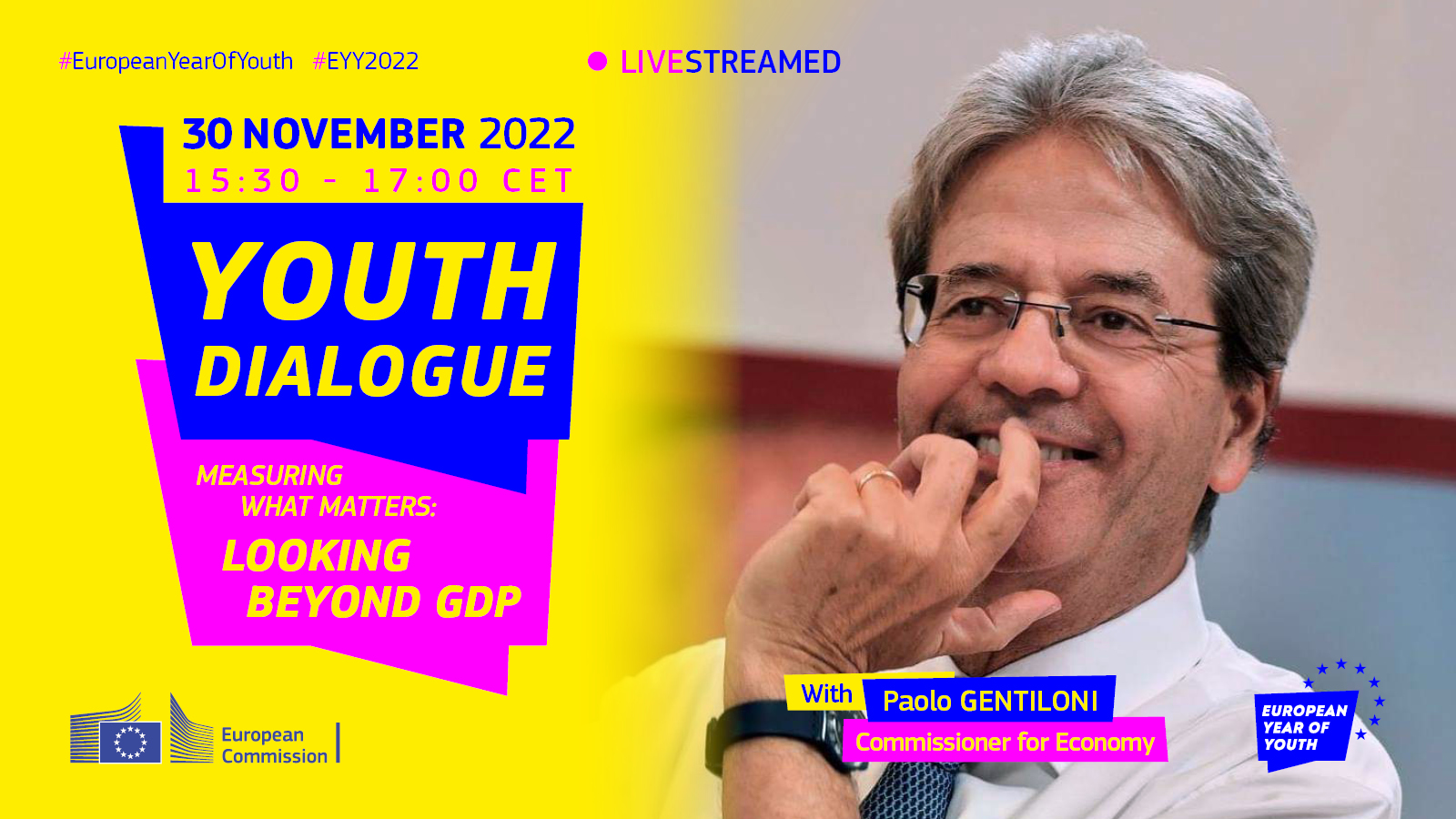
Policy Dialogue with Commissioner Paolo Gentiloni: "Measuring what matters: looking beyond GDP"
 @European Union 2022
30/11/2022 15:30
30/11/2022 17:00
[CET] Hora da Europa Central
wifi_tethering Follow the live stream
Rue de la Loi, 200, 1049, Brussels, Bélgica
Global concerns such as climate change, resource depletion, inequality, poverty, and health are pressing decision-makers to move away from a narrow focus on Gross Domestic Product (GDP) as a single metric to measure economic success and citizens’ wellbeing. However, there is a lack of consensus on how to achieve this. Would you like to take up the challenge? Join this Youth Policy Dialogue and make your voice heard!
Here’s what you need to know:
- Event: Youth Policy Dialogue with Commissioner for Economy Paolo Gentiloni.
- Location: livestreamed from Brussels on 30 November
How can I replay the Dialogue?
Head to the European Commission's Streaming Service and to DG ECFIN’s Twitter profile to replay the Dialogue and check out the photos from the event.
Here you can also check some of the highlights.
Take aways from the Dialogue
- Gross Domestic Product (GDP) is a key indicator for an economy as it gives a snapshot of the market value of its production. A shared, clear and global system of measurement, it is easily understandable by public opinion and through media. Nevertheless, GDP was never intended to be the only measure of welfare. Depending on the aim of the measurement and the policy objective, GDP is and can be further complemented with indicators that draw a bigger picture of society's well-being and available public goods. Indicators should be added that can capture elements such as carbon emissions, social cohesion, quality of life, youth impact and territorial distribution as well as the availability of certain types of infrastructure or national defence. The maxim should not be "beyond GDP" but "GDP and beyond".
- The EU and the Member States already consider many additional indicators besides GDP in their analyses. However, these need to have some of the characteristics of GDP itself: easy to understand and communicate; released with high frequency; and measured according to internationally agreed standards. Established indicators such as the Sustainable Development Goals provide a good framework to complement GDP and shape policy choices. Additionally, there are various indicators also referring specifically to young generations, such as the Youth Progress Index, which offer valuable input on issues that affect youth. The Youth Test, discussed in several Youth Policy Dialogues, might also have a positive impact on economic decision making, in particular in policy areas related to demography, such as pensions.
- The objective for the future will be to analyse the diverse measurement methods and further develop indicators that complement GDP. However, it is not only a matter of finding new indicators, but also of using them and turning them into something that really influences policy-making and the perception of a society's situation.
INFORMAÇÕES SOBRE A ATIVIDADE
| Formato da atividade | Híbrido (em linha e presencial) |
| Início em | 30/11/2022 15:30 |
| Termina em | 30/11/2022 17:00 |
| Fuso horário | [CET] Hora da Europa Central |
| Organizada por | European Commission |
| Sítio Web da organização | https://economy-finance.ec.europa.eu/events/measuring-what-matters-looking-beyond-gdp-2022-11-30_en |
| Email de contacto | ECFIN-SEMINARS@ec.europa.eu |
| Grupo etário visado | 18-24; 25-30 |
| Língua da atividade | inglês |
| Tipo de atividade | Debate |
| Temas da atividade | Participação e compromisso; Economia e finanças |
| Reserva | Basta aparecer — sem inscrição |
| Objetivos no domínio da juventude relacionados com a atividade | Conectar a União Europeia com a juventude; Espaço e participação para todos |
| Relacionado com a Conferência sobre o Futuro da Europa | Não |
| Número previsto de participantes (estimativa) | 14 |