

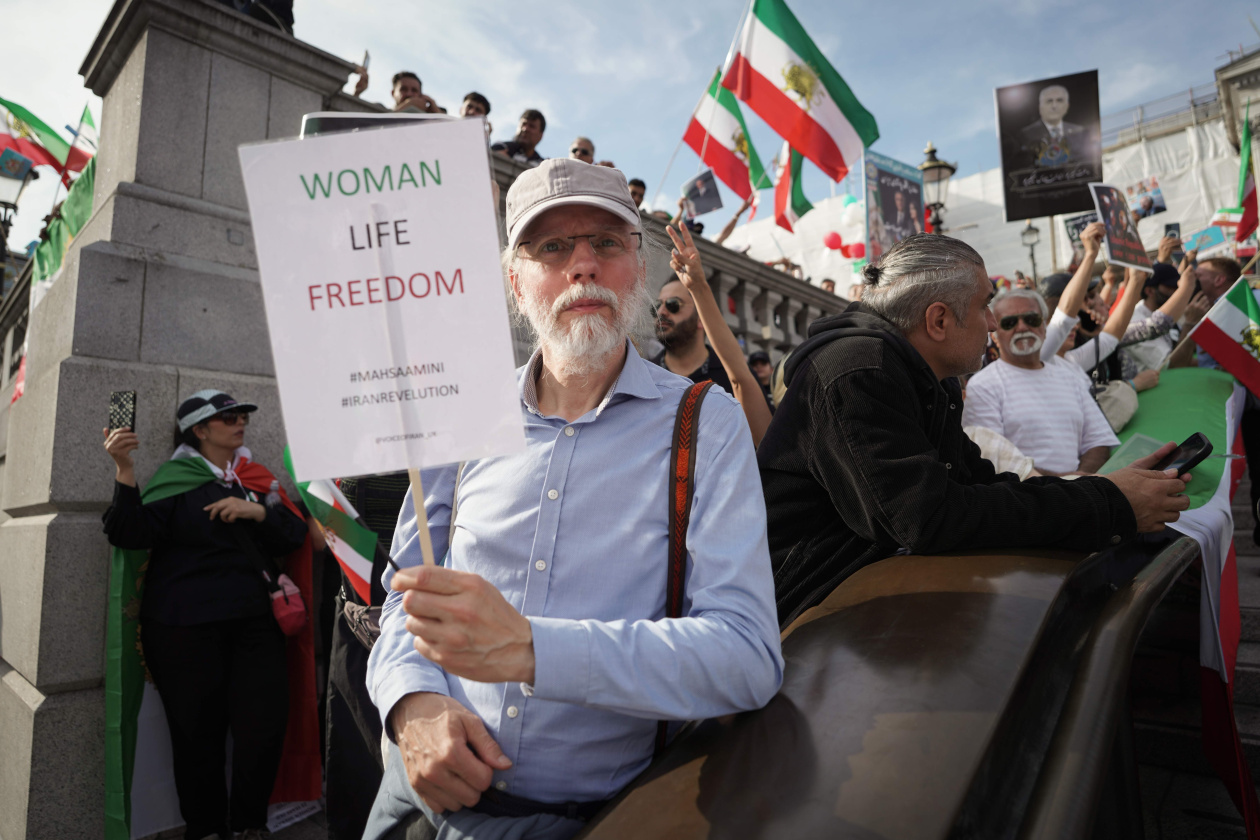
 “Woman, Life, Freedom – 53203149737” by Alisdare Hickson, via Wikimedia Commons, licensed under CC BY 2.0
“Be our voice”: meeting Shena Razabi, Kurdish Human Rights Activist
An nuashonrú is déanaí an An Mháirt, 27/01/2026
What does Iran look like, three years after a young Kurdish woman, Mahsa Jina Amin, died after being detained by religious morality police? For Shena Razabi, a Kurdish humanitarian activist who has represented Kurdish interests to the UN and EU, it looks like heartbreak; it looks like a country that still has no place for her and her people.
“My parents had to flee Iran before I was born,” she told me, “after the revolution.”
The Iranian revolution of 1978-9, which established Ayatollah Khomeini as the Supreme Leader of the Islamic Republic of Iran (IRI), was brutal. Ethnic and religious minorities were targeted by the new administration; the IRI set up the Revolutionary Courts to put opponents of the new regime on trial. They had no defence lawyers, no jury, and no hope of overturning their sentence, which was, for so many, death. Though the Revolutionary Courts were later restructured to allow lawyers to defend those deemed enemies of the regime, the Iranian government refused to acknowledge the past injustice, and the death penalty continues to be a key way that the state silences criticism and opposition.
In July of this year, Kristine Beckerle, Amnesty International’s Deputy Regional Director for the Middle East and North Africa, declared a “horrific execution crisis” in Iran; over 700 people have been executed this year alone, many on politically motivated charges, including humanitarian aid workers.
Even before the revolution, Kurdish people - an ethnic minority group that is estimated to make up between 8 and 17% of the population of Iran - faced an existential threat from the Iranian state, with their language and culture suppressed. Despite active participation in the 1979 revolution, Kurdish demands for autonomy were met with a violent response from the new leader of the Islamic Republic of Iran. Activists like Shena’s father and brother were faced with no choice but to flee.
“They were threatening them,” she said, “if they come back … they would kill them.” Some of her family did not take the threat seriously; four of Shena’s uncles were arrested in Iran, and one was executed. Her parents decided to stay in Iraqi Kurdistan - the Kurdish-populated region of Northern Iraq, neighbouring Iran. There, Shena Rabazi was born in the city of Sulaymaniyah, registered as a refugee.

Supreme Leader of the Islamic Republic of Iran, Ali Khamenei.
“Ayatollah Ali Khamenei with Hajj organisers” by Khamenei.ir, via Wikimedia Commons, licensed under CC BY 4.0.
To be a refugee is to be continually questioned on the legitimacy of your own existence; to be a refugee from a regime that actively persecutes you and people like you is to live in a state of constant fear. During the 1990s in Sulaymaniyah, agents of the Iranian regime systematically targeted Kurdish refugees who had criticised the government, removing them from their new homes on the other side of the border. Shena’s father had represented Iranian Kurdish asylum seekers’ interests with the UNHCR, the UN’s Refugee Agency. This made him a target.
On 7 November 1999, Shena was sitting in her house in a glum mood. Her baby brother, just two months old, was distracting her while she tried to prepare for a history test the next day. They’d already used up their allocated two hours of electricity for the day; it was the first rain of the autumn, and her father still hadn’t come home. He’d been asked to go help a stranger in the neighbourhood a few hours ago, though neither Shena nor her mother knew what the errand was. It got late. They started to get scared: hearing constant stories of harassment and persecution from the people around them, the family had all agreed not to stay out after dark, for their own safety. Shena’s mother cut up fruit for the family to eat together, but they didn’t eat it: they sat around a kerosene lamp, waiting to hear her father approach the door.
At 9:21 pm, they heard something else instead.
“First, there were a few, single shots,” she tells me, imitating the “ta-ta-ta” staccato sound she heard. “After that, it sounded like a clashing cough - and that’s what you call it.”
The noise Shena heard that night was a Kalashnikov rifle, or AK-47. Her father had just been shot outside their home by an agent of the Iranian regime. Her mother ran out of the house, leaving Shena alone with her baby brother. She was just twelve years old.
“It was about 1 am when my mom came home with a huge, heavy black plastic bag,” she recalled. Shena assumed the worst, but her mother brought shocking news: her father had survived the assassination attempt and was in the hospital. The bag was full of clothes for him. There was hope. But they could not stay in Sulaymaniyah anymore.
After her father recovered, Shena’s family moved to Finland as asylum seekers.
“The first few months were like nightmares,” she told me on video-call from Finland, where she still lives - and thrives - today. After spending her whole life being taught to hide her identity as a refugee, the twelve-year-old Shena was surrounded by white people, and stuck out - visibly different - in every room. “My parents kept telling us that we were safe here,” but it took Shena months to relax in this alien society.
“No one even knew who Kurds were, and there were not many of us,” Shena remembers. “That didn’t make (the integration process) any easier.”
After a rough start in Finland, she began to grow comfortable with the new world she had entered. She even began to grow interested in politics.
“I started thinking, why are we not living like this [in Iran]? In Finland, we have not only Finnish people, but also Samis, Finnish-Swedish people … and they all live in peace.”
The peaceful democratic system she had discovered in Finland was a sharp contrast to the world she had left behind. For the first time, she could see the full injustice of the conditions of her childhood as a refugee.
Shena wanted her hosts in Finland to see that injustice, too. She started volunteering with an Iranian-Kurdistan youth organisation, and never stopped. From then, Finnish human rights organisations came knocking; she spoke to Iranian opposition organisations, organised meetings with the Finnish foreign ministry, and fought for recognition of the human rights violations taking place in Iran. Last year in Geneva, Shena Razabi addressed the 17th session of the UN Forum on Minority Issues.
Among the victories came fresh heartbreak. Her family had hoped that after moving to Finland, they’d never again have to fear the government of the country they’d left behind - but then her brother-in-law moved back to Iraqi Kurdistan, wanting to be nearer to the struggle of his people. He was killed in 2016, Shena tells me, by the Iranian government.
“It was very hard for our family,” she says simply. Even recounting the memory brings her fresh pain. “We still suffer from that experience.”
What Shena wants more than anything is for Europeans to see what she’s up against. Ethnic minority groups cannot speak their own language in schools; in 2020, a woman was sentenced to ten years in prison for teaching Kurdish by the Revolutionary Courts. Protestors are put to death for daring to criticise the regime. It’s hard to imagine that the international community could overlook such human rights abuses in the twenty-first century.
But even for activists as experienced as Shena, it’s hard for their campaigns to gain traction in the international community when we scroll past so many tragedies every hour on our newsfeeds. It’s harder still to communicate the scale of human rights abuses when the information coming out of Iran is so limited; the regime has reportedly forced political prisoners to “confess to their crimes” on national television prior to their executions, and broadcast racialised propaganda through the same channels.
“Most of the time, the world does not hear our voice,” she says. Like so many other refugees around the world, she tells me, “I’m not asking for pity, but for solidarity.”
2022 felt like a turning point - after Mahsa Amini was killed after being detained for allegedly improperly wearing a hijab, protests kicked off and received global coverage. Young people played music and danced in the streets, challenging the government’s strict comportment rules. The protests weren’t only about general repression and civil liberties, but also about the Iranian targeting of Kurds, who face disproportionate rates of arrests overall. 'Women-life-freedom' is a Kurdish slogan, Shena tells me, and represents not only “opposition to patriarchal structures in Iran … but also the voices of the unrepresented and oppressed people in their fight for dignity and freedom.”
“I had a lot of hope when this happened,” Shena says. “My parents, for the first time, thought they could move back to Iran.” These hopes were dashed. The Iranian government was swift in its crackdown, arresting protesters and sentencing them to death. As of July 2025, there are still nine people held in custody awaiting execution in relation to the protests.
In the wake of a fresh outbreak of conflict between Israel and Iran this summer, Iranian authorities cracked down once again, killing civilians at vehicle checkpoints and raiding provinces with a heavy concentration of ethnic minorities - including Kurds and Baluchi peoples, as well as Baha’i, Christian and Jewish citizens - on the grounds of the presence of, or collaboration with, Israel. Things on the ground seem to be worse than ever.
What can young people in Europe do? “During Women Life Freedom (protests), most of the people who went out on the streets were young people,” Shena says. “It’s important that European youth show solidarity with these young people.”
Facing down a state propaganda machine that violently silences opposition, the most valuable resource we have is the truth, Shena argues. “Share information on social media about the minorities who are suffering because of this regime - knowledge about the human rights situation is the first step. Ask your government to think about the human rights situation when they want to make deals with the Iranian regime.”
Shena believes that we have a responsibility to do what our peers in authoritarian regimes cannot: speak our minds. “Young people in Europe have freedom,” she tells me. “They have this chance to be our voice.”
Young Journalists in Europe - Meet the author
Hazel Mulkeen
“I’m a student at Trinity College Dublin, currently pursuing a bachelor’s in French and German. As a competitive debater with a particular interest in public affairs and economics, I’m fascinated by how each citizen’s rights interact with governmental policies. I’m honoured to be a Young Journalist this year, and I hope to find and share stories that resonate with young Europeans".
Article collaborators: Angela Garrido Rivera, Oliver Čechmánek, Alexandros Tsianakas
This article reflects the views of the authors only. The European Commission and Eurodesk cannot be held responsible for it.