

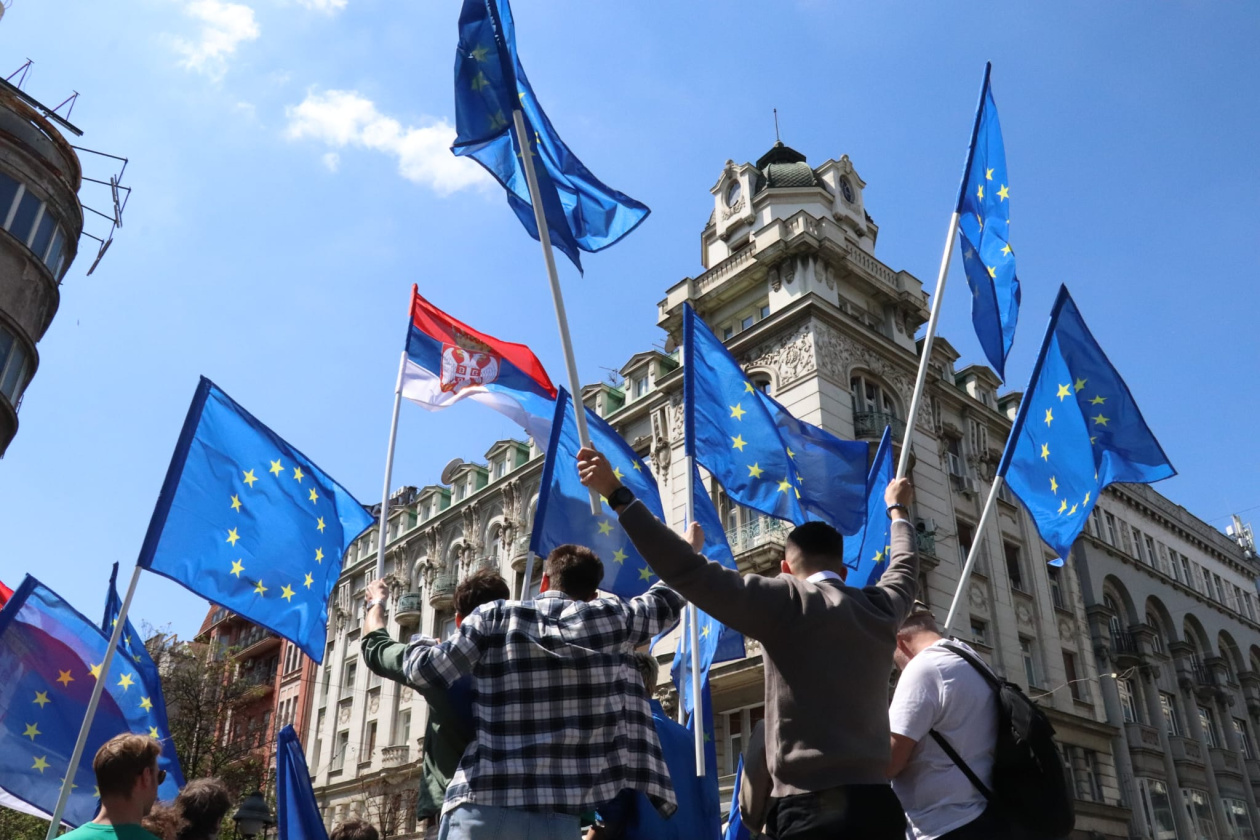
 © Vukasin Cvetkovic for JEF Europe
The Torchbearers Of Change: Katarina Bogićević On Youth And EU In Serbia
Τελευταία ενημέρωση Τρίτη, 21/07/2026
Youth activism in Serbia has transformed since the tragic accident in Novi Sad, when the collapse of the railway station canopy took 16 lives in November 2024. Students blocked faculties across the country and organised protests demanding accountability for corruption. This struggle prompted students to go to European institutions, seeking dialogue.
Although young people worked hard to inform European institutions about the situation in Serbia since the tragedy, EU membership remains a highly sensitive issue at home. This is largely due to the gap between the government’s seemingly pro-EU rhetoric and its close ties with China, refusal to impose sanctions on Russia, and continued democratic backsliding and the erosion of the rule of law.
Two years later, in April 2026, the rally “For a European Serbia, for Serbia in the EU” took place in the capital of the country, Belgrade. It was a gathering attended by about two hundred people, according to Serbian media, but even then, the participants faced a wave of hate speech by opponents of EU membership on social networks. On how young people are shaping a new perspective on democratic values and EU integrations, our interviewee, Katarina Bogićević, president of the Youth Forum of European Movement in Serbia, member of Young European Federalists - JEF Serbia, and a researcher in Peace and Security Studies, will continue from here. The interview was originally conducted in Serbian and later translated into English by the author of this article.
How did the rally held in Belgrade on April 18, titled "For a European Serbia, for Serbia in the EU," go?
The rally proceeded peacefully and in a spirit of togetherness among young people from Serbia and all over Europe, sending a clear message that Serbia's future in the European Union entails the active defence of democratic values, and that the citizens of our country are not alone in these efforts. In circumstances where democratic principles and freedoms are under pressure worldwide, including within European space, it is especially important for young people to insist on solidarity, political and institutional accountability, and the preservation of space for civic action.
What was the most memorable moment during the rally?
That day, the song “Bella Ciao” echoed through the main street of Belgrade as a symbol of the anti-fascist struggle, whose significance transcends the historical moment from which it originated. Its presence does not speak of everyone having the same ideology, but rather of an unbreakable need to no longer compromise on human dignity and fundamental rights.
However, the reactions that followed on social media after the rally confirmed once again why this fight has not yet been won. Hundreds of comments marked by hate speech, misogyny, homophobia, transphobia, racism, as well as conspiracy narratives about the "decadent West," bore witness to deeply ingrained patterns of exclusion and dehumanisation.
The wave of attacks was joined by the Minister for European Integration in the Government of Serbia, who cynically devalued the gathering and called those present the “self-proclaimed Belgrade elite” and the “NGO jet-set.
It is important to understand that such behaviour is not an isolated incident but a part of a broader effort to discredit civil society and promote anti-EU narratives, often reinforced through major media outlets, Katarina continues.

Katarina Bogićević, president of JEF Serbia, Youth Forum Serbia and a researcher in Peace and Security Studies, personal archive.
How engaged are young people with the issue of Serbia’s membership in the European Union? In your experience, is there a real political will among youth to join the EU?
Public understanding of this issue is oversimplified, and misinformation and polarisation make informed debate about EU integration more difficult. However, looking at relevant public opinion research, and specifically youth attitudes, there is still significant, albeit varying, support for Serbia's EU membership.
At the same time, there is a noticeable gap between support for the EU’s values and trust in the institutions and political actors involved in the integration process. While a large number of people participate in EU-supported programs and share many of the Union’s values, they are often more sceptical of the accession process itself, seeing it as distant from the concerns of ordinary citizens.
Once the current political crisis in Serbia is resolved (the current ruling regime has led to decreased democratic values and civil and media freedoms and resulted in mass student-led protests), there may be an opportunity to rebuild trust and make the integration process feel more relevant and connected to people's everyday lives.
How have the responses of European institutions so far changed the student struggle for the fulfilment of student demands?
When it comes to the responses of European institutions, it seems they initially had a limited and predominantly symbolic reach, but at the same time, they influenced the way the student struggle positions itself within an international framework. In this context, they contributed to its further internationalisation, visibility, and support networks. The resolutions of the European Parliament and the reactions of the Commission are not negligible, as they signal that Serbia is not a peripheral point in a geopolitical sense either, but part of a wider space where similar patterns of dissatisfaction, resistance, solidarity, and demands for a fairer social order are being articulated.
Are young people in Serbia ready to build a society of understanding, equality, respect for human rights, democracy, and tolerance, and has the first step on this path already been taken?
It would be wrong to claim otherwise. Over the past year and a half, young people have clearly demonstrated both the willingness and capacity to drive social change. At the same time, young people are far from a uniform group. While this movement carries significant transformative potential, it's important not to overlook existing divisions and the risk that some forms of exclusion and radicalisation may continue to grow.
Are there clear stances within Serbian official institutions, as well as in society, that indicate opposition to Serbia's membership in the European Union, and does their presence or absence affect youth engagement in improving and continuing European integration?
As I have already suggested, Serbia’s institutions appear willing to continue the path toward EU membership, but not necessarily to see it through to completion. Contradictory messages from political leaders often create confusion and make it difficult for citizens to form clear and consistent views on the issue.
People are entitled to hold different opinions about EU integration, but meaningful debate requires a shared understanding of basic facts. Young people have created alternative spaces for discussion and engagement, but these initiatives often struggle to shape broader public discourse in a lasting way.
What is the role of organisations like the Youth Forum of the European Movement and JEF Serbia in working with young people?
The Youth Forum of the European Movement in Serbia aims to connect young people with discussions on EU integration through accessible and participatory forms of engagement. Its work focuses on encouraging youth activism and civic engagement, although its reach is often limited by funding and challenges that civil society organisations face.
Through JEF Serbia, the national section of the Young European Federalists, young people also gain opportunities for international networking, exchange and cooperation. In both roles, our goal is to create a supportive community where young people can learn more about the EU, develop new ideas and become active shapers of Europe’s future.
Young Journalists in Europe - Meet the author
Andrijana Martačić
“I am in my final year of Communicology and Public Relations studies at the Faculty of Philosophy in Novi Sad, and I work as Deputy Editor at the student media outlet Univerzitetski Odjek. Journalism was never part of my original plans, but through my studies, I came to realise that it is the only field I truly feel passionate about.”
This article reflects the views of the author only. The European Commission and Eurodesk cannot be held responsible for it.