

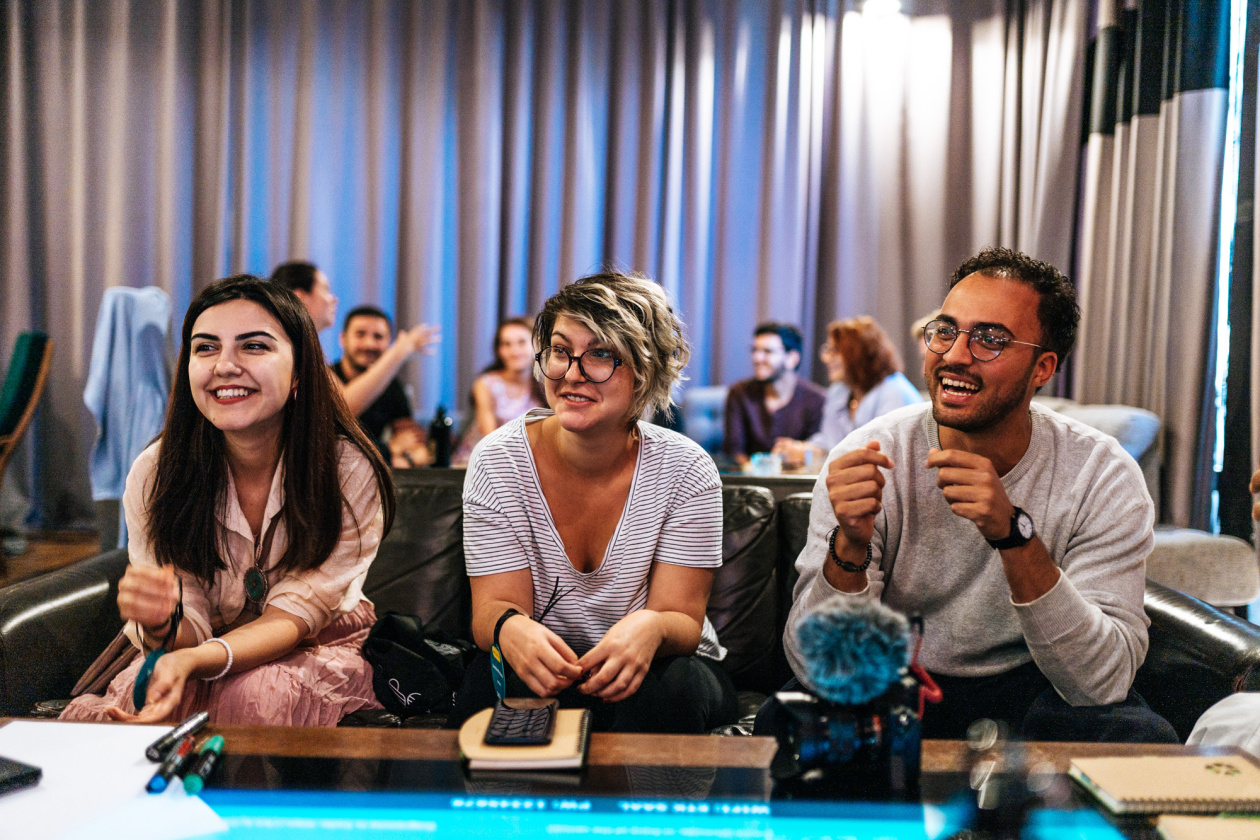
 Credit: Media and Information Literacy Project Lab participants in Tallinn, Estonia. Photo: Karin-Liis Tambaum
Find Inspiration and Make Your Projects Shine!
Atnaujinta Pirmadienis, 04/08/2025
Running an Erasmus+ and European Solidarity Corps project? Read the article below to learn about what makes your project stand out, become inspired by high-quality examples and find out what's in it for great projects!
Have you been thinking about launching an Erasmus+ or European Solidarity Corps project? Or have you already started the work? Wherever you are in the process, you are probably wondering how to make the most of it, and how to make it remarkable and exciting. Keep reading to find some answers to these very important questions! Tip: Read to the end to discover the perks for the best projects!
What makes a project great? Useful tips & questions to ask about your own project
When it comes to youth projects like yours, it is important that you make it participatory. For example, you can bring young people together and involve organisations from different countries while finding ways for everyone to learn and make a valuable contribution. Even better, you can engage participants in the decision-making process. If you don’t know how, you can find more information in the Participation Resource Pool and very practical tips, worksheets and self-evaluation questions about projects and participation in the Participation Toolkit. Ask yourself: what other organisations did you involve and have you planned any follow up with them after the project? Be ambitious, think big, think how your project can focus on a real problem and help your participants grow their knowledge and awareness.
Have a strong policy dimension!
Think about how you can show a strong policy dimension: how does your project contribute to the achievement of one or more of the EU Youth Goals? Make it for and about young Europeans, stimulate their civic participation and put their ideas at the centre of the learning experiences. Your project can make a real difference, if it encourages young people’s participation in Europe’s democratic life – be it at local, regional, national or European level. What is inspiring and impactful about it? Plan your activities in such a way that they unite the participants behind the same vision and goal to create inspiring experiences. Ask yourself whether your outcomes make it possible to multiply your project’s impact beyond the direct participants? Is your project sustainable beyond its lifetime?
Link to Erasmus+ and European Solidarity Corps horizontal priorities!
Link your project with one or more horizontal priorities of the EU Youth Programmes: Inclusion and Diversity, Digital Transformation, Participation in Democratic Life, and Environment and Fight Against Climate Change. It is important that you show how your project goals, activities and outcomes address and foster these priorities. Also, what makes your project worth remembering? What are the lessons learnt? It is best for you to showcase how you managed to grow through this project individually and as a team, and what your learning outcomes and/or high-quality tangible results were.
Would you like to learn from real examples? See a few of the projects below to hear directly from the participants and organisers!
Example 1: Saving sea turtles with Erasmus+
Plastic-Free Youth, an Erasmus+ youth exchange project focused on the EU priority “Environment and fight against climate change” and the Sustainable Green Europe youth goal, brought together young people from rural and urban backgrounds from four countries (Spain, France, Romania and Croatia) to work on ocean pollution problems and the protection of wildlife. The project took place in Fuerteventura (Canary Islands).
The programme included visits to the sea turtle recovery centre and the island’s natural freshwater spots to show how fragile the ecosystem is. Participants collected rubbish while jogging around those places to understand the effects that humans have on the environment. They explored what microplastics are and collected them on beaches that seemed to look clean. They also recorded some data about the current state of the coast while learning more about citizen science.
The activities got the participants really excited:
“The most amazing thing for me was to learn about microplastics and to connect the dots as to how we are impacting the seas” – says Cosmina Andreea, a Romanian team member from Plastic-Free Youth. “I think we managed to learn a lot about plastic pollution, exchange ideas and opinions about the problem, raise our awareness and understanding, and make new friends from different cultural backgrounds along the way,” adds her Croatian team lead Vid Tomljenović. “The most inspiring aspect for me was the activity in which the whole group collected rubbish. This instilled a sense of community and union among the group and a sense of service towards the common goal in me.”
Example 2: Empowering volunteers in a new local community with European Solidarity Corps
Ambassadors of European Solidarity, a European Solidarity Corps volunteering project, brought together six young volunteers from France, Germany, Poland, Italy and Greece in the wine growing region of Amarante, Portugal, where they became involved in the local community, helping organic farmers, organising fair trade workshops in schools, supporting social institutions and running exciting cultural events. This project also provided a wide range of public events involving the local community and contributed to enhancing the visibility of the project and the Erasmus+ Programme.
Miguel Pinto, an experienced volunteering Project Coordinator, discusses the project: “Most of our volunteers come from cities, without any experience in farming or community work. Everything is new to them, and meeting people from different backgrounds can be a little scary at first. But when they see how much the community appreciates what they are doing, especially in schools where they offer non-formal educational activities about culture, healthy lifestyle and volunteering, it has a fantastic impact on their confidence. Kids feel really energised by their workshops and can’t stop talking about them at home [...] Volunteers set the cultural agenda of our youth centre and make it happen, sharing their own unique talents with the community [...] They support local institutions, the elderly centre, the disabled centre, the orphanage, the municipality and the schools. They help organic farmers sell their produce at the Saturday market, and visit schools to give talks about the importance of fair trade and sustainability.”
SALTO Awards and the Flagships
By the way, did you know that your project can become known by thousands of people across Europe and, perhaps, light a spark in someone to follow in your steps? Read this last bit and find out how to get your project featured among the best and most exciting youth participation projects!
SALTO Participation & Information Resource Centre is looking for high quality youth participation projects. To date, 18 inspirational youth projects have been added to the projects collection called “the Flagship Projects Collection” or in short, “the Flagships”. You can search and filter depending on the EU Youth Programme Priority and Youth Participation Strategy category you are interested in. Most of the projects are youth-led and focus on the EU Youth Programmes through different key actions. Each project has gone through a tough selection process (only 1 in 100 got in!), so it is fair to say they are more than exemplary.
You may be wondering how to get your project into this collection? There are several ways:
- Nominate your project for the SALTO Awards – an annual contest of innovative youth projects in several categories ranging from Youth Participation to Digital Transformation and Sustainability. The winner in each category earns a place in the Flagships and a cash prize.
- Get a direct recommendation from your country’s National Agency (find the list of National Agencies here) to include your projects in the Flagships.
- Apply for the Erasmus+ and European Solidarity Corps Programmes once the application rounds open again because best projects are also identified from the project result databases. Don't miss the deadline!
Remember – be ambitious, be bold, think long-term and involve young people in decision-making processes! And don’t forget to check the Flagships Projects Collection for more stories! Let’s see what you come up with and best of luck to you and your teams!