

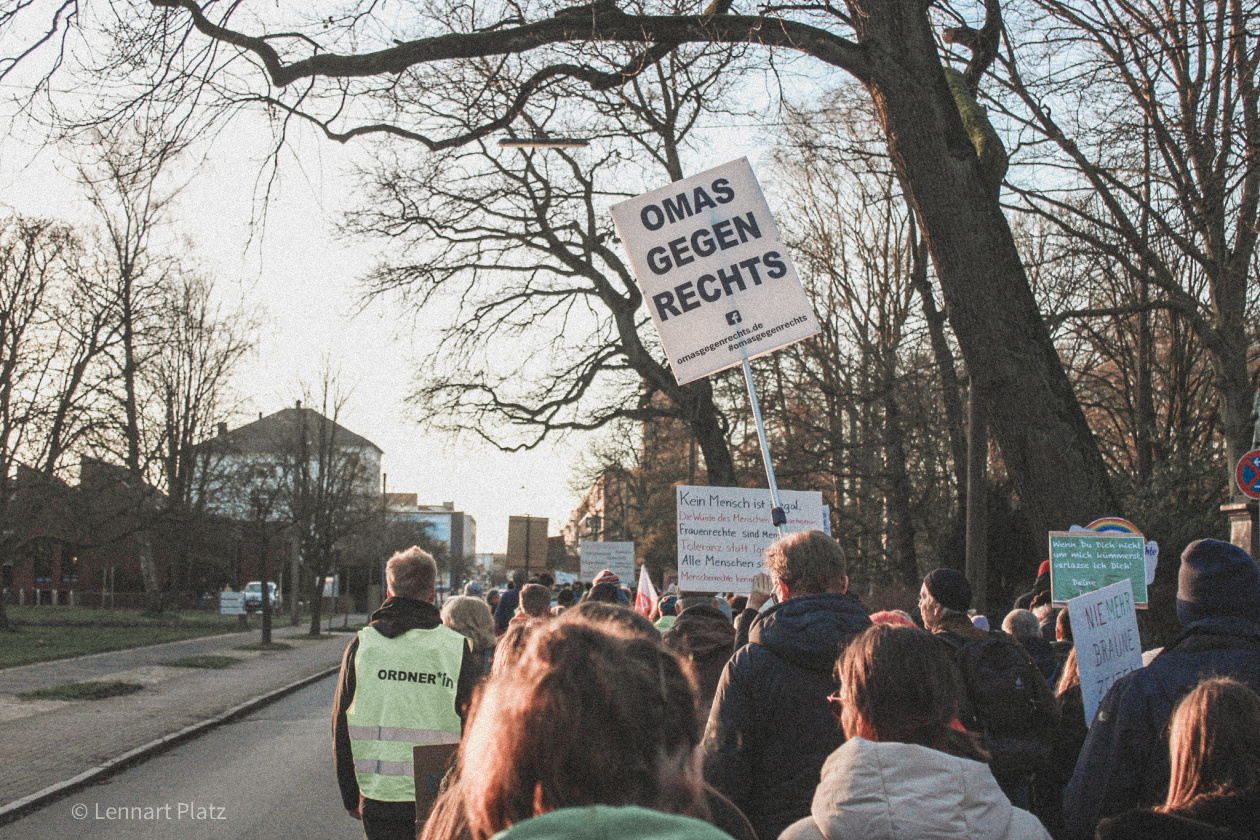
 © Lennart Platz, 2024. Demonstration march through Wilhelmshaven (DE).
Fascism on the rise in Germany - what’s driving young and old into the streets today?
Zadnja sprememba Torek, 02/06/2026
Since the beginning of this year, protests against fascism have been ongoing in many German cities. The catalyst for this was a secret meeting involving politicians, businessmen, and far-right extremists. Still, the question lingers: What really happened during that secretive meeting, and what motivates both the older folks and young individuals to stand up for a cause and go on the streets?
19 January is a historic day in German history, on which people come together to stand up for causes. It’s a cloudy Friday in the heart of Hamburg. Colorful posters can be seen. Chants can be heard. People of all ages have come to demonstrate together against the rise of right-wing extremism in their own country. Later, the event has to be cancelled due to security concerns. Anyway, the message was so strong that many more events followed in Germany. The Hamburg interior ministry later spoke of up to 180.000 people gathering on the streets at the time. One of the main triggers for the protests occurred two months before and took place behind closed doors in a hotel near Potsdam.
A team of investigative journalists discovered in January that a secret meeting had been held between representatives of political parties, businessmen and people from the right-wing milieu in November 2023. The meeting focused on a topic that the participants referred to as ‘remigration’. The content was about the deportation of millions of people from Germany into another country. Most of those people have been living in Germany for several years. This meeting was published by the investigative research network Correctiv, leading to many protests and demonstrations in Germany afterwards.

© Lennart Platz, 2024. Demonstration march through Wilhelmshaven (DE)
Even a few months later, demonstrations are still taking place, with hundreds of people attending. In addition to major cities like Berlin, Hamburg, or Leipzig, protests are increasingly taking place in smaller towns.
One of them is Nele, a 23-year-old girl. She lives in Wilhelmshaven in north-west Germany. She wears glasses, has shoulder-length brown hair, works in a coffee bar and holds a cardboard sign at the rally. In colourful letters, it says "Human rights instead of right-wingers”. For her, the demonstrations in Wilhelmshaven and Oldenburg were the first she had ever attended. For Nele, young people in particular must stand up for democratic values, "because we have to live in this world. We can still make a difference”, she stressed.
As well as young people, there are many older people at these kinds of demonstrations. One of them is Hanna. Hanna is 84 years old and attending a demonstration for the first time in her life. She is particularly worried about the rise of the AFD, a right-wing party in Germany. Her grandson told her that there were demonstrations against fascism in her neighbourhood, she said. So she joined them. Hanna believes that the demonstrations can have an influence on people to better deal with the issue of emerging fascism. Above all, however, she appeals to the fact that the "centre of society must show that it is bigger” and that solidarity must be lived together in a society.
According to recent surveys, the AFD's surge in popularity has at least been halted. It lost ground in the latest polling. From a democratic perspective, this can be good news because there will be elections in three Eastern German states in the next autumn. There’s a good chance that the centre-right party will lead a state government.
The horrors of the Nazi era, particularly during the Second World War, are less than a century old. They systematically persecuted and killed people who did not fit into the worldview of the National Socialists under Hitler. This included particular Jews or people with disabilities and homosexuals. The fall of Hitler's regime in 1945, the road to democracy and especially the process of coming to terms with the past are still taking place.
This dark period of history has made people in Germany very sensitive about plans for expulsion and the fueling of enemy stereotypes. For this reason, Nele and Hanna will continue to take part in the demonstrations, standing up to protect democratic values in their own country, in their own unique way.
_______________
Young Journalists in Europe - Meet the author
Lennart Platz
Hello, my name is Lennart. I'm 23, from Germany, and I'm studying Media Management and Journalism. I've travelled to lots of places in Europe and met different people. My friend and I run a small radio show where we talk to new German musicians. We work to make the show fun for everyone, young and old. I'm curious about sports, music, and culture, and I'm always ready for new ideas or projects that can help people meet and make new things.
This article reflects the views of the authors only. The European Commission and Eurodesk cannot be held responsible for it.