

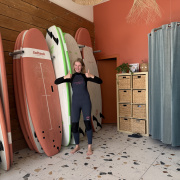
Emelie on exchange in Nantes
Emelie, DenmarkMy biggest advice is simply to say yes to everything. Stay open-minded and embrace new experiences. Studying abroad can be challenging, but it is truly worth it. I would never want to be without my experiences in France.
Which exchange program did you attended and why did you chose it?
I went on exchange to Nantes, a city near the west coast of France. When deciding where to spend my exchange semester, I looked at what the different universities could offer. I had always dreamed of going to France to experience the culture, the country, and the language. I believe it is important to have a clear idea of what you want your exchange experience to be before going abroad.
My main interest was experiencing France and exploring different regions and cities, which is why I chose a slightly smaller city with excellent train connections. Nantes was an ideal choice because it offered plenty of opportunities to travel around France. The city is home to Audencia, a business school that offered ten sustainability-focused courses, which was exactly what I wanted to study.
Practical aspects of the exchange stay
The practical aspects of studying abroad mainly revolve around accommodation, transportation, academics, and finances.
I had previously lived abroad for a semester and had very positive experiences using Airbnb. I explored the housing options in Nantes, including accommodation available through Erasmus, but my priority was to live in the city centre so that it would be easy to get home after travelling, social events, or nights out with classmates. Living in the city centre turned out to be one of the best decisions I made because all our evenings usually started with my friends gathering at my apartment for dinner since I lived closest to everything. It also meant that I could say “yes” to every idea and event without having to worry about transportation.
Transportation in Nantes is very accessible. The tram system can take you almost anywhere, and there are also excellent bus connections. Nantes has made efforts to become a bike-friendly city, so on sunny days I would rent a bike and cycle home instead of taking the tram. I travelled extensively around France, and it was essential that Nantes had great train connections through its large central station. From there, you can take direct trains to cities such as Lyon and Strasbourg.
Financially, my student grant, the Erasmus scholarship, and part of my savings were enough to cover my expenses. As mentioned earlier, it is important to reflect on what you expect from your exchange experience. I placed a strong emphasis on travelling around France and bought a train subscription called MAX Jeune, which cost €80 per month and allowed me to travel for free at certain times, or otherwise at a guaranteed discount. Because of this, I often ate out while travelling and stayed in hotels or Airbnbs, which naturally made my exchange more expensive than some of my friends’ experiences, as they stayed in Nantes most weekends.
What did the exchange experience give you academically and personally?
My exchange experience improved my French skills and gave me a better understanding of what it feels like to arrive in a country without speaking the language or fully understanding the culture. Living abroad increases your independence as you learn to navigate a new country, language, and culture. In addition, it strengthens your adaptability, and of course you grow significantly as a person through the experiences and people you encounter.
The exchange also provided insight into how teaching is conducted in another EU country. Education in France was very different from what I had experienced in Denmark. For example, attendance was mandatory in class, which is not the case in my degree programme in Denmark. In many ways, it felt a bit like high school again, but it also meant that everyone in the class became very close because we saw each other almost every day for several hours. This also created a greater cultural understanding because we spoke much more with our classmates, and my class consisted of students from all over Europe, which made discussions on different topics both exciting and insightful.
Which courses did you take and what were they about?
I took a course package consisting of ten courses, each worth 3 ECTS credits. All courses were connected to sustainability, as I was enrolled in the Sustainable Business programme. The courses focused on topics such as financing sustainable businesses, creating sustainable supply chains, sustainability across cultures, and sustainable business strategies.
The ten courses were:
System Thinking and Sustainability
Sustainability Across Cultures
Strategies for Sustainability
Financing for Sustainable Impact
Building Sustainable Supply Chains
Leading Change for Sustainability
Materiality, Reporting and Auditing
Multi-Capital Accounting and ESG Ratings
Sustainability Certification: Carbon Footprint
Stress Management, Emotional Intelligence and Care
What you did in your free time and what everyday life in France was like
In my free time, I travelled around France to explore different cities and experience the contrasts between regions. From drinking apple cider in Normandy during the apple harvest to enjoying vin chaud in Strasbourg, the Christmas capital of France, with its famous Christmas market and beautifully decorated streets, every destination offered something unique. In total, I visited 23 cities, both with friends and on solo trips. In nearly every city, I tried local delicacies and regional wines, which aligned perfectly with what I hoped to experience during my exchange semester in France.
In Nantes, something was happening within my friend group almost every day. We would go out for dinner, visit the cinema, or take walks through the parks or around the castle. Together with my friends, I rented a boat and sailed along the river, and we also went go-kart racing at a track located about 20 minutes from the city centre.
School played a significant role in everyday life, but because we spent so much time at school, we rarely had homework or assignments outside class. This meant that our free time felt very relaxed, and we could enjoy activities without feeling guilty about not studying or finishing group work. Daily life was characterised by long breaks, close friendships, and late dinners.
Around Nantes, there are several smaller towns as well as the Loire Valley. Angers, for example, is known for its wine, and I visited both castles and vineyards there. Along the Loire River, you can find many famous castles such as Chambord, Chenonceau, and Azay-le-Rideau. If you choose Nantes or another nearby city, I would highly recommend visiting the Loire castles to experience historical French culture and learn more about French royalty.
Erasmus also organised activities during the week. Every Tuesday there was a party at a club with a different country-themed night, where only music from that country would be played. The Spanish and Italian nights were especially fun. Every Thursday there was karaoke at an Irish pub, and we attended almost every week to sing loudly alongside the many tone-deaf international students.
Advice and reflections for other students
My advice to students going on exchange to Nantes or France in general is to think carefully about what you want to gain from the experience. There are plenty of student organisations and Erasmus activities, meaning you could easily stay in your chosen city and focus mainly on spending time with friends. Personally, I found travelling around France absolutely incredible, and I would strongly recommend the MAX Jeune train subscription, which allows you to travel almost freely throughout the country for only €80 per month.
Beyond that, my biggest advice is simply to say yes to everything. Stay open-minded and embrace new experiences. Studying abroad can be challenging, but it is truly worth it. I would never want to be without my experiences in France.
Another important piece of advice is to actively make an effort to learn the language, even if you do not feel confident. Speak French whenever you can, make mistakes, and take advantage of the small everyday opportunities to practise. It makes a huge difference when you can connect with people in their own language. I only experienced French people as kind and appreciative of any attempt to communicate in French.
It can also be beneficial to build relationships with both international students and local French people. International students provide a sense of comfort and community because you are all in the same situation, far away from home and everything familiar. Local friendships, on the other hand, offer a more authentic insight into the culture and everyday life. I became close friends with a French girl, and we met twice a week for coffee to practise speaking French and English together.
Finally, I would like to remind future exchange students that it is completely normal to experience homesickness or culture shock along the way. Give yourself time, be patient, and remember why you chose to go abroad in the first place. I would never trade my experiences in France, as they have given me both personal and academic experiences that I will carry with me for the rest of my life.
Even now, my Erasmus friends and I are already planning to reunite. Since we all come from different countries and cities, we decided that each year we will visit one another’s hometowns. We have already booked tickets for the first destination: Prague.
Updated on Dinsdag, 26/05/2026