
European Youth Event
Sixtine, Luxembourg, Age 30The friendships you make here will stay with you forever.
Hello, Wilkommen, Moien, Bonjour!
My name is Sixtine and I'm here today to tell you about the European Youth Event, or EYE,
held in Strasbourg from June 9 to 10.
The aim of EYE was to bring together thousands of young people, aged 16 to 30, from all
over the European Union and the rest of the world, at the European Parliament in
Strasbourg and online, to share, exchange and shape their ideas for the future of Europe.
Why young people in particular? Because of the particular European and global context in
which we find ourselves following the latest crisis, but also because the European elections
of 2024 are fast approaching, and the parliament is doing everything they can to increase
youth involvement and motivate them to go to the polls.
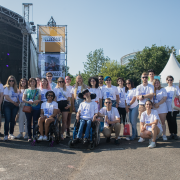
Eurodesk Brussels coordinated our delegation, while I represented Eurodesk Luxembourg.
There were 29 young people and accompanying adults, with participants from Germany,
Belgium, Spain, France, Ireland, Italy, Romania, Sweden... a great team!
We all met up in Strasbourg: some arrived together, others alone, but on Thursday June 8,
2023 we were all there! The next morning, the alarm went off early for the whole delegation:
no time to lose!
First step: the inauguration of the EYE Village in the presence of the Mayor of Strasbourg,
Jeanne Barseghian, and Fabienne Keller, former Mayor of Strasbourg and now Member of
Parliament. After some very interesting speeches, and a question-and-answer session that
didn't shy away from touching on delicate topics like the recent scandals, our delegation split
up so that everyone could get on with the activities they had chosen.
For me, this meant going to Parliament to attend the opening session in the Hemicycle, with
President Metsola. Or trying to: unfortunately, the organisation of the security checks at the
entrance caused such a queue that I ended up missing it completely. But the feedback I got
described a very interesting speech by the President:
"[This event is] The flagship event of the European Parliament. I and my colleagues here are
extremely enthusiastic and have been looking forward to this event, where you will hold us to
account. Tell us what you like. And above all, what you don't like. [...]I invite you to take
advantage of this opportunity to talk, listen, network and learn. To meet new people. Don't
just talk to your travel companions. Don't just use the language you're most comfortable in.
The friendships you make here will stay with you forever.
My second activity was extremely interesting, and worth the long wait to get in: a discussion
on multilingualism in Europe, chaired by American linguist Erin McInercy, and Alsatian MP
Victor Vogt, who campaigns for the preservation of Alsatian! Being both Belgian and
Luxembourgish, and therefore representative of the only two countries in the European
Union with three official national languages, I couldn't miss it! The discussion was
fascinating, not only for the linguistic, sociolinguistic and neurolinguistic aspects, but also for
the political aspects of languages and their use across Europe.
Then I took part in an Escape Game organized by the ERYICA Association on information,
access to information and fake news, which was very interesting and enabled me to
exchange ideas with young people from Turkey and the Czech Republic.
After that, I wandered around the parliament and tried out various activities open to the
public, particularly in the area dedicated to languages! And did you know? Luxembourgish is not one of the 24 officially recognized languages of the European Union! In fact, at the time,
the Luxembourg government only indicated German and French as their official languages.
To end a great day on an even greater note, our delegation met up at the EYE Village to
enjoy the food trucks and open-air concerts as part of the European Emerging Bands
Contest.
The next day, we got up early to make sure we could get into Parliament in time for our
activities. My first activity of the day took place in the hemicycle, and I have to say it's an
impressive place! It's huge, and very modern, and it was fascinating to see where the MPs
work, of course, but also where the interpreters are and how the translation tools work.
Some members of the public had their own sign language interpreter with them, although the
hemicycle had screens on which the translation was live. But I assume that the parliament's
interpreter was interpreting in English sign language, which of course differs from French,
German and so on.
The conference I attended was on the social gap in Europe and the different forms it can
take. The speakers - a pleasant surprise to have a 100% female panel! - were Belgian MP
Sara Matthieu, Sabina Gylsheni, from the European Centre for Social Welfare Policy and
Research, and Rosario Ortega, representing an association promoting the inclusion of
disabled people. Overall, the conference revealed that while much progress has been made
in recent decades, much remains to be done, and the recent crises have not helped.
I then spent the rest of the day exploring the parliament and the village, and chatting with
other young people, asking them for their views on the event, their expectations, and what
they see as the biggest issues for young people. Unsurprisingly, ecology and social
inequality were the most frequently mentioned issues, followed by human rights. Mental
health and access to it was also raised as an important issue, especially after the multiple
crises of recent years. Their main aims were to learn more about parliament and how it
works, as well as the impact of the decisions it makes and the opportunities it creates for
young people.
I was also able to talk to a delegation from Luxembourg, more specifically students, from
3eme and 4eme, and their teachers, from the Lycée Hubert Clément, one of the high
schools involved in the Europroject. They’d loved the conferences and discussions, as well
as an activity revolving around European cinema and film writing. But they also admit that
they were by far the youngest participants, and that some of the topics were things they'd
never thought about before, or that didn't concern them yet. Coupled with the language
barrier - English being the language of the event - they weren't always able to follow
everything as they would have liked. However, they really enjoyed their time at the EYE, and
were keen to learn more about European opportunities... which I took the opportunity to tell
them about Eurodesk, the Opportunity finder, but also about European volunteering with the
European Solidarity Corps!
All in all, I really enjoyed my stay in Strasbourg and my participation in EYE. I arrived without
knowing exactly what to expect, and I came away with a lot of information but, above all, a
lot of contacts, a lot of new encounters. And that, I think, is the strength of events like this: to
enable young people from all horizons to meet, exchange ideas and prepare to build the
future of Europe together.
Updated on Tisdag, 17/02/2026