

Good mental health needs community support, and refugeeism is not the only thing refugees have something to say about
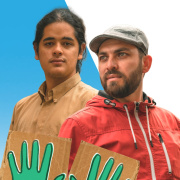
Arman and Aimal, FinlandPeople often think that everything a refugee does is about being a refugee. But I can also know something about Finnish people’s problems, and in fact, I sometimes see them more clearly as an outsider.
Arman and Aimal were confused to observe the anxiety felt by people living in ‘the happiest country in the world’. Now their observation is being turned into a documentary film that got off the ground thanks to Solidary Corps project funding. Arman and Aimal reflect on how the lack of communality impacts on wellbeing, and on the obstacles that hamper refugees’ or immigrants’ involvement and participation.
The idea of a documentary expanded beyond the Solidarity Project and is already generating new ideas for peer support
Armani and Aimal had an idea for a documentary film about mental health problems in Finnish society which stems from an everyday observation.
They had carried out background research and talked to experts, they had the required training and skills for directing and filming, and they had spent several years getting the filming equipment together. Because of their studies and work, however, it was difficult to find time for the project.
“Then a Finnish film producer told us about the Solidarity Projects and said that although they had never funded a film project before, it was worth a try. We did receive funding, and the Solidarity Project gave us the energy to really launch the project”, Aimal recalls.
At first, they were planning to produce the documentary independently, only relying on the Solidarity Project funding. However, film producers advised them and said that taking more time and a more professional approach would be worthwhile if they wanted the documentary to reach the audience.
Some of their acquaintances, producers and production companies are currently interested in the documentary, but the first task is to find the rest of the characters from different parts of Finland. This is where some luck will be needed, as the topic is sensitive and requires networking, and the pandemic makes finding such people even more difficult. The film-makers have also had to take trouble in order to remain loyal to themselves as the process goes on.
“We have talked to many documentarists and producers, and all of them – each and every one – has suggested that we should have more refugees in our film. I have said from the outset that I do not want to make a film about the mental health problems of refugees. I have not experienced them, but I have experienced the mental health problems of Finns. People often think that everything a refugee does is about being a refugee. I do not agree. I do not want to be a refugee filmmaker. I just want to be a filmmaker, a person who makes films. Even so, it is more acceptable for me as a refugee talk about refugees’ problems. However, it is also possible for me to have knowledge about Finnish people’s problems. In fact, I can know more about them because I look at them from the outside”, Arman emphasises.
After coming a long way themselves, Arman and Aimal have started considering ways of making their skills, knowledge, networks and tools available for others interested in filmmaking to use and borrow. Not everyone has the same opportunities.
Arman and Aimal are also concerned in a more broad sense over how obstacles related to language skills, cultural differences, networks and resources affect immigrants’ and refugees’ possibilities to influence societal issues.
“When I came to Finland almost eight years ago, I was experienced and really wanted to change things, but there did not seem to be many opportunities for that. The language was one of the biggest challenges, and also people’s narrow way of thinking”, Aimal describes his experience.
Cultural focus on individuality may expose Finns to mental health problems
The fifth European Youth Goal is about Mental health and wellbeing: recognising them as an important theme and problem for young people, a need for better services, and fighting the stigma about mental health issues.
Arman and Aimal’s idea for the documentary also originated from an observation related to young people’s mental health – especially in Finland.
"It all started when I listened to Finns talking about their ordinary life. At some point I noticed that many of my friends suffered from anxiety. Some could not leave their homes for several days or weeks because they were so anxious. It was new to me, I had not experienced anything like that in my home country, Iran, where I lived for a short time. Then Finland was selected as the happiest country in the world. I think this is an interesting contrast”, says Arman.
Arman and Aimal hope to use their documentary to draw attention to this phenomenon and raise questions. As artists, they find that this role comes more naturally to them than proposing solutions directly.
“Personally, I think that this phenomenon could be caused by the focus on individuality and the fact that there are no communities in Finnish society. There are individuals and society, but nothing in between. If you think about Iran and Afghanistan, for instance, religion creates communities in these countries. Feeling that you belong to something makes it easier to face the difficulties of life. On the other hand, such issues as environmental problems have a negative effect on young people’s mental health, in particular”, Arman analyses.
Arman and Aimal think it is comforting that young people are not afraid to talk about mental health. It is not a taboo. On the other hand, they worry because people talk about it and agree, but that is all.
“Individualism is a tricky thing. We can't just say that you should get a community together. Different parties need to react and have access to support, we need public awareness, the media – perhaps a few films about this subject”, Aimal smiles knowingly.
Updated on