

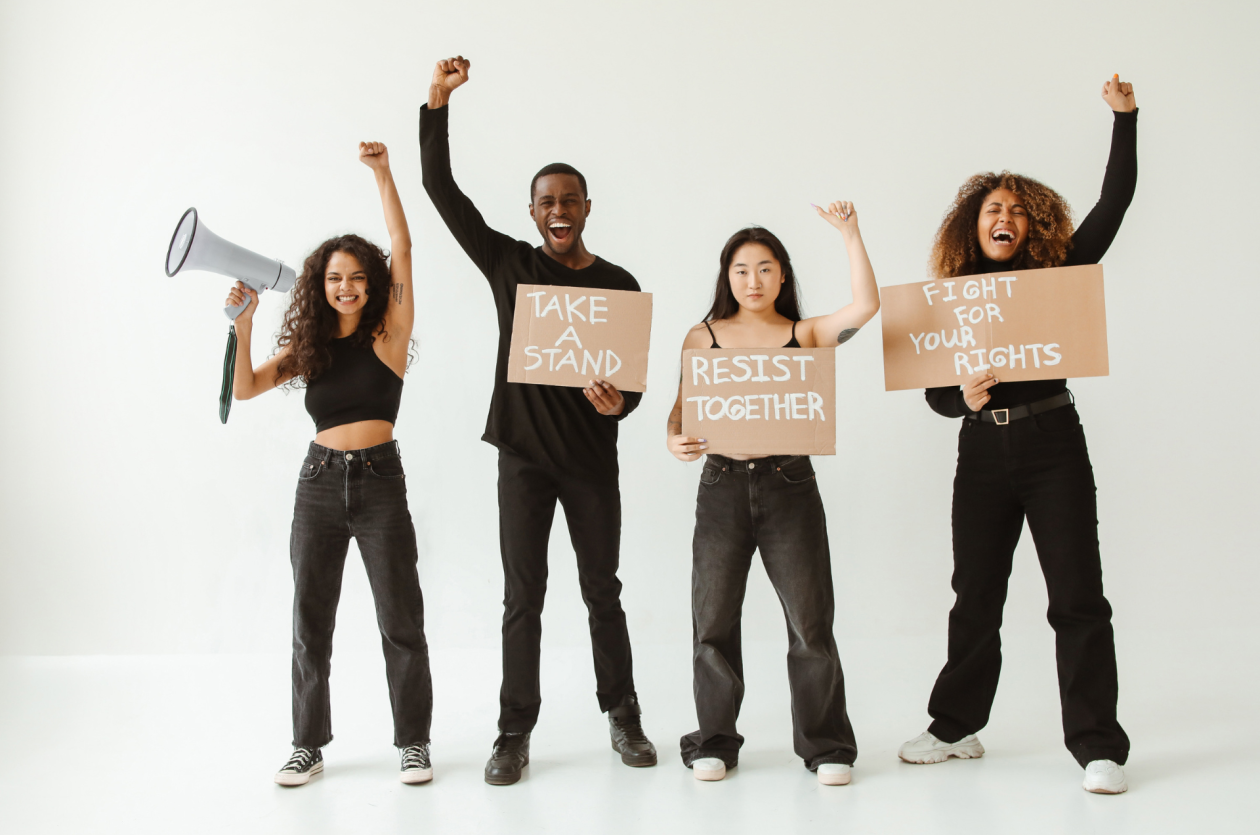
 © Polina Tankilevich from Getty Images/CANVA
What do young people gain from being active citizens?
Zadnja sprememba Sreda, 22/10/2025
Have you ever noticed an issue being overlooked in your local community? Perhaps you've felt a lack of support for a specific cause, or you've had a gut feeling that not enough is being done to promote solidarity. This sense of dissatisfaction or injustice can ignite a desire for change.
Have you ever noticed an issue being overlooked in your local community? Perhaps you've felt a lack of support for a specific cause, or you've had a gut feeling that not enough is being done to promote solidarity. This sense of dissatisfaction or injustice can ignite a desire for change.
It usually only takes one person to create this domino effect, and today, young people are at the forefront of various causes, such as asking for social justice, climate action, and for their voices to be heard in public debates. Young activists, as discussed in the Youth Forum's "Activism Inside Out" guide to activism, are primarily motivated by a desire to tackle inequality and create a more equitable society.
Youth active participation is supported by international institutions such as the Council of Europe, which promotes the participation of young people in decision-making in local and regional life in its Revised European Charter on the Participation of Young People in Local and Regional Life.
The European Union also actively supports and encourages young people to become active citizens. Through various policies and programmes, you can take your first step to get involved! Thanks to these programmes, young people can turn their ideas into action. They can also learn, grow their professional networks and improve their employability skills.
Initiatives such as DiscoverEU, Erasmus+, the European Solidarity Corps, and the Pool of Young Journalists in Europe have been proven to positively impact the young people who have participated.
Here’s what some young people have to say about how different EU programmes contributed to their active citizenship:
Erasmus+ Youth Participation Activities
Erasmus+ activities give young people a chance to meet other young people across the EU, gain new experiences and explore new cultures.
Hana Živko, attended a seminar called Green Youth Work, where she participated in workshops on sustainability, such as upcycling and addressing digital waste. She gained practical tools for her future role as a teacher by learning about green practices, networking with other European youth workers, and even appearing on national television to discuss about her experience.
“I took part in the Erasmus+ seminar Green Youth Work in Rijeka, and here’s what I’m bringing home – a full heart, new knowledge, and a backpack full of 'pljukanci" memories!”
European Solidarity Corps
The European Solidarity Corps offers hands-on experience in meaningful social projects whilst developing professional skills. Ana, who worked as a seabird conservation assistant with BirdLife Malta. Through her conservation work, she combined environmental activism with community engagement, showing firsthand how active citizenship involves both practical action and collaboration with a wide range of people.
"I would recommend the Solidarity Corps program to anyone looking for a hands-on opportunity to grow professionally while working on meaningful projects and connecting with diverse people."
Pool of Young Journalists:
The Pool of Young Journalists in Europe is an EU initiative supported by Eurodesk and co-funded by the European Commission. The young journalists get the chance to publish their work on the European Youth Portal.
Efe, a member of the 2025 Pool of Young Journalists from Latvia, believes that working across different cultures has given him an understanding of cross-cultural relationships and the diversity of European people.
"The Pool of Young Journalists provided me with the seeds of journalism and an understanding of how European media works. With my colleagues, I collaborated with many valuable institutions in Belgium. This gave me a more engaging understanding of high-level communication and professional feedback for my career. Ultimately, this mechanism of active citizenship has enabled me to enhance my skills in my daily life."
What about influencing EU policies?
Young people have direct and indirect means to influence policy, starting with voting in national general elections to determine the government whose Ministers represent the country, such as in the Council of the European Union.
Recently, the European Commission introduced EU Youth Tests to guarantee that the interests of young people are taken into account in new EU policies and legislation. With this youth test, the EU will be able to develop policies that genuinely affect young people, while also reducing inequalities and addressing the needs of both current and future generations of all young people.
Moreover, voting in European Parliament elections directly shapes the Parliament's position on legislation and helps determine the European Commission President.
Furthermore, young people can directly take part in online public consultations, joining citizens' dialogues with high-level officials, or supporting/launching a European Citizens' Initiative (ECI), which allows citizens to ask the Commission to propose new laws.
Finally, influencing decision-makers is possible through youth projects, petitions, and other grassroots initiatives. A great example of this is the EU Youth Dialogue, a mechanism between young people and decision makers taking place in the framework of the EU Youth Strategy. It ensures that the views of young people and youth organisations are taken into account when defining EU youth policies.
Through various EU initiatives and programmes, young people have the opportunity to engage in active citizenship. Through skills such as leadership, intercultural understanding, and critical thinking, they are using their voice to tackle social issues.
Being active is also good for you
Through activism, young people develop leadership, communication and problem-solving skills. Research done by DCU Professor Niamh Gaynor showed that active citizenship enhances critical thinking skills whilst also simultaneously enhancing this sense of belonging with communities.
Want to learn more about European active citizenship and participation?
Check the Eurodesk’s Euro-Participation brochure. It provides all the necessary information on how young people can get started when it comes to participating and active citizenship. You can also have a look at the European Youth Forum's "Activism Inside Out" guide!
Written by Eurodesk Brussels Link