

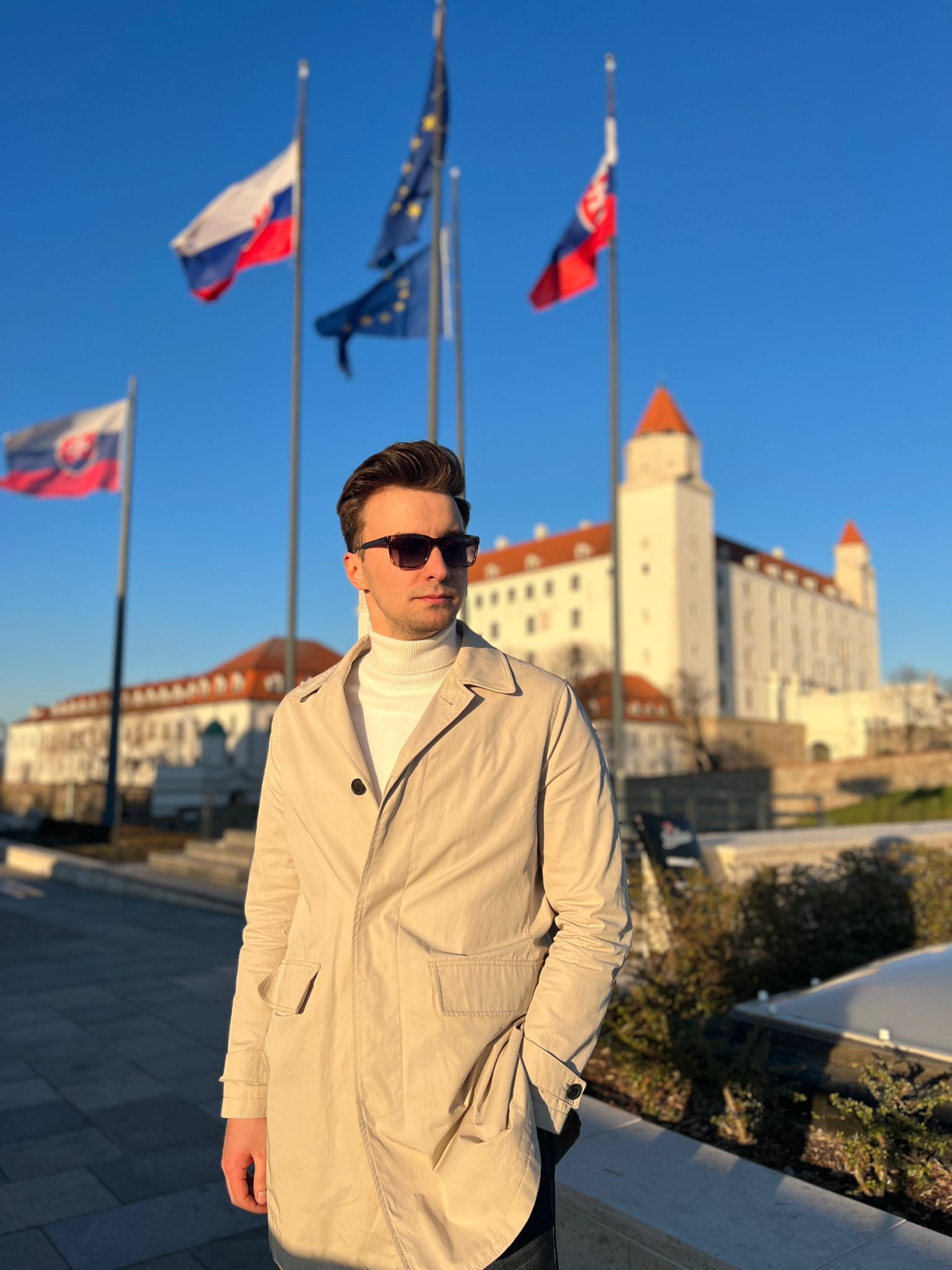
 © Oliver Čechmánek
From protest to exile: a Belarusian student's fight for democracy
poslední aktualizace pátek, 12/09/2025
What drives a young man to leave his country behind? Daniil Kayun, a 24-year-old Belarusian student now in Slovakia, reflects on activism, fear, and the fight for democracy.
Daniil is 24 years old, a student of financial management, and a quiet but determined activist. Born in Belarus, he now lives in Bratislava. His life changed drastically after the 2020 presidential elections in Belarus, and so did his understanding of freedom. We met during a youth project in Armenia, where he told me about his path from organising student protests in Minsk to fleeing his country. His story is one of fear, courage and persistence.
Oliver: Can you tell us how you got to Slovakia and what your first impressions were?
Daniil: I moved from Belarus in November 2020 because the political situation there was very difficult. First, I went to Ukraine. Then I applied to study at Comenius University in Bratislava, and I got accepted. I started learning Slovak and began my studies. I arrived in May 2021, and on my very first evening I went up to Bratislava Castle. The view impressed me – the city looked beautiful and peaceful. I liked that a lot. I feel calm and free here.
What was it like growing up in Belarus? Did you feel that your freedoms were limited?
Daniil: I was born in 2001, and Lukashenko had already been in power since 1994. When I got older, I started learning more about history and realised how he slowly took more power, especially through the controversial referendums in 1996 and 2004.
But the awareness started earlier. At school, I saw the same portrait of the “moustached old man” – Lukashenko – on the wall every day, alongside the red and green state flag. From history lessons, I knew that our real national flag and coat of arms looked completely different. That’s when I started to feel that we were being taught the wrong things and that the truth was being hidden from us.
How did your peers and teachers react to these ideas?
Daniil: Teachers and staff mostly supported the regime, especially since our schools and universities are all state-run. But often it was not because they believed in it – they were afraid of losing their jobs. There was no real choice. Students, especially my close friends, were more independent. They supported democratic values. In fact, I moved to Slovakia with two of my best friends who believed in the same things: democracy, freedom and Europe.
We’ve known each other since primary school, trained together in a swimming sports group, and later studied Marketing at university. After the elections, we organised student protests together and eventually emigrated from Belarus. Now they’re studying at Comenius University and working here in Slovakia.
How did you first get involved in political activism?
Daniil: I was inspired by my first protest in 2018, on the 100th anniversary of the Belarusian National Republic. That protest was officially approved by the authorities, so there was no immediate threat of violent repression. There, I saw many people who shared my views – who believed that Belarus should follow a European, democratic path. It was a powerful moment. I realised I wasn’t alone.
In 2020, before the presidential elections, I joined the initiative group for opposition candidate Viktar Babaryka. I helped collect signatures to support his candidacy. At that time, he was seen as the favourite – someone who could really win in the second round. But then he was arrested on fake charges. Around the same time, another major opposition figure, Siarhei Tsikhanouski, was arrested too. His wife, Sviatlana Tsikhanouskaya, stepped in and became the main opposition candidate. (Siarhei was recently released from prison after more than four years.)
Can you describe a protest or action you helped organise?
Daniil: The first action I helped organise was a student strike at my faculty, where I was studying Marketing and Management at the Belarusian National Technical University. Together with my friends, we created a Telegram channel for our faculty to share news and information about protests. It eventually grew to over 600 subscribers, even though our whole faculty had only around 450 students.
We started with actions on campus and later organised a student march on the main avenue in Minsk. That protest lasted only about ten minutes. OMON, the riot police, arrived quickly and arrested around 70 people. All of them were sentenced to 15 days in prison. I was lucky that day – I knew the streets well and could run fast.
Were you ever afraid you’d be arrested yourself?
Daniil: Yes, absolutely. That fear was always there. Especially on 9 and 10 August 2020 – those were two unforgettable nights of street resistance. Pushkinskaya Street and the Stella monument became central protest sites. There were barricades, riot police, soldiers, and smoke grenades. We all knew that if we got caught, it meant at least 15 days in prison.
But the scariest moment happened at home. One night, someone tried to break into my apartment. According to my parents, it was the police. Luckily, I wasn’t home – I was at my girlfriend’s place. The next morning, I packed my things and took the first bus to Kyiv. That same night, ten of my friends – including those from the student strike group – were arrested. Some were sentenced to up to two and a half years in prison. If I hadn’t left, I’m sure I’d be in prison too.
You mentioned the Stella monument. Could you tell us more about its significance?
Daniil: The Stella is the “Minsk – Hero City” monument, located almost in the very centre of Minsk. It was the site of the bloodiest clashes on the first night of barricades, 9 August. And exactly a week later, on 16 August 2020, it became the location of the largest protest in Belarusian history.
According to independent estimates, between 200,000 and 300,000 protesters took to the streets of Minsk. I remember that day vividly – there were beautiful people dressed in white, holding flowers, and there were so many of them that as we walked down Independence Avenue, I couldn't see the end of the crowd. At that moment, it felt like there were no pro-regime security forces or riot police in the entire city. I believe that on that day, we truly had a chance to make a revolution happen.
What was the hardest part of being an activist in Belarus?
Daniil: You always feel like terrible things are happening – in politics, education, the army, foreign policy. And then there's the constant fear of being arrested. You need a strong inner motivation to keep going.
How do you view the political situation in Belarus today?
Daniil: It’s terrible. There are more than a thousand political prisoners. The country is basically occupied by Russia. On 24 February 2022, when Russia began its full-scale invasion of Ukraine, they even used Belarusian territory. That was one of the most shameful decisions by Lukashenko’s regime. Belarus is no longer just a dictatorship – it’s now complicit in international crimes.
How do you compare politics in Slovakia to Belarus?
Daniil: Slovakia is a democracy, like most European countries – thank God. People here can protest, organise, vote. If something doesn’t work, you can change it through fair elections. In Belarus, we don’t have that. Elections there are fake.
Do you see any warning signs or similarities between Slovakia and Belarus?
Daniil: The only thing that worried me was when the Slovak Prime Minister visited Moscow on Victory Day. But he came back, and here, you still have a real opposition and fair elections. That makes all the difference.
Have you participated in any protests in Slovakia?
Daniil: Yes, once, at the very first protest in support of Ukraine, on 24 February 2022. I couldn’t stay aside.
What advice would you give to young people protesting in Europe?
Daniil: Never think you’re too small to make a difference. One person can start a wave of change. You need tough skin, and never give up. Always, never give up.
What do you think people in Western Europe don’t understand about living under authoritarian regimes?
Daniil: Life under a dictatorship is completely different. You’re always scared. People in Belarus are afraid to even like a political post online. If you do – if you like or share something from an opposition source – you can be arrested and sentenced to two weeks in prison. That’s the reality.
What keeps you hopeful for the future?
Daniil: I’ve always believed that dictatorships get weak over time. Sooner or later, they all fall. It happened in Chile with Pinochet, in Romania with Ceaușescu, and in other places too. I believe it will happen in Belarus and Russia as well. Guys like that never end well.
© Oliver Čechmánek
Young Journalists in Europe - Meet the author
Oliver Čechmánek
My most impactful experiences include volunteering at a scout festival in North Macedonia and assisting at the Ukrainian border shortly after the invasion.
This article reflects the views of the authors only. The European Commission and Eurodesk cannot be held responsible for it.