 © Iris Trehin, 2023
What is worth remembering from a Media and Information Literacy lab in Tallinn?
L-aħħar aġġornament sar fi L-Erbgħa, 02/08/2023
An Erasmus-funded project is always a great opportunity to network with well-minded individuals, youth workers and youth representatives, and of course, a fabulous occasion to share knowledge on various topics. Well, that’s what we did as young journalists! However, what we loved the most was the chance to attend some nicely organised workshops and received several tips on media literacy.
Do people have great ideas to share about Media and Information Literacy (MIL)?
The short answer (happily) is yes!
Going to this MIL lab organised by SALTO-YOUTH as young journalists, we met ambitious people, willing to contribute to a better world through the implementation of projects on this field.
Individuals and youth workers from all around Europe and its neighbouring countries teamed-up and presented a potential project on tackling misinformation, Another group, consisting of NGOs’ representatives, came up with a series of workshops which aim was to make young people engage in democratic processes and civil society. All in all, most of the ideas presented seemed to be great and well-structured!
The significant debate should focus on enhancing the European Union's ability to further facilitate the implementation of such initiatives.
Most of the individuals who participate in these projects live in different countries and time zones, having full-time jobs, something that potentially hinders the implementation of any prospective project.
Nevertheless, meeting literacy professionals from all around Europe was the best way to broaden our horizons when it comes to accessing information. In that context, networking has the potential to serve as a facilitator in addressing the issue of information disorder.
A walk through the workshops
In this 3-day training session, we had the opportunity to attend some interesting workshops delivered by great communicators. In the next few lines, we unfolded our two favourite ones, based on the fact that we think they were the ones with the most valuable information to share.
Making memes workshop
Michele Di Paola, a youth trainer and a non-formal education expert delivered an enjoyable presentation on “Making memes.” Here is what we consider a ‘must-know’:
1. Did you know that a meme, which is considered a cultural unit of information transmitted through imitation, was coined by British evolutionary biologist Richard Dawkins in 1976 in his book "The Selfish Gene?" The term "meme" originates from the Greek word "mimema", meaning "imitated".
2. Nowadays memes are a way to refer to someone’s common sense. They are usually associated with our feelings such as the joy of achieving a specific goal, the revenge feeling, our negative or positive attitude (like/dislike) towards an idea, etc.
An example:
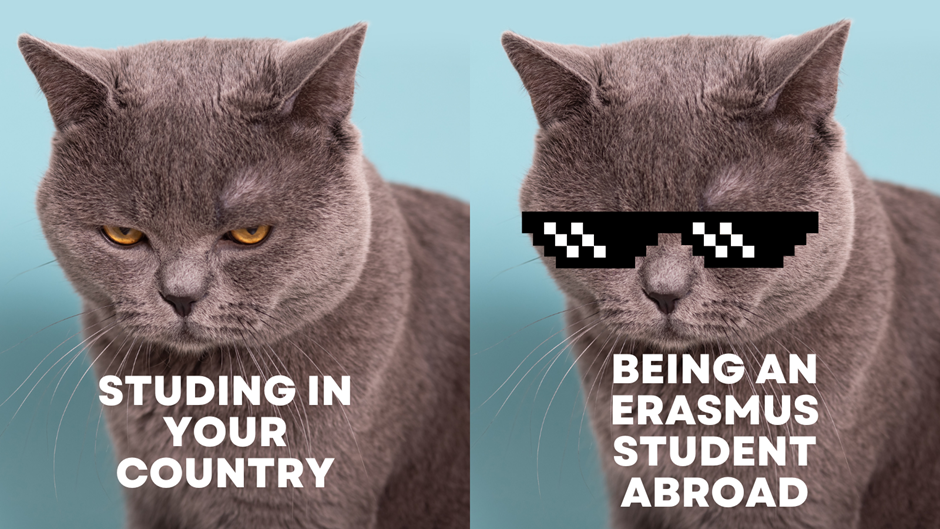
3. Memes can also be used to impose their own “common sense.”…..and this might be harmful or unethical sometimes.
An example:

The memes were created and modified in Canva.com which is a copyright-free platform.
Surely, memes are a great way of communication. However, context, content and ethics matter, and we should take them into account before publishing a meme.
Information disorder workshop – from strategic lies to human errors
Maria Murumaa-Mengel is a media researcher and educator who delivered an insightful presentation on information disorder. Here is what we consider a ‘must-know’:
1. People tend to confuse misinformation, disinformation and malinformation. Misinformation refers to unintentional mistakes such as inaccurate photos whereas disinformation refers to misleading content designed to manipulate, harm, or influence individuals with false information. On the other hand, malinformation refers to a truth that is presented in a way that causes potential harm.
Maria Murumaa-Mengel suggests that we should refrain from using the term ‘fake news’ because the phrase itself implies that news can be inherently false, which is not accurate. To put it differently, she argues that news, by its nature, cannot be fake.
2. Fact-checking is a must for tackling information disorder. Thus, when it comes to fact-checking, do not forget to implement at least a couple of the following tips:
a. Is it fact-checkable? Or is it someone’s opinion?
b. Change the platform, don’t just stick to YouTube, TikTok, or only one website.
c. Is there something in the news about it? Local, national, regional, global?
d. Is it a hoax? In such cases, you can use tools like Google fact check toolbox, Snopes.com, Poynter.org, Factcheck.org.
To sum up, the project lab in Tallinn was a great learning experience which equipped us with a strong knowledge of MIL and its associated concerns.
Listen to what some of the project’s stakeholders have to say about the event!
_______________
Meet the authors
Iris Tréhin
Currently working as a freelance journalist for TV in France. I am very versatile: I can write, film, take pictures, edit (both video and sound) and voice-over. Social and cultural subjects are my favourites: feminism, societal issues, documentaries, TV series... I am an adventurous person. I travel as much as possible, always trying to think out of the box and step outside my comfort zone. In two years, I have planned to drive around the world and produce video portraits of inspiring people.
Yiannos Christoforou
Hi, I’m Yiannos and I’m from Cyprus. Currently, I’m a communication trainee at the European Monitoring Centre for Drugs and Drugs Addiction.
As someone who loves marketing, I enjoy dealing with data. In my opinion, writing is the form of an act that demonstrates your ability to illustrate data and create meaningful stories. This is what data journalism does, and that’s why it is one of my favourite forms of journalism. I am here to climb out of my comfort zone and enrich my content creation skills.
This article reflects the views of the authors only. The European Commission cannot be held responsible for it.