Fausta Sragauskaitė

Learning to Live

Fausta, Lithuania

I have learned to distinguish work from my leisure time and relax.

When I was 14 it was my first time hearing about youth opportunities and such thing as a gap year. It was usual in my family that after high school graduation everybody goes to university. However, I declared to my parents that I will take a gap year and will go volunteer with the European Solidarity Corps (EVS still at that moment). In addition, I wanted to learn French.


My both dreams became true when I got accepted for a volunteering project in Youth and Culture house in Graulhet, France. The beginning was difficult: without any French language knowledge I could not express myself and I was dreaming even nightmares about that. Also, there were loads of problems with WiFi at our house. However, it was a good motivation to put loads of effort into language learning. And without the Internet connection I could spend more time with myself, therefore I understood that I want to study psychology, not sociology.


All of this happened during the first month and nine more were waiting ahead! I had an opportunity to get to know nice and smart children coming from difficult life situations, influence and help peers to go and experience life with ESC, implement my own ideas and work together with other ESC volunteers. But most importantly I have learned to distinguish work from my leisure time and relax. As I was living with another volunteer from Germany, together we traveled, cooked, watched myriads of movies, and learned from each other how to live. It is very delightful to mature together with like-minded people. All in all, thanks to the opportunity provided by ESC I have put a strong foundation of ‘adulthood’ skills for myself and made 2020 memorable!

Updated on Tuesday, 17/02/2026

EU is coming

„EU is coming“ - my Erasmus+ Youth Exchange experience

Nera, Croatia

In other words, besides learning more about the actual topic of the exchange, I learned a lot more about myself.

At the time I decided to participate in my first Youth Exchange, I was writing short texts for my organization’s website and had very little knowledge about the world of Erasmus+. It was something that I remembered hearing about in high school and I knew that it included travelling.

But when it came to travelling, my Youth Exchange experience was a little bit different, since I didn't actually leave the country, but went on a car ride to Duga Resa, a town next to my own. But even though I was just 10 km away from my hometown I got to experience a week of multiculturalism and diversity.

The name of the youth exchange was „EU is coming“ and I came back home with new knowledge about the European Union, its institutions and policies and the opportunities it has to offer to young people. Being a young person myself, I found this incredibly useful since we do not have adequate education about such topics within our elementary or high school programs.

We used non-formal methods, which made this learning experience very fun: we made our own podcasts, some of which also came with very creative videos. We had a treasure hunt, a human library activity – where different people who were more experienced and knowledgeable about Erasmus+ shared their knowledge and advice with us. We also participated in a live event on the Facebook page of DrONe organization, where we held a podcast about Youth Exchanges in general, what they are, how they work and also talked about the Youth Exchange „EU is coming“, which had been taking place at the moment.

These kinds of activities that included speaking in front of a large group of people were not just a step, but an entire leap outside my comfort zone. But it was precisely those that were of most value to me in the long run. Now that I am back at college, I feel much less pressure about having to perform in front of my peers and I’m able to express my opinions and ideas more freely.

In other words, besides learning more about the actual topic of the exchange, I learned a lot more about myself. More than I expected and more than I initially realized during or right after the exchange. I got a clearer picture of what I'm good at and which areas may need a little more work. I also got a new confidence and learned that I am capable of much more than my mind allows me to believe.

I would definitely recommend Youth Exchanges to anyone who wants to get to know themselves better and learn more about their interests and strong suits. I believe that travelling and being immersed in different cultures, living with a group of people from different countries for a week or two all while discussing important issues is a very valuable experience in the development of any young person.

Updated on Tuesday, 17/02/2026

S kolegicom iz Rumunjske na "We are Europe", studeni 2013. / Privatna arhiva

How E+ activities have changed my “settings”

Ivona, Croatia

Erasmus + activities have helped me stop thinking that the things I don't have are more important than they really are and taking for granted many things I have. More precisely, I learned that I need to plan things in advance, but with the awareness that not everything will go according to my plans.

Staying in a foreign country for a long period of time and/or with people you don't know often changes us. Nevertheless, talking about the changes that Erasmus + activities have caused in them, the participants usually challenge you with a sentence: "You have to experience it yourself!". That is why the change caused by Erasmus + in me can most easily be compared by “the change of personal settings”. I could see many things that had been on my blind side before.

Firstly, I used to take some serious things too casually and some less important things too seriously. It was difficult for me to face the fact that sometimes in my life I had only had one opportunity to talk to a person, but also that one substantial conversation could open many new opportunities for both interlocutors, an opportunity to be a positive example to someone and an opportunity to learn something new from that person. It could also open the opportunity for cooperation, some new projects and a positive impact on society. Before my first participation in the Erasmus+ activity, I had never perceived things that were not directly related to me as an area where I could take part in any changes in public policy. But activities like EU Youth Dialogue, have shown me that my opinion counts and that it can influence policymaking in the long run.

Erasmus + activities have helped me stop thinking of things I don't have to be more important than they really are and taking for granted many things I have. More precisely, I learned that I need to plan things in advance, but with the awareness that not everything will go according to my plans. Changing Plan A to B or C is for me a time of learning the most important lessons Erasmus + has given me. Time to make me aware of my real needs as a person with a disability, time to empower and seek possible solutions and time of open communication with people I know as well as with people I don't know. "Well, well, Ivona, you're a journalist, that shouldn't be a problem for you," could be said by many who know only a few "statistical" facts about me. So, we come to the overlap of two particularly important topics: prejudice and vulnerability.

The prejudice is that journalists talk a lot and without hesitation. However, many introverts who are also journalists (like me) weigh their words very well, which makes it difficult to communicate with strangers, such as communication with Erasmus + participants. Most of them don't know each other yet, and they must communicate in English, most often in groups. I'll give you one trick I use in these situations: I listen to the extroverts outvoting each other, I observe and "absorb". I only get into a conversation when I really want to say something concrete or when I am called out during a discussion in a circle of, most often, very different participants.

These circles at Erasmus+ activities always help me become aware of some of my prejudices. Then I get a chance to overcome those prejudices or… which is even better, to neutralize some false assumptions like the one I had, that the homeless are to blame for their own situation. When I heard the life story of a homeless woman at an E+ activity, I realized that homelessness, like no other seemingly unsolvable problem, is not (only) the fault of an individual, but also a reflection of the functioning of society in general. Life can become harsh overnight, so we need to have an understanding of the people we meet.

That understanding does not come without a willingness to be honest and vulnerable. If we truly provide understanding, we often go beyond the boundaries we set for ourselves, then we create the preconditions for our own vulnerability. This exact vulnerability, and not the content of the activities or the amount of interaction with the other participants, is the most important thing that I bring home from Erasmus+ activities, as a part of my personal development.

I know, "personal development" is one of those abstract terms that you're probably rolling your eyes at now. You think that I have "turned" from concrete examples into abstract concepts. But personal development is nothing more than a "cocktail" of these ingredients: pushing your own boundaries, overcoming things that hold you back in life, and doing things you wouldn't otherwise dare do.

Erasmus + activities were an ideal opportunity for me to do all that. I pushed my own boundaries when it came to food because the food in some of the countries I visited was indeed a source of surprise. I overcame accessibility restrictions, by proving to myself in various unpredictable situations on inaccessible areas that most obstacles can be coped with, and that I am more resourceful than I could have ever imagined. About doing things I would not otherwise dare to do, I learned gradually, first by not doing.

There was a part of me that I ignored because I didn’t like it, and that is reacting in conflicts. As a person who "swallows" things too often to avoid a conflict, I used to be passive in situations where I needed to express an "unpopular" opinion.

But, during one training session, an unimaginable situation happened: one of the coaches left the training. It later turned out that we had been subjected to a social experiment and that it was all staged. We, the participants, thought the coaches were really arguing and we sent messages of support to the coach who had left, but we didn’t talk about it at all with the coach who stayed. When we were told it was an experiment (and the coach came back), only one colleague had the strength and courage to express his frustration, saying he did not want to be treated like a rat. It was at that point that I realized that I didn’t have the courage to say it, because of my habit of avoiding conflicts so as not to stand out too much.

After that, I began to speak my opinion openly more often, presenting my own and respecting other people's arguments as well. Open communication has thus become an irreplaceable reminder of the fact that each person is special, and their story is important. It is the experience of other people and their insights that are different from mine, that often helps me look at something from another angle and thus get the complete picture.

To gain something like that, I had to communicate intensively with five or six participants of the Erasmus+ activity, and sometimes with the whole group, which was extremely exhausting for me as an introvert. After the activities, evening gatherings are usually organized, and the group stays together all the time. Sometimes I was very confused. Although I was filled with experiences, I was also exhausted by the fact that I did not have the opportunity to be alone for at least half an hour for several days in a row.

At Erasmus+ activities, each participant meets at least five new people. He/she shares a lot with them during the activity, although they will most likely never meet again in their life. The meaning of such gatherings is sometimes difficult for introverts to understand. Nevertheless, I once got a valuable opportunity to develop a special friendship with a person I met thanks to Erasmus+. Although we communicated in English, which was a foreign language for both of us, we became close friends and have stayed close for years. We still understand each other very well.

The Youthpass, in which we enrol the acquired skills and knowledge, has not got a record of any of this. In fact, it has, but – between the lines, because it is difficult to describe the change of personal "settings" in a few labels. My biggest victory, enjoying mobility even though I don't really like to travel, has brought me to two important goals: increasing my active listening capacity and improving my communication skills.

Active listening and talking so that you really experience the interlocutor have brought a big shift in my personal and professional development. That is why I always try to be careful with each person I communicate with, aware of the fact that Theodore Roosevelt realized a long time ago: "Nobody cares how much you know until they know how much you care."

Updated on Tuesday, 17/02/2026

Sofija i Ivana!

Solidarity for Green Dalmatia 2020 - volunteers' story

Sofija, Croatia

It is important to go and explore everything new and of course come home with a suitcase full of memories.

Ivana and Sofija are two volunteers who, through the European Solidarity Corps programme, participating in the "Solidarity for Green Dalmatia 2020" project organized by the Association for Nature, Environment and Sustainable Development Sunce. We talked to them about their experience on the project.

Introduce yourself in a few words!

IVANA: My name is Ivana and I come from Skopje, Macedonia. I'm studying to be a design engineer and I am 24 years old. I volunteer at Association Sunce.

SOFIJA: Hi, I'm Sofija. I come from Skopje, Macedonia. I am a student at the Faculty of Chemical Technology. I am always looking for something new to try so Ivana recommended this volunteer program to me.

Why did you decide to participate in the European Solidarity Corps program?

IVANA: It was simple. I needed a change in my life because of this COVID situation and some family things that happened. And then I saw an Instagram post from an organization from Skopje “Go Green”. They were looking for two volunteers in Split, Croatia and I immediately send this to Sofija and said- “Hey! Read it. It’s interesting and we can do something good!”. So, we applied and now we’re here. I’m really glad I’ve spent almost a year here in Split.

SOFIJA: It all happened during Corona time. Before the pandemic, I had a feeling I wanted to move on. I was nearing the end of my studies and had a couple of exams left. I was looking for something through UNICEF and the UN. During the summer we found some environmental cleaning actions and signed up for them. We met a lot of young people there who told us about their experiences- we were there, we did that… Somehow it all had an effect on us. And by chance, a month after that Iva found that post. I registered in just half an hour.

How does volunteering on an ESC project look like? What did you do?

IVANA: We made Christmas decorations from the material found in the house. Zero waste decorations made of plastic, flour, salt, water… After that we made an eco-calendar with eco tips for each month. For Earth Day, we made seed bombs for tomato seedlings. We organized eco cleaning actions on Ilija stream in Solin and at Pantan beach in Trogir. We went on a green trip with kids from kindergarten. We had workshops on making plant-based milk, making beeswax foils and drawing on canvas bags. And in addition to holding workshops, we participated in many as well.

SOFIJA: I was a guest on a radio show on Radio Sunce where I talked about the ESS project. Together with the association Permakultura, we participated in the action of distributing seeds. We were recently at the Green Action organization at a workshop about activism. We also participated in the “Hack for Split” hackathon and won the award for best design because we created a personal stylist page for second hand clothes and a blog that talks about how the textile industry affects the environment. And we just started with movie nights in our association that are planned for each week, Wednesdays at 6 p.m.

What did you learn about yourself?

SOFIA: I have learned that I can very easily adapt to a new environment, whether it is new company or a new place. I realized I wasn’t as brave as I thought. I was preparing to jump off a 5-meter cliff for half an hour, and that was too much preparation for just 5 meters. I discovered that I have a talent for French, that I can easily learn it through movies, songs and communication with other volunteers. I just told Iva the other day how relaxed we were here. We talked about the role of this program. The program serves to find yourself and sort out what is inside of you. To stand up for yourself and enjoy yourself. Fortunately, Iva and I did not have any problems in our association. They always gave us the opportunity to stand out. Whatever we wanted to do, they let us.

IVANA: What I can say now is that I am confident. During this year, my self-confidence has grown considerably. Before coming here, I was confident, but not as much. I talk a lot now. I never talked that much before.

How would you describe this experience? Do you have any advice for other young people?

IVANA: I would recommend that young people try volunteering projects because they will learn a lot of things, a lot of life lessons. Just go with it.

SOFIJA: Before young people apply for this program they definitely should check where they are applying, what the project is about, what the timeline is. But even if a project is offered in a village somewhere in the mountains, you have to go because the most important thing is the experience and the people you meet. They should take advantage of opportunities that are being offered now. Young people should not hesitate when it comes to something like this. They need to take advantage of their youth and advance themselves constantly. It is important to go and explore everything new and of course come home with a suitcase full of memories. That sounds like a cliché, but it really is true.

Updated on Tuesday, 17/02/2026
Skupina na razmjeni.

Move the world! - Experience from the Erasmus+ Youth Exchange

Ivan, Croatia

Yay, no more cramming of boring materials!

From July 27th till August 1st, I had the opportunity to participate in the Erasmus+ Youth Exchange in Osijek, which was organized by a Youth Group Breza. Although I had originally planned to travel abroad for the youth exchange this summer, due to certain circumstances I had decided to do my very first exchange in Osijek, and I am very glad I was able to do it in my hometown. During those six days, I hung out with young people from Romania and Spain as a part of the Erasmus+ Youth Exchange program MOVE THE WORLD!. Through that, I was able to make unforgettable memories and gain new experiences.

Yay, no more cramming of boring materials!

Considering it was my first Erasmus+ youth exchange, I had no idea how the workshops, that were in the six-day program, functioned. Even though I have participated in various projects, I had the opportunity to encounter a unique way of learning and spreading knowledge for the very first time. Every participating country organized a workshop with a specific theme. The main leaders of those thematic workshops were the young people who spread knowledge, skills and experience to the other participants. The participants from Spain organized a workshop for sustainable development, the participants from Romania held a workshop about human rights and migration, and we, the team from Croatia, talked about the subject of media literacy. The workshops were interactive and differed from the usual way of teaching that is often seen in educational institutes. There was no ‘dry’, per se, curriculum and long presentations which made it easier to cover certain social issues. Although formal education is very important, I would like to point out that informal education is as important and that young people might find it easier to learn something that way and apply it to everyday, real-life situations as well.

Youth – the bearers of great social change

Even though the participants come from different parts of Europe, it was extremely interesting to hear about different social issues of each country and to see how those young people wish to make positive changes and create an inclusive society without any form of injustice. Regardless of our differences, different backgrounds, different opportunities in life, etc., we acknowledged that we are actually equal. We all came to the youth exchange with the same goal – to change the world! Almost all of them agreed that we are the initiators of big changes in society and that older people often disregard our ideas and opinions. I can definitely say that young people want to make the world better and that, through these projects, their voices and ideas should be valued and respected. I made many friends through this exchange, whether with people of equal or different opinions as me. However, the thing that united us was the eager wish to solve social issues and leave a positive mark on the world.

“For me personally, the youth exchange was a big lesson on maturity and responsibility because it showed that young people were capable of changing the world and contributing to human rights, sustainable development, climate change etc. Even though we continuously exchanged knowledge and participated in workshops, we had absolute freedom to hang out with friends from different countries and to explore the city. Osijek was our home for a week and it taught us a lot about different cultures, human rights, media literacy, sustainable development, migration, and most importantly – friendship”, pointed out Alexandra Albert, a participant in the Erasmus+ youth exchange from Romania.

Guests, like fish, begin to smell after 3 days – Benjamin Franklin

As a part of the Erasmus+ youth exchange, I had the opportunity to participate in a three-day event U gostima where young people from different European countries, some of who were a part of different exchange programs that were simultaneously happening in Osijek, came together. Andalusian dance, Finnish dance, Romanian singing, drawing with henna, calligraphy, etc. were just some of the creative workshops that curious passers-by and youth from the exchange could participate in. I would also like to point out that young people from the exchange led various workshops for others from different exchanges and, in that unique way, taught them about their culture and the uniqueness of the country they come from. I participated in several workshops, and I would like to point out the Romanian singing and Andalusian dancing as the most interesting. I am glad they taught me many interesting things about their culture and spread their knowledge with me, as well as others. Additionally, one special workshop was a weaving workshop in which the young people created an international textile web containing motifs of their countries. That way various objects and symbols could be found on the colourful fabric that represents a specific country that participated in the three-day event, as well as the youth exchange.

“As a participant of the intercultural manifestation in Osijek, I feel it was really fun to share the culture of my country with youth from other countries and interested passers-by. It was interesting to see that people of all ages were interested in learning the typical Andalusian dance sevillanas. What I found particularly interesting was leading the dance workshop with young exchange participants from Spain. The dance might have seemed complicated at first, but all the participants of the workshop did a great job”, says Araceli Luque Lopez, a young participant of the exchange MOVE THE WORLD! from Spain.

Updated on Tuesday, 17/02/2026
Aleksandrs from Latvia

Discovering Europe through tastes

Aleksandrs, Latvia

There has always been a desire to go to Greece and fly – both desires came true at the same time.

In September 2018 I had a unique possibility to go to Greece on an Erasmus+ youth exchange project “Taste of Europe”. There has always been a desire to go to Greece and fly – both desires came true at the same time.

There, on the coast of the gulf of Corinth, in small town Xylokastro, participants from 9 Europe countries shared knowledge between each other and locals about the culture, traditions and traditional food of our countries. Such knowledge sharing is very useful because it clearly and intelligibly shows how different, but sometimes so similar our cultures can be. Most vividly I remember the second evening of presenting our countries – both events happened in Xylokastro town square so that locals and tourists also could gain insight into the national cuisines and traditions of different European countries. On the second evening we were one out of 5 countries that where presenting their countries. Ofcourse we had many different dishes and Latvian products with us and one of them were sprats in oil. One of the Italian participants, Marco, liked sprats in oil so much that we decided to gift him one can. Two days after the project Marco sent me a picture of him trying to teach his family how to eat sprats in “Latvian style”. Even bigger surprise I had when Marco found “Riga sprats” at his local market.

At the beginning some participants, including me, had troubles to start dialogue with complete strangers (other participants and local people). However by the end of the week, all participants felt more free and the communication went smoothly.

If I have to give an advice to other youngsters, then I can say only one thing – you have to take part in this kind of project (Erasmus+ youth exchange) atleast one time. And the tastier the topic the better.
 

Updated on Tuesday, 17/02/2026
Bruno from Latvia

Youth exchanges - opportunity to find new friends

Bruno, Latvia

Everyone was super friendly, you feel truly accepted all the time.

My name is Bruno and until now I have participated in 2 youth exchange projects. Both of them took place in Lithuania 2-3 years ago. I thought it was a cool opportunity, I gained new friends, learned a few words in Lithuanian language as well.
The best part of a youth exchange project, in my opinion, is that everyone is really open minded and share their life experience – also those people who are not participants, but included somehow otherwise – like pupils from local school that we visit or project’s organisers.
It was interesting to visit a local school in one of the projects. During all exchange we had to communicate in English and it was a good language workout. Everyone was super friendly, you feel truly accepted all the time and all that together was what I really liked.


Updated on Tuesday, 17/02/2026
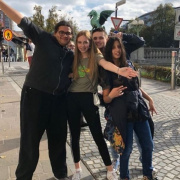
Loic in croatia

Puppet theater in Croatia

Loic, Luxembourg

I will never forget this experience and I'm thankful to anyone I met during this journey.

In February 2021 I started my 6 months European Solidarity Corps in Petrinja, Croatia. My topic, was Education through Puppetry.

The main focus of my voluntary activity was to create puppets with items that you could find at home, publish puppet making tutorials on the YouTube channel of my HOSTING NGO, UDRIGA IKS and perform a theater play with Muppets puppets in front of an audience of kids.

Other tasks were, for example, writing various articles about the life in Petrinja, and the life as a volunteer in Croatia, organize and hold arts and crafts ateliers for kids in container villages, do activities, like cooking and swimming, with blind elderly people, and anything that could help my association and their partners.

Before applying for an ESC didn't know which association was going to pick me or what country I was going to go but I'm grateful I was a volunteer for UDRuGA IKS, in Petrinja, Croatia.

Those 6 months were a wonderful experience. Mainly because of my supervisors at IKS, my Croatian roommate who was also a long term volunteer at IKS, the other long term and short term volunteers I met and became friends with.

My advice, to anyone who wants to do an EVS, is, you should. In my opinion its a great way to step out of your comfort zone but still learn and grow as a person. Especially because you will have people on your side who will take their time to get to know you and work with you.

I will never forget this experience and I'm thankful to anyone I met during this journey.

Updated on Tuesday, 17/02/2026

Roos

From capital to capital, but in nature!

Roos, Netherlands

I used to live in Amsterdam for 7 years, so living in Finland definitely made me realize again how much I enjoy nature. There is so much space here! Even living in Helsinki sometimes feels like being on holiday.

My name is Roos and late 2020, I moved to Helsinki for my European Voluntary project. I work for a ngo as a program assistant, with my role being to help volunteers coming to Finland and going abroad! It’s very interesting and nice. An office job mostly, but with different kinds of tasks still: from answering questions and helping with getting a visa to organizing trainings and helping with communication tasks.

When looking for a volunteering project, I mostly searched for projects in the north. Simply because I’m a big fan of the winter! During my first month here I already saw the northern lights dancing in the sky and the first winter really was a proper winter, frozen sea included! There weren’t just people walking on it, but also playing ice hockey, cross country skiing and biking.

Next to spending time in another country and getting to enjoy winter as much as I get here in Finland, a great thing about volunteering through the European Solidarity Corps is the fact that you get language lessons. Learning the local language really makes it easier to live abroad. My favorite word in Finnish? Korvapuusti! Korva means ‘ear’ and their word for a cinnamon bun therefore  literally means ‘twisted ears’. Quite funny – and really delicious.
 

Updated on Tuesday, 17/02/2026

Alicia in Slovenia

Bitten by the youth exchange bug

Alicia, Netherlands

It was very much out of my comfort zone to join a youth exchange, but overall a very fun experience. Two years later, all I want is my personally organised youth exchange to take place as soon as possible!

My name is Alicia and when I was 16, I joined a youth exchange for the first time. We had to leave from the airport in the middle of the night and it was super cold, and we were very nervous as well. It wasn’t like anything I had done before, it was way out of my comfort zone. However, I got bitten by the youth exchange bug and have been working on – and have gotten Erasmus+ Youth funding for – our own youth exchange since then.

For eight days, together with young people from Slovenia, Moldova, Cyprus, England and of course the Netherlands, we got together in Slovenia’s capital Ljubljana. We stayed in a hostel that used to be a prison, which made it a very pretty and interesting place. The exchange was called ‘From your passion to your dream job’ and we explored many diverse topics and did different kinds of workshops like cake baking, photography and writing resumés.

Together with three friends, who also were part of the youth exchange in Slovenia, we are now counting down to our own youth exchange, together with a partner from Finland. It’s been postponed because of Covid, but I can’t wait for it to finally happen!
 

Updated on Tuesday, 17/02/2026

Subscribe to