
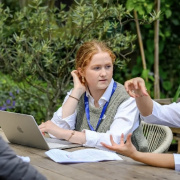
From Dublin to the Dutch Dairy Industry – My Erasmus+ Adventure
Aoife, IrelandEager to gain international experience and broaden my understanding of worldwide agriculture, I applied for an Erasmus+ Traineeship with KI Samen, the largest privately owned artificial insemination station in the Netherlands.
As a 3rd year Animal Science student at University College Dublin, I am required to complete 20 weeks of professional work experience as part of my degree. Eager to gain international experience and broaden my understanding of worldwide agriculture, I applied for an Erasmus+ Traineeship with KI Samen, the largest privately owned artificial insemination station in the Netherlands.
I spent ten weeks living and working in the Netherlands, gaining experience across many areas of the business. From laboratory work and research projects to spending time on the company’s dairy farm, I was exposed to aspects of the livestock industry that I had never encountered before. I travelled throughout the Netherlands, Belgium and Germany to visit customers’ farms, providing an insight into diverse production systems and the technology driving the industry forward.
While the professional experience was invaluable, Erasmus+ offered so much more than just work experience. Living abroad allowed me to immerse myself in a different culture, meet new people and experience a new way of life. I spent weekends exploring Dutch cities, taking part in national celebrations such as King’s Day, and cheering on the Dutch team during the World Cup! These experiences helped me grow in confidence, become more independent and create memories that will stay with me for years to come.
However, it wasn’t all smooth sailing! Moving away from home alone and adapting to a full-time role in a busy work environment definitely challenged me. One of the biggest adjustments was transitioning from the flexibility and freedom of student life to a structured work routine. In the end, this became one of the most beneficial parts of the placement, helping me develop responsibility, professionalism and strong time-management skills. I was also pleasantly surprised by how easy it was to settle in, thanks to the friendliness of the people I met and the fact that almost everyone spoke excellent English.
Looking back, Erasmus+ has been one of the most rewarding experiences of my university journey so far. It broadened my perspective, strengthened my confidence and allowed me to view my field of study through an international lens. Most importantly, it showed me the value of stepping outside my comfort zone and embracing new opportunities.
My advice to anyone considering an Erasmus+ experience is simple: just go for it even if you don’t feel ready. Feel the fear and do it anyway. No matter where your interests lie, the experiences you gain through Erasmus+ will teach you far more than any classroom!
Updated on Friday, 17/07/2026