

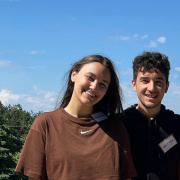
Joseph and friend

Joseph's wild adventure with DiscoverEU

Joseph, Denmark, Age 18

"It was something that I had always dreamt about."

The planning started immediately when I got this amazing opportunity to go on a Interrail-experience through DiscoverEU. It was something that I had always dreamt about. 


I started my journey in Greece where I met up with one of my good friends. From there on we went to Sofia in Bulgaria. 


It was two unforgettable weeks filled with spontaneity and unforeseen experiences. One of the things that I remember the best is all of the times when we took a nap or slept a whole night on the train - such as on our 17-hour long train ride through Romania. 


To fall asleep to the sound of wheels on rails, in a rumbling train compartment, is almost like getting tucked to bed like a child. To then wake up in a new country, or a new city and feeling like the day is just like a fairytale in a dream, which ends and begins when you fall asleep on the next train. 


A journey from Sofia and Bucharest's Orthodox churches to the great rivers of Budapest and Prague, ending with museums and food experiences in Berlin. A wild adventure. 


Updated on Tuesday, 17/02/2026

Marieke in Austria

Volunteering at a care farm in the Austrian Alps

Marieke, Netherlands

I did not hear cars in the morning, but donkeys!

I wanted to go abroad to learn a new language after my education for teaching assistant. My grandmother is from Austria, so the choice was easy. Through the European Solidarity Corps, I found a European Volunteer Project that allowed me to gain experience in care and welfare in a new area of work for me; with mentally disabled adults.

The project allowed me to work a lot outdoors and with people. That sounded perfect to me! I also followed a German language course through the European Solidarity Corps and many expenses were reimbursed. Besides lunch and dinner, we got accommodation, travel expenses, insurance and pocket money.

I found it very exciting in the beginning, because I could not yet speak German very well and hardly anyone there spoke English. This was quite tiring with all the new impressions, but it was more than worth it. I enjoyed nature and space, because the farm is beautifully situated in the Alps. I did not hear cars in the morning, but donkeys!

My German got better and better and I can now get by well in that language. The work itself was also very nice. I came to work in the kitchen and in the café. Outside of work, I also learnt a lot. I am more independent now, because I was living on my own for the first time. You learn to solve your own problems if something goes wrong. 

I also made international friends. I lived with three other volunteers: a boy from Scotland, two girls from Spain and one from Germany. We took trips together, including to Vienna, and we went snowboarding, climbing and hiking. How I miss that now that I'm back in the Netherlands! Now I work as a teaching assistant in the Netherlands. I'm having a great time and am saving up to travel again. It's so cool to get to know people from other backgrounds.

Updated on Tuesday, 17/02/2026

Pleun organizing a youth exchange

Organising your own youth exchange

Pleun, Netherlands, Age 25

People across borders might as well be your friends as your neighbour

This exchange stemmed from six places in Europe with the same city name (Linden) in the Netherlands, Belgium, Austria, France, Spain and Germany. Ten young people from each country came to the Netherlands. I wanted to help with the organisation to do something in return for the countries that had made it such a beautiful experience for me in the past.

Because of the war in Ukraine, it became clear how important it is to have connections across borders. Therefore, the theme of the exchange became: together we are stronger, develop for Europe. One thing was certain: we will speak English. That is quite a step for someone aged 15, but one language ensures that everyone is equal. We wanted to create a group feeling and show that we can work together, whatever your nationality. People across borders can be your friends just as much as your neighbour.

The organisation consisted of ten young people. In the beginning, we didn't know what everyone’s strengths and weaknesses were, so we discovered it together. We made the programme together, a budget, wrote the funding application and arranged practical matters. We knew it was a lot of work, but in the end we thought it was super cool that we were given the responsibility and freedom to put something like this together.

All activities had a link to working together and to Europe. It was extraordinary to see that everyone approached the activities differently! Afterwards, we heard from the participants that they felt like one group and got to know another side of themselves. What I also really liked was that the participants were really a reflection of society. Yet everyone was equal. There were girls who liked each other and no one had any judgment on that. I thought that was so cool, because that really isn't possible everywhere.

I really enjoyed organising a youth exchange. It gave me a lot of satisfaction and self-confidence that things just work out!

Updated on Tuesday, 17/02/2026

Melati styding in Barcelona

Studying in Barcelona for half a year

Melati, Netherlands, Age 25

I got a certain feeling about that city and thought: this is where I am going to live.

During my bachelor, I went to Birmingham, England, for a semester. That was really cool and I had learnt so much from that, I wanted to do something like that again. I love Spain and during a holiday in Barcelona I got a certain feeling about that city. I thought: this is where I'm going to live.

During an introductory day, I immediately met other people. Many events and trips were organised for foreign students, but I mainly met the Spaniards from my master's programme. We often made field trips in the mountains for the study, spending a whole day together, so we got a bond that way.

I got to know different Spanish cultures, as I had friends from the Basque Country, Catalonia and Rioja and they each had their own customs. The way of living in Spain is wonderful. I had college from 2pm and I liked that, because I'm not really a morning person.

Going back to the Netherlands was terrible! Not only did I have to say goodbye to the city, but also to my friends. When I arrived in the Netherlands in winter, I immediately wanted to go back and so I did for a weekend a few months later.

I made many friends and memories, but also got to know myself. I now know that I like change in my life and cannot stay in one place for long, that I am good at being alone and that I make friends easily. I can also speak a little Spanish now. It causes a lot of stress in the beginning, but you get so much in return. It's really worth it! It was one of the best times of my life.

Updated on Tuesday, 17/02/2026

© Martin B.

ESC in Armenia or how I felt in love with the country

Martin, France

I feel incredibly lucky to have been able to dive into this culture so unique, at the crossroads between Europe and Asia.

A few years ago, I developed a passion for foreign languages that changed the course of my life. Before then, I had never really felt the need to leave my comfort zone or explore the world but all of a sudden, all I could think about was travelling abroad, discovering new cultures and practicing new languages. To the astonishment of my relatives, I turned my thoughts into actions and, thanks to exchange programs and internships, I left France to work and study in various countries. And I liked it. After I graduated, I started looking for new opportunities and that was when I first heard of the ESC programme from a friend. I started scrolling through the projects on the European Youth Portal. I had no specific destination in mind. I would either practice a language or learn a new one, so it didn’t really matter. The most important thing for me was to find a project that matched my personality and skills. One day, I came across a post from KASA, an organisation aiming at promoting the French language in Armenia. Curiosity instantly overwhelmed me. What could life be like in Armenia? Which alphabet do the Armenians use? What kind of landscapes can one see there? Is Armenia’s Soviet past still present? Now, I was sure. The only place I wanted to go to was Armenia. I applied without hesitation and a few weeks later, I was heading to the Caucasus region.

Once settled in Armenia, I joined KASA’s team in Yerevan. My main task was to take pictures during events. Doing so allowed me to travel through Armenia, meet various communities and understand much better Armenian society and the importance of KASA’s work. I could develop technical and artistic skills, but also work on photo editing. Simultaneously, I was teaching French to the staff through formal classes and conversation workshops. Occasionally, I was helping the team with punctual tasks: translating, proofreading, indexing, teaching English and even preparing crepes! Lastly, when I had free time at the office, I wrote a journal to talk about my experience as a volunteer, the projects in which I was involved and life in Armenia. The main purpose of this was to encourage potential new volunteers to join KASA.

Speaking of life in Armenia, there would be a lot of things I could say. First of all, I was pleasantly surprised by Yerevan’s city center, which really stands out from stereotypical Soviet cities, often depicted as bleak and ugly. On the contrary, with its numerous parks and fountains, colorful pink tuff buildings, museums and monuments, Yerevan is a very interesting, easy city to visit. Putting aside wild dogs and traffic, insecurity is quite low and the pace of life is rather slow. During my volunteering, I stayed with an Armenian family and was able to taste a wild range of traditional dishes from Armenia, but also from Georgia and Russia (how I miss my Armenian grandma’s pirojkis!). Talking with them, I discovered many aspects of Armenian culture and history (did you know that chess was a compulsory subject at school there?) and practiced Russian, still the second most important language in the country. What about Armenian people? They are very welcoming! They are very proud of their culture and they will be happy to share it with you. (Be ready to receive baskets filled with all kinds of fruits!)

And Armenian culture is extremely rich. Despite invasions and tragedies, Armenians have managed to keep alive their language, religion, traditions and identity. I feel incredibly lucky to have been able to dive into this culture so unique, at the crossroads between Europe and Asia. In only five months, I learned the basics of Armenian, tasted many Caucasian dishes, danced at an Armenian wedding, set foot in each of the 10 provinces of Armenia, met local and diaspora Armenians (but also Russians, Lebanese, Iranians, Syrians and even a French girl coming from my hometown!) and visited numerous places dear to Armenians. And interesting places in Armenia are indeed numerous! Whether you are looking for nature or culture, you will definitely get more than you bargained for! From pagan temples to monasteries so typical of the Armenian Apostolic Church, from the snowed-capped peaks of the Aragats to the green canyons in Lorri region to Lake Sevan in the East… In the end, the only thing Armenia doesn’t have is the ocean. About cultural shock, one thing that stroke me as a French person in Armenia is the local concept of time. If you plan a meeting with an Armenian, don’t be surprised if you have to wait half an hour or even a whole hour before they show up! (This is also true for professional meetings). After a while however, you get used to it.

I would say that I got used to living in Armenia pretty well. I have absolutely no regret about my decision to go there for my ESC. It was a lifetime opportunity to get to know this underrated country and its culture and I am happy I took it. I keep in touch with former colleagues, my host family and friends living in Yerevan. I keep learning Armenian and I hope that some day I will be visiting the country again!

Updated on Tuesday, 17/02/2026

Matea

To spread solidarity

Matea, Slovenia

To spread solidarity truly is to act upon your compassion, understanding and respect towards people around you, but also, to be kind, accepting and in harmony with yourself.

It was the summer of 2022, when the ending of my short-term ESC volunteering was approaching. Boiling Sicilian summer led me to the conclusion that I want to direct more of my time towards spreading ideas and acts of solidarity, so I decided to apply for long-term volunteering. I sent a couple of applications to organizations in different countries and Zavod Nefiks was among the ones who replied the fastest. Not only was the response fast, but I was also really pleased with the interview, with the information I received and with the dear faces I saw. It didn’t take me long to make a decision that I will accept a 12 month long volunteering opportunity at Nefiks.

Colors of the dusk in Trnovo, Ljubljana

Colors of the dusk in Trnovo

My volunteering experience was primarily based in the youth center Vič, in Ljubljana. There, I had a chance to work with my dear coordinator Karmen, to interact with a lot of playful, smart and ambitious Ljubljana kids and young people, to play a bunch of board games, table tennis, football, billiard, my beloved darts, to draw and express myself creatively. I was also assisting with different events and activities, mainly educational, non formal workshops considering a spectrum of topics.

Other parts of volunteering revolved around participation in activities, panels and conferences related to youth work, to the protection of environment, human and workers rights (I was extremely inspired to actively participate in the discussion about prevention of precarious working practices, in the National assembly of Slovenia 💪) and to the prevention of sexual violence. I also had a chance to participate in Nefiks’s career day workshops, where I was able to share my educational, professional and international experiences with highschool students in and around the Ljubljana area, as well as to answer the questions about international opportunities (which I find very satisfactory 😀). Being in the process of creating and facilitating the escape room about international opportunities was also a really creative, educational and enriching experience. Likewise, the creation of the board game, which will help young people get more familiar with the possibilities they have when figuring out their education and career path, was also a useful experience.

Brain teasing game, whose name I forgot

Brain teasing game, whose name I forgot

It was a really interesting and challenging adventure to conduct an interview with a Slovenian speaking young artist and to see how resourceful I can be while writing reports and articles in the Slovenian language - Slovenian language and Croatian dialect I am using in my hometown have a lot of similarities, which, for me, was not always constructive, but for sure it was stimulating and entertaining. 😀
Moreover, I am glad to say that I used an opportunity to create and facilitate an online Croatian language course - it was my first time trying to help people willing to practice and learn at least some of Croatian in a more organized manner.

Picking what was suppose to be a burger from the floor

Picking what was suppose to be a burger from the floor

Volunteering at Nefiks also enabled me to make my few years old idea come true. I did it through my personal project “Cookueendom without cookies”. Participants of the project and I were cooking vegan dishes. We were using and developing our improvisational and culinary skills while hanging out and talking about mental health, together with everyday obstacles we (and people we know) either faced or are facing. Imperfections of that project, together with precious participants, made it perfect. I got experience in planning, preparing, organizing and facilitating a day and a half long event, which was way different from organizing and leading 45, 60, 90 minutes long workshops. It really was a dream come true, thanks to which I am able to prepare something similar or bigger, but with less of old and more of new imperfections. 😁

Yes, we also baked those bagels 😉

Food prepared during Matea's volunteering experience

Volunteering at Nefiks enabled me to cooperate with two other youth work oriented NGOs in Ljubljana, as well as to join the volunteer crew on a few music festivals. Valuable part of my time in Slovenia was driving around with bicycles, visiting beautiful wonders of nature, absorbing sun rays and rain drops surrounded by picturesque seaside places, roaming the hills, mountains, forests, rivers and waterfalls. I am so grateful that I was able to spend my free days in Lucija, Piran and in the magical Soča river and to say “Goodbye” to dear Ana and Lea (thank you, girls!).

Soča river

Soča river

Obviously, connections I was able to make with other ESC volunteers from different countries, as well as with residents of Slovenia, were and still are extremely valuable. Thanks to people on the other side of those connections, I was also able to see a panoramic view of the beautiful Slovenian coast. 😃

Part of the view from the plane

Part of the view from the plane

I also had an opportunity to share my living space with dear Valeriia, Alejandra and Ash.

I dare to say that one of the most enriching things in human life is feeling and being understood, appreciated, respected and accepted the way you are, while being aware that it is only natural to go through changes. To have an opportunity to change your point of view without judgment, to broaden your perspective and grow as a person for me is equivalent to being and living in a safe space. I definitely can say that my Slovenian experience was that - space full of understanding and support. At the same time, it was a challenging space, with its obstacles and difficulties, but they are an inevitable part of most spaces known to society (and yes, those are solvable, with proper support! 😁).   

 Getting ready for b-day party in Idrija

Getting ready for b-day party in Idrija

I really have to direct my thanks to Nives, Viktorija and, again, Karmen and Martina - thank you for helping me through not so easy and challenging times. It really means a lot!

Thank you Nefiks for giving me the opportunity to get more familiar with youth work and myself; thank you for many opportunities to spend my time doing things which are valuable to me!

And for you, who are on your way to Nefiks and Slovenia - be confident, be YOURSELF, express and respect your needs, expect the unexpected of this wonderful nature and welcoming working environment and be sure - there are many opportunities for you to help around, to continue your life path after the ESC, but richer in experiences, broader in skills, competences and knowledge.

To spread solidarity truly is to act upon your compassion, understanding and respect towards people around you, but also, to be kind, accepting and in harmony with yourself.

Updated on Tuesday, 17/02/2026

Photo of Sebastián- DiscoverEU travel pass winner

Solo travelling is not such a big problem and it has many advantages which can make your life much better.

Sebastián, Slovakia, Age 18

After your journey you will become a more independent and self – confident person.

Are you afraid of solo travelling and setting off on your journey on your own? I can understand you because I had the same worries before my trip too. Now I know that it is not such a big problem and it has many advantages which can make your life much better.

The main benefit which I can see is that you can meet so many people from all around the world but mainly from all around Europe. My best advice for you guys is to book your hostel through Hostelworld app. Because of the chat there you can make appointments with other travellers . I met so many people when I went for a picnic in Paris which was organized in this group chats. Second way how to meet new people is going on #DiscoverEU meetups in different cities. Luckily, I attended 2 meetups. One in Hamburg and the second one in Bratislava. There you can meet travellers who won interrail tickets as well and they are your age. I really enjoyed meet up in Hamburg because I was there for three days, and we were learning about sustainability in the big cities. We had fun with the guys who were there. For example, we went to the most famous Penny market in Hamburg, we bought some snacks and went to the bank of the Elb river. I made good and strong relationships with people on my journey and I plan to visit them in the future.

After your journey you will become a more independent and self – confident person. Because this trip made me a more extroverted person than I was before and now I know that meeting new people is not so hard. Of course, I got better in my English because I was talking in English for 3 weeks. It has a lot of benefits which I did not mention. I found out that I can make the laundry by myself in Ghent. I know that it looks really hard to go solo travelling in Europe but after your trip you will fall in love with it like I did. For me it was the best thing which I could do as a young person and I think you should use your interrail ticket too.

Updated on Tuesday, 17/02/2026

'Europe is open to you' guide

Europe is Open to You!

Leah, Ireland, Age 25

A brilliant resource - filled with ideas and inspiration!

I came across this guide ‘Europe is open to you’ when flicking through the Eurodesk Ireland website - the title grabbed me immediately so I thought I would have a look inside. I was really delighted with all the information it contained - tips, useful websites, and links to services you can contact to help you volunteer, work, train, study, or travel in Europe. The links are dynamic so you can click on them and you are brought to the original source with further information (very useful!)

My interest at the moment is volunteering opportunities but it was great to see that there are also opportunities in education and employment - which I had no idea about! 

I can't wait to pack my bags for a new adventure across Europe!

Download here

Updated on Tuesday, 17/02/2026

Zala in front of a train during her DiscoverEU experience

My Europe trip

Zala, Slovenia

TRAVEL. Your money will return, your time won't.

I found out about DiscoverEU through a friend. We applied together, but unfortunately we were not selected. I tried again the following year and was selected. 

I thought about where I wanted to go and I knew straight away that it was Amsterdam. As it is quite far from Slovenia, I looked for other cities closer to Slovenia, but the desire was too strong not to visit it. I was supposed to go with my sister, but unfortunately she couldn't come with me, so I took the courage to go on my own. I made a travel plan. 

In one week I visited Amsterdam, Prague and Vienna. I would have loved to go somewhere else, but unfortunately I did not have enough time. It was really interesting to travel by train, meeting new people from all over the world, getting to know the local environment and, above all, getting to know myself.

I am very happy to have been given the opportunity to live the DiscoverEU experience. My motto that I try to live by is: TRAVEL. Your money will return, your time won't. 

So I encourage everyone aged 18 to apply and experience it for themselves.

           Zala having a presentation about her DiscoverEU experienceZala on a swing in Amsterdam during her DiscoverEU experience    


Updated on Tuesday, 17/02/2026

ajp

Portugal, my home country

Beatriz, Luxembourg, Age 22

The things you learn while you're abroad..

Beatriz is answering 13 questions that  helped her to describe her voluntary experience 

1) What motivated you to go abroad? I decided to go abroad for several reasons, but the main ones were to get out of my comfort zone, to challenge my independence a little, to take a break from studying, but above all to think about my future and what I want to do.

2) What skills did you acquire during your experience abroad? The skills I improved the most were my social skills. They weren't the only ones, of course, but they were the ones that I and the people around me noticed the most improvement in. I began to find it easier to speak in public and give presentations, and I became more open to meeting other people. I also became more confident in other aspects of my life, such as spending the afternoon in a café, something I found difficult to do before. 

3) Why do you think going abroad is beneficial? In my opinion, going to another country is beneficial for several reasons. Firstly, to get to know a new country and its culture. Then, all the new people you meet while you're there, the adventures and memories you share. And also the things you learn while you're there, and how much you can grow as a person.

5) If you had to do it all over again, would you do it again, and if so, in which country? If I could do it again, I'd be happy to. I'd probably go to Greece for a while as I wanted to try it out first, but I think I'd also like to visit Ireland. But if I could, I wouldn't mind going back to Portugal either. 

6) What was your most memorable experience abroad? During these 11 months I made many memories with friends I met while volunteering. Some of the ones that stand out for me were the carnival in February, the evening outings we went on, the walks we did and sunsets we saw, and of course the games we played as a group or all the good times I had with my housemate. Not to forget all the good times I spend with the kids and the fun activities and games we did. 

7) Was there anything you learned about yourself or your own culture by being in a different environment? It's funny, because I went to volunteer in my country of origin. I've always had contact with my culture and my home country, but with volunteering I was able to get to know customs and other regions that I hadn't known before. I got to know more about my country. 

8) Would you recommend a foreign experience to other young people? I would definetely recommend this experience to other young people. You can meet people from other countries, experience activities you might not have done before, see new places, etc. 

9) Did you know how to speak the language of the host country before coming? If not, how did you overcome language barriers? I could in fact speak the language fluently, that is something that helped me a ot, but I got to witness how the other volunteers, that did not speak portuguese, used various ways to communicate with the kids. They learned some portuguese vocabulary that our co-workers and the kids would teach them. They also communicated with them through gestures, and often the kids would also ask for help to translate what they wanted to say. 

10) Why did you choose this particular destination? Like I said before, Portugal is my home country. I wanted to feel more connected to my culture and the country itself. I also wanted to see how things were there in terms of living in case I decide to go back. 

11) Did you try any new activities or foods during your trip? I did try new foods from different regions in Portugal, foods and snacks I hat not tried before. I also got to try foods from other countries, thanks to the Intercultural evenings we would organize every two months at the organization, so I also got to try some French, Italian and Turkish food. 

12) How did you adapt your lifestyle to the local culture? I adapted very quickly since it is my culture as well, but I noticed that I started to implement some habits in my daily life, like going for a little coffee after lunch every day with my co-workers. 

13) Did you make any new connections with other people? I did a lot of connections during my time spend there. I made mostly french connections and even some luxemburgish ones. I made friends with some Turkish volunteers and also with portuguese locals. Some of these connections I still keep contact on a regular basis and I know that if I travel, be it in Portugal, France or even Turkey, I would love to go and visit these people.

Updated on Tuesday, 17/02/2026

Subscribe to