
A.7 Will preference be given to specific transport operators?
No. The contractor who will book the travels can select any transport mode and any operators or lines (private cars and chartered coaches are, as a general rule, excluded).
No. The contractor who will book the travels can select any transport mode and any operators or lines (private cars and chartered coaches are, as a general rule, excluded).
Yes, as long as they book and pay for the travel costs themselves. However, they are advised not to book tickets or accommodation before your DiscoverEU travel pass is delivered.
If you want to apply, you must have a valid email address. There are many free e-mail providers you can use! Make sure you remember your credentials as communication will be sent to this email address.
When establishing this action, the European Parliament chose to focus on young people turning 18, as this age marks a major step to adulthood and to European citizenship.
No, the aim of the programme is to offer travel passes and discount cards to young people who have not yet received a travel pass and a discount card in the past selection rounds.
You can find more information in the Rules section 3. ‘Application procedure’.
You will find the answer to this question in the Rules section 2. 'Eligible applicants'.
DiscoverEU is an action of the Erasmus+ programme giving 18-year-olds the opportunity to travel around Europe. Young people discover Europe’ stunning landscapes, its endless variety of cities and towns, meet like-minded travellers, become more independent and confident as well as explore their EU identity. Young people can apply during the regular application rounds which are announced on the European Youth Portal and the European Union provides the successful applicants with a travel pass and a discount card.
The English language was very challenging for me, I was so shy, I couldn't even speak at first... so when I realized I could understand people, watch a movie without subtitles etc., I was very proud of me!
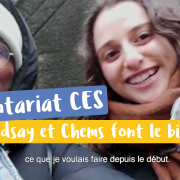
Chems and Lindsay are two young girls from Belgium and France who met each other while volunteering at Jauniešu studija “BaMbuss" in Riga, Latvia, within the framework of a European Solidarity Corps project.
In this video both volunteers sum up their experiences and discoveries, and share their views on the EU funded programme.
Updated on Tuesday, 17/02/2026
Even if I haven’t seen the most attractive sightseeing places in the country I lived in the small villages and I understood that travelling, mindset and best memories were about a variety of people that I have met.
My mobility experiences started about half a year ago when I was seventeen years old.
It started here, not that far from my town when I participated in the training. Little did I know then that I was going to travel constantly, have friends around the world and have fun while learning and growing as a person.
So, participating in Erasmus+ projects for the first time was an enormous step out of my comfort zone. First of all, it was living in another place, being surrounded by strangers and having to speak a language that is not my native.
Turned out that the scary part lasted only as long as I was on my way to a project place and everything was only in my head. Everything was going with the flow, people were generous and I felt like I had known them for my whole life.
After participating in Erasmus+ projects in Lithuania, I couldn’t stop thinking about how it would be amazing to travel somewhere too, it would be an even bigger step out of comfort zone. So, I found a project in Romania at the last minute, packed my stuff and my very first solo trip to a little Romanian village started. Even with some problems during the trip and being alone around strangers in a country that is far away from my home, I enjoyed every minute of it. After it, my self-confidence kicked in and I started to search, apply and go to more projects. Also, the stuff I learned during the Erasmus+ projects will be a great help while stepping to the future career path. So, it was the best decision ever. Even if I haven’t seen the most attractive sightseeing places in the country I lived in the small villages and I understood that travelling, mindset and best memories were about a variety of people that I have met. I perceive the world and beauty the of it through people and that is the best thing the mobility opportunities gave me.
Updated on Tuesday, 17/02/2026

I hope all humans will understand how badly the earth is polluted and will start to prevent this.
I want a cleaner air, no pollution, no animal abuse. I also want better life for people that live in North Korea or Belarus. I want them to be free and live a better life than now, because now they suffer from their presidents. I want everyone to be nice to each other and don’t make wars, because a war is not good for anyone.
I think the world in the future will be polluted, there will be less woods and trees and many things' robots will do for humans. The air will be not clean and the water in rivers and oceans will be really polluted and there will be more garbage than there is now.
If I will be alone to do this I can to nothing, but if the world will be together, we change the future that everybody thinks will be bad. If I don’t really need to go somewhere with a car, I can walk, or use a bike, a scooter, or public transport, because when car goes it throws away the gas and turns the air to not fresh one and later it will smell bad. I buy bags, packs or straws that are made from paper or other material that are good for nature. Be friendly to the world, don’t make it more polluted, if we will be together, we can change the future.
Feeling
When thinking about the future, I feel worried that the flora and fauna will disappear from the earth. And I hope that everything will be all right.
Influence
Alone I can’t do anything; thus, it is very important that all people understand the danger and act together. I can share the information about the environment pollution in social media so more people would understand what environmental danger could do in the future.
Updated on Tuesday, 17/02/2026