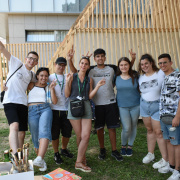
Staying in a foreign country for a long period of time and/or with people you don't know often changes us. Nevertheless, talking about the changes that Erasmus + activities have caused in them, the participants usually challenge you with a sentence: "You have to experience it yourself!". That is why the change caused by Erasmus + in me can most easily be compared by “the change of personal settings”. I could see many things that had been on my blind side before.
Firstly, I used to take some serious things too casually and some less important things too seriously. It was difficult for me to face the fact that sometimes in my life I had only had one opportunity to talk to a person, but also that one substantial conversation could open many new opportunities for both interlocutors, an opportunity to be a positive example to someone and an opportunity to learn something new from that person. It could also open the opportunity for cooperation, some new projects and a positive impact on society. Before my first participation in the Erasmus+ activity, I had never perceived things that were not directly related to me as an area where I could take part in any changes in public policy. But activities like EU Youth Dialogue, have shown me that my opinion counts and that it can influence policymaking in the long run.
Erasmus + activities have helped me stop thinking of things I don't have to be more important than they really are and taking for granted many things I have. More precisely, I learned that I need to plan things in advance, but with the awareness that not everything will go according to my plans. Changing Plan A to B or C is for me a time of learning the most important lessons Erasmus + has given me. Time to make me aware of my real needs as a person with a disability, time to empower and seek possible solutions and time of open communication with people I know as well as with people I don't know. "Well, well, Ivona, you're a journalist, that shouldn't be a problem for you," could be said by many who know only a few "statistical" facts about me. So, we come to the overlap of two particularly important topics: prejudice and vulnerability.
The prejudice is that journalists talk a lot and without hesitation. However, many introverts who are also journalists (like me) weigh their words very well, which makes it difficult to communicate with strangers, such as communication with Erasmus + participants. Most of them don't know each other yet, and they must communicate in English, most often in groups. I'll give you one trick I use in these situations: I listen to the extroverts outvoting each other, I observe and "absorb". I only get into a conversation when I really want to say something concrete or when I am called out during a discussion in a circle of, most often, very different participants.
These circles at Erasmus+ activities always help me become aware of some of my prejudices. Then I get a chance to overcome those prejudices or… which is even better, to neutralize some false assumptions like the one I had, that the homeless are to blame for their own situation. When I heard the life story of a homeless woman at an E+ activity, I realized that homelessness, like no other seemingly unsolvable problem, is not (only) the fault of an individual, but also a reflection of the functioning of society in general. Life can become harsh overnight, so we need to have an understanding of the people we meet.
That understanding does not come without a willingness to be honest and vulnerable. If we truly provide understanding, we often go beyond the boundaries we set for ourselves, then we create the preconditions for our own vulnerability. This exact vulnerability, and not the content of the activities or the amount of interaction with the other participants, is the most important thing that I bring home from Erasmus+ activities, as a part of my personal development.
I know, "personal development" is one of those abstract terms that you're probably rolling your eyes at now. You think that I have "turned" from concrete examples into abstract concepts. But personal development is nothing more than a "cocktail" of these ingredients: pushing your own boundaries, overcoming things that hold you back in life, and doing things you wouldn't otherwise dare do.
Erasmus + activities were an ideal opportunity for me to do all that. I pushed my own boundaries when it came to food because the food in some of the countries I visited was indeed a source of surprise. I overcame accessibility restrictions, by proving to myself in various unpredictable situations on inaccessible areas that most obstacles can be coped with, and that I am more resourceful than I could have ever imagined. About doing things I would not otherwise dare to do, I learned gradually, first by not doing.
There was a part of me that I ignored because I didn’t like it, and that is reacting in conflicts. As a person who "swallows" things too often to avoid a conflict, I used to be passive in situations where I needed to express an "unpopular" opinion.
But, during one training session, an unimaginable situation happened: one of the coaches left the training. It later turned out that we had been subjected to a social experiment and that it was all staged. We, the participants, thought the coaches were really arguing and we sent messages of support to the coach who had left, but we didn’t talk about it at all with the coach who stayed. When we were told it was an experiment (and the coach came back), only one colleague had the strength and courage to express his frustration, saying he did not want to be treated like a rat. It was at that point that I realized that I didn’t have the courage to say it, because of my habit of avoiding conflicts so as not to stand out too much.
After that, I began to speak my opinion openly more often, presenting my own and respecting other people's arguments as well. Open communication has thus become an irreplaceable reminder of the fact that each person is special, and their story is important. It is the experience of other people and their insights that are different from mine, that often helps me look at something from another angle and thus get the complete picture.
To gain something like that, I had to communicate intensively with five or six participants of the Erasmus+ activity, and sometimes with the whole group, which was extremely exhausting for me as an introvert. After the activities, evening gatherings are usually organized, and the group stays together all the time. Sometimes I was very confused. Although I was filled with experiences, I was also exhausted by the fact that I did not have the opportunity to be alone for at least half an hour for several days in a row.
At Erasmus+ activities, each participant meets at least five new people. He/she shares a lot with them during the activity, although they will most likely never meet again in their life. The meaning of such gatherings is sometimes difficult for introverts to understand. Nevertheless, I once got a valuable opportunity to develop a special friendship with a person I met thanks to Erasmus+. Although we communicated in English, which was a foreign language for both of us, we became close friends and have stayed close for years. We still understand each other very well.
The Youthpass, in which we enrol the acquired skills and knowledge, has not got a record of any of this. In fact, it has, but – between the lines, because it is difficult to describe the change of personal "settings" in a few labels. My biggest victory, enjoying mobility even though I don't really like to travel, has brought me to two important goals: increasing my active listening capacity and improving my communication skills.
Active listening and talking so that you really experience the interlocutor have brought a big shift in my personal and professional development. That is why I always try to be careful with each person I communicate with, aware of the fact that Theodore Roosevelt realized a long time ago: "Nobody cares how much you know until they know how much you care."
Updated on Tuesday, 17/02/2026