

Steeped in history but with an eye on the future, Larissa embraces bold ideas and progressive approaches that are fully in line with the New European Bauhaus (NEB) values and initiatives.
In 2021, the Municipality of Larissa launched an international ideas competition for the design of the area surrounding the city’s first ancient theatre. A key part of ancient Greek culture, vibrant theatres were at the heart of social life. Besides theatres, a mere five-minute stroll will give you a sense of Larissa’s rich and varied history – from ancient Greece to the Ottoman Empire. Textile markets known as bezestenis – from the Arabic words for cotton (bez) and textile merchants (bezzaz) – were a key part of Ottoman urban life, showing that the city was an important, bustling commercial centre. Larissa’s bezesteni was built in the late 15th and early 16th century, and although only four stone walls remain today, it once hosted 21 shops.
Larissa is an enticing blend of contrasting cultures, both old and new, and its innovative approach is transforming it into a modern city on ancient foundations. It is also a CLEVER City, using innovation and co-creation to regenerate its urban landscape with nature-based interventions.

Following the values embodied by the New European Bauhaus (NEB), Thessaloniki is pushing boundaries by giving its traditional architecture a modern twist. One of the city’s coolest spots is the Aigli Geni Hammam, a former Turkish bathhouse that has been reimagined and now houses a cinema and all-night parties in winter. In the lively Valaoritou district, you can visit the Three Pieces speakeasy, a canteen with a hidden bar and photobooth. Near the old town, you’ll find the Pasha Gardens, a mysterious park of unknown origin that contains numerous cryptic stone structures, shapes and symbols.
If you’re into art, make sure you check out the Metropolitan Organisation of Museums of Visual Arts of Thessaloniki, which hosts fascinating exhibitions ranging from photography to the Russian avant-garde.
As well as a cultural hub, Thessaloniki is a beacon of sustainability. In 2021, the city adopted a Sustainable Urban Mobility Plan to redistribute public space and develop more pedestrian routes. Thessaloniki's Smart Mobility Living Lab is a European pioneer in the use of technology to improve urban mobility. And, to encourage sustainable tourism, the city has launched a Sustainable Tourist Card that encourages low-emission activities, such as guided walking tours. Don’t forget to pick up your card when you’re visiting!

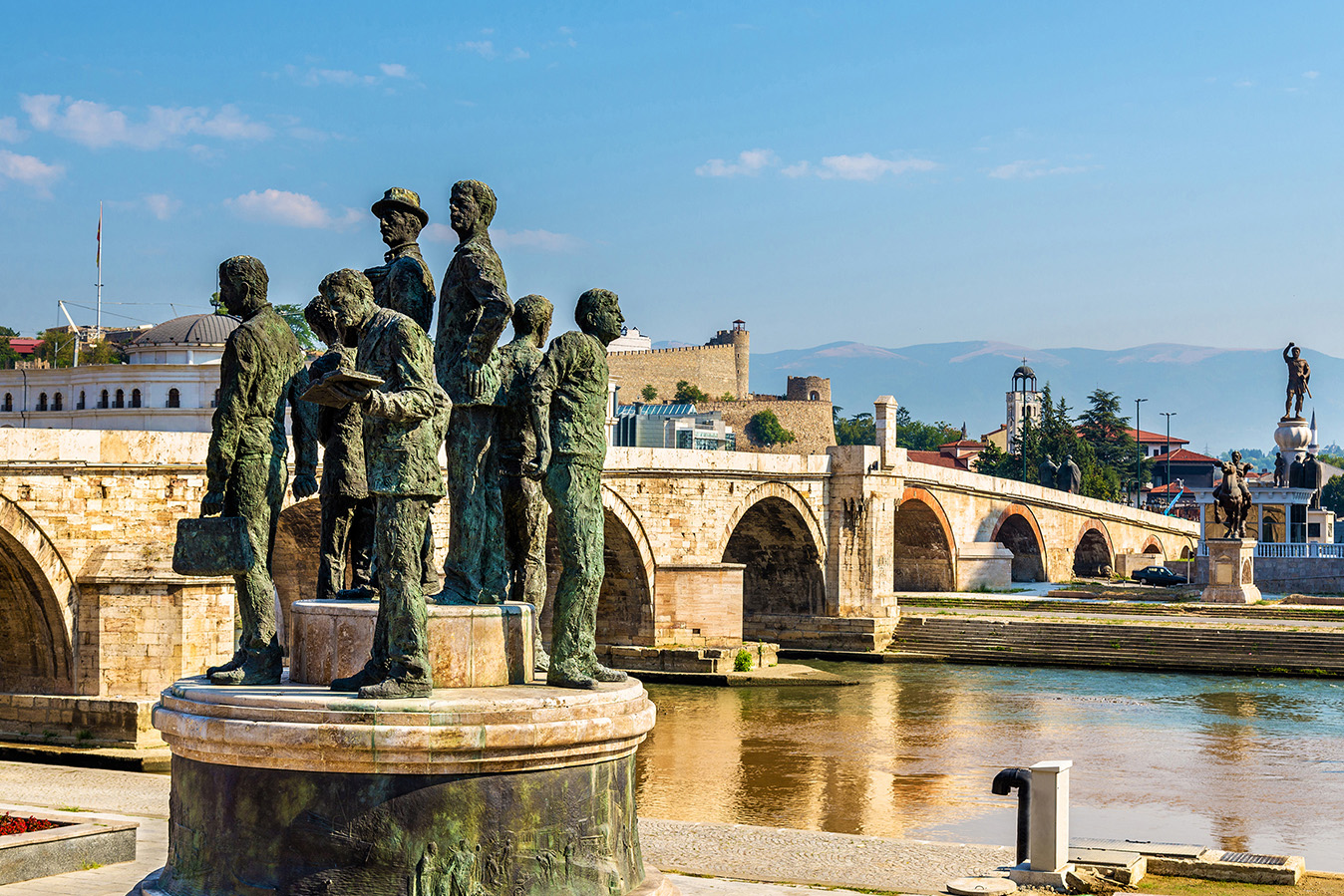
The capital of North Macedonia is a unique and charming city. Now thriving on the New European Bauhaus (NEB) values and objectives, Skopje is the first city in North Macedonia in the Green Cities network. Compact and walkable, it has plenty to see when you visit, like Čaršija, an old Ottoman hillside town, or the Art Bridge, which is adorned with statues of notable Macedonian artists and musicians.
Sustainability is a rapidly rising concern in Skopje, best shown by the youth organisation Go Green. The organisation has launched the 'From Door to Door' initiative: a social enterprise that uses a sustainable waste management model to improve the social inclusion of informal waste pickers in the city. Skopje was a finalist in the European Mobility Award 2016 thanks to its innovative municipal car-pooling service.
In 1963, a devastating earthquake forced the city to undergo a total rebuild, leading to some extraordinary modern architecture. One example is the Central Post Office, designed by Janko Konstantinov. Built in a modern brutalist style, the building has bold, unusual shapes jutting out of its façade. The city is also peppered with nearly 300 statues and structures, from historical figures to abstract artworks, and a 66-metre tall Millennium Cross.
Niš is an inebriating mix of historical Balkan design, brutalist and post-socialist architecture, and creative reimagining of urban spaces, where you can experience the true essence of the New European Bauhaus (NEB). These approaches combine to give it the feel of a bustling city rich in history and culture. One example is Tinkers Alley, the last remaining street of the former Niš bazaar, where numerous cafés and traditional taverns or coffee shops, knowns as kafanas, converge in a vibrant melting pot of tourists, students and locals.
In 2005, Niš became a member of Energy Cities, a network of local authorities that strives to empower cities and citizens to transition to futureproof living. In 2014, the city adopted the Covenant of Mayors Sustainable Energy Action Plan, a commitment by local governments to reduce greenhouse gas emissions by adopting sustainable and efficient solutions to urban development. Niš is also one of six Cities of TOMORROW that are leading the transition towards low-carbon, resilient and more liveable cities. In 2016, Niš hosted the first International Conference on Urban Planning, bringing together academics, researchers and mayors to find solutions to the challenges that 21st-century cities face. Niš is a sustainable city with its eyes firmly on the future!
While you’re there, check out the fortress built by the Turks in the 18th century (although there have been forts on the site since ancient Roman times). It’s a great place to spend a few hours admiring the architecture and exploring its art gallery, market stalls, restaurants and cafés. The fortress also hosts the Nišville Music Festival, so add it to your calendar if you like jazz music.

Belgrade is one of the oldest continuously inhabited cities in Europe. It has a turbulent history, having been inhabited by the Celts, Romans, Byzantine Empire, Frankish Empire, Bulgarian Empire, Kingdom of Hungary, Ottoman Empire, Habsburgs and more, before becoming the capital of Yugoslavia in 1918. It’s been fought over in 115 wars, razed 44 times, bombed 5 times and besieged too many times to list. Visit the Ružica Church, where you’ll find two chandeliers made of bullet casings, swords and cannon parts from World War I – a decorative feature befitting of Belgrade’s past.
What makes Belgrade particularly relevant to the New European Bauhaus (NEB) is its architecture, with a fascinating brutalist emphasis on materials, textures and construction, with some beautiful Art Nouveau and neo-Byzantine influences thrown in. Some striking examples include the sloping, Lego-like blokovi apartments in New Belgrade, the Telephone Central Office, which seems to float above the ground, and the rocket-shaped Avala Tower. Belgrade also hosts green markets such as Dorćol Platz, which sell sustainable produce, second-hand clothing, and recycled materials.
Despite its rich history, Belgrade is working hard to modernise itself and build a city of the future that works for everyone. In 2018, Belgrade joined the European Bank for Reconstruction and Development’s Green Cities network, committing to building a sustainable infrastructure and adopting a Green City Action Plan.

Home to over 65% of Iceland’s population, Reykjavík has a thriving cultural and design scene. With breathtaking landscapes and seemingly otherworldly land formations around the city and beyond, nature has a big influence on Icelandic art. Its population’s famed creativity has been attributed to its progressive culture and a lack of natural materials.
Icelandic design is bold, innovative and experimental, embodying the New European Bauhaus’ (NEB) forward-thinking and sustainable spirit. Its fashion industry displays a daring, quirky style rooted in ecological commitment – promoted by celebrities such as Björk (a global style icon), and materials such as fish leather and lava rock furniture. Two prominent abstract and avant-garde artists, Svavar Guðnason and Nína Tryggvadóttir, are from Reykjavík.
Visit an iconic landmark of the Reykjavík cityscape, the Harpa Concert Hall. This blocky waterfront building, with its distinctive coloured glass façade, was designed in collaboration with the artist Olafur Eliasson. Harpa won the prestigious European Union Prize for Contemporary Architecture – Mies van der Rohe Award in 2013. Iceland is a member of the Nordic Carbon Neutral Bauhaus, an NEB Lab project.
While Iceland may not be known as a sunbathing destination, just outside Reykjavík you’ll find Nauthólsvík, a man-made beach with golden sand and a heated swimming pool. Entry is free in the summer and costs around €5 the rest of the year.
